



FILTERED RESULTS
FILTERS
MCap $2.9T -0.4%24h Vol $112.1B -28%Fear & Greed 71/100Alts Index 59/100
BTC.D 58.3% 0%Stable.D 9.3% +0.1%ETH.D 11.4% 0%Others.D 21.0% -0.1%
SOON$0.4058+35.95%•QNT$291.83+27.62%•ZBCN$0.00259854+20.1%•PUMP$0.00572522+19.45%•ZRO$1.797+17.99%•GRASS$0.7306+17.01%•NIGHT$0.0326+15.06%•DEEP$0.0243+13.55%•ETHFI$0.7724+12.89%•COMP$26.320+12.49%•
LIT$3.776-13.27%•HBAR$0.1041-11.99%•AI$0.1982-9.26%•BR$0.8281-8.92%•ALGO$0.1249-8.1%•ZAMA$0.0732-6.81%•BTW$1.302-6.08%•Q$0.0235-5.94%•PROM$5.941-5.4%•CC$0.1267-5.31%•
•
·
·
FILTERED RESULTS
Ethereum Spot ETF Saw Net Outflow of $2.8086 Million Yesterday, BlackRock ETHA Led with $8.9408 Million Net Outflow
Bitcoin spot ETFs saw net inflows of $66.1947 million yesterday, marking 9 consecutive days of net inflows
RootData Partners with South Korean Exchange Coinone for Enhanced Market Research
Samsung Electronics Projects HBM to Reach 30% of DRAM Wafer Production Capacity in 2027
Bitdeer Reports Significant Net Loss in First Half of 2026
Goatseus Maximus (GOAT) Price Prediction 2026, 2027-2030
Illinois to Tax Crypto Trades 0.2%—Even on Losing Trades
Celo (CELO) Price Prediction 2026, 2027-2030: Is Now the Best Time to Accumulate CELO?
Institutions: China's humanoid robot shipments exceeded 19,000 units in H1, accounting for about 77.9% of the global total
Cathie Wood's Ark Invest now holds direct exposure to Kalshi through $ARKK , $ARKW , and
Binance Will Add 7 bStocks Tokenized Securities as Collateral Asset - 2026-09-30Binance Cross Margin...
SlowMist: Suspected North Korean Hackers Route Stolen Bitget Funds Through CoW, ChainflipSlowMist...
SBI, Mesh, Money Forward Plan Japan JV for Crypto Connectivity, Stablecoin Payments
UK Orders Crypto Fraudsters to Repay £851,402 to Scam Victims
Binance to List ADBEB, FWDIB and Other bStocks Spot Trading Pairs
Hyperliquid co-founder Jeff Yan said at Korea Blockchain Week 2026 that he sees a "big
Binance Exchange Adds Adobe (ADBEB), Forward Industries (FWDIB), Hewlett Packard (HPEB), PDD Holding...
SlowMist's Cos: North Korean hackers use Cow and Chainflip combo for cross-chain, automated scripts move stolen Bitget funds into BTC
South Korean opposition party calls for review of virtual asset taxation, urging postponement or abolition of crypto tax set for January next year
Bitmine Chairman Tom Lee said at Korea Blockchain Week 2026 that upcoming bull
Whales are buying $AAVE!Two wallets swapped 50.95 $WBTC($4.26M) for 25,502 $AAVE...
US SOL spot ETFs see single-day net inflow of $5.438 million
Abracadabra launches proposal vote to shut down the protocol and liquidate MIM
SEC Charges WhatsApp Crypto AI Scams Allegedly Taking Over $15.3M
619 $BTC (51,629,550 USD) transferred from Coinbase Institutional to unknown wallet...
XRP Price: Can Bulls Push XRP Above $1.60 This Week?
Binance Pay Integrates with PayPay to Allow USDT Spending in Japan
Bitdeer reports H1 revenue of $417.7 million and net loss of $251.8 million
Trader Killa: Market's expected deep pullback may not materialize, still bullish on Bitcoin toward the $90,000 range
Maelstrom CIO Arthur Hayes said at Korea Blockchain Week 2026 that no digital currency —
Abracadabra Proposes Liquidation Agreement for MIM Stablecoin Holders
DeepSeek Open-Sources Infrastructure for Huawei Ascend Computing Platform
Binance Pay Brings PayPay QR Payments to Tourists in Japan with Limited-Time 10% Discount!Binance is...
750 $BTC (62,660,077 USD) transferred from unknown wallet to Coinbase Institutional...
Abracadabra Proposes Winding Down Magic Internet Money at Four Cents on the Dollar
Brazil's CSD BR Collaborates with Ripple to Integrate Securities Records on XRP Ledger
Bitget Releases 47th Proof of Reserves, Composite Reserve Ratio Across 19 Asset Classes Reaches 131%
Abracadabra Proposes Liquidation of MIM at Four Cents on the Dollar
250,000,000 $USDC (250,033,000 USD) minted at USDC Treasury...
Ripple Brings XRP Ledger to Brazil’s BRL 22 Trillion Asset System
Binance Will Support the Ronin (RONIN) Network Upgrade & Hard Fork - 2026-10-07Starting at appro...
Velocity (formerly Drift Protocol) co-founder Cindy resigns; exchange restarts after rebuilding following hack
171,900,000 $USDC (171,922,604 USD) transferred from Unknown Whale 1 to #Aave...
171,900,000 $USDC (171,921,917 USD) transferred from #Aave to Unknown Whale 1...
Whale 0x9a80, who bought 30M $ENA($8.3M) 3 days ago, bought another 7.96M $ENA($1.99M)...
Whale that bought 30 million ENA three days ago buys another 7.96 million
100,000,000 $USDC (100,015,350 USD) transferred from #Ethena to unknown wallet...
Arrington Capital transfers $3.44 million worth of HYPE to FalconX
Multicoin Capital announces investment in DePIN project Grass, which generated $17 million in revenue in the first half of 2025 and 2026 respectively
XRP Seoul Brings Tokenization, Yield, and Privacy Firms Together
986 $BTC (82,446,607 USD) transferred from unknown wallet to Coinbase Institutional...
Kalshi is ending its volume incentive program, effective no earlier than Oct. 13,
Kalshi Ends Volume Incentive Program Effective October 13, 2026
1,827 $BTC (152,513,055 USD) transferred from #Paypal to unknown wallet...
Quant Network founder moves about 25,800 QNT worth $6.97 million after 7 years of dormancy
Quant Network founder wallet 0x48E9 moved 25,776 $QNT($6.97M) to new wallets after 7 years of...
1,826 $BTC (152,396,197 USD) transferred from unknown wallet to #Paypal...
Sentora split 50% Aave revenue, but suppliers absorb all losses
Robinhood is launching in-app perpetual futures trading in coming months, allowing
LIT briefly falls below $3.7, with $6.86 million liquidated in 4 hours
Robinhood Introduces 10x Leveraged Crypto Trading for US Users
Machi closes PUMP long for $827,000 profit, then opens $5.26 million 10x leveraged long
1,333 $BTC (111,291,916 USD) transferred from unknown wallet to unknown wallet...
Anthropic Research Highlights Zhipu GLM-5.3's Network Utilization Capabilities
VelocityDEX Launches After Audit Completion Amid Co-Founder Departure
Michael Saylor Sees $100T Digital Asset Industry With Rule Changes
Machi (@machibigbrother) closed his $PUMP long 9 hours ago, realizing a $827K profit.Right after...
1,332 $BTC (111,225,164 USD) transferred from unknown wallet to unknown wallet...
Grayscale's ETF adds $2.36 million worth of LINK
Ethereum’s institutional staking boom is growing, but Lido’s share is shrinking


Lido, the liquid-staking protocol, captured just 5.7% of Ethereum’s net staking growth in the first half of 2026. For holders of its LDO token, the business challenge is to turn a growing market into DAO income that can fund automated purchases.
The gap is visible in NEST, Lido’s automated buyback mechanism. At 00:00 UTC on Sept. 9, the contract that releases funds for purchases recorded a negative cumulative budget of about $517,024 and skipped an allocation. Its negative budget measured a deficit in calculated buyback capacity. Funding was already in place, while the rules required more cumulative surplus before a purchase could be financed.
Institutional routing is one part of that business challenge. Lido’s first-half report describes capital moving into segments where it captured less growth, while its current institutional offering includes a fee waiver that favors adoption over immediate income. ETH’s dollar price and the rewards earned on each staked coin also affect the outcome.
A growing market, a smaller share
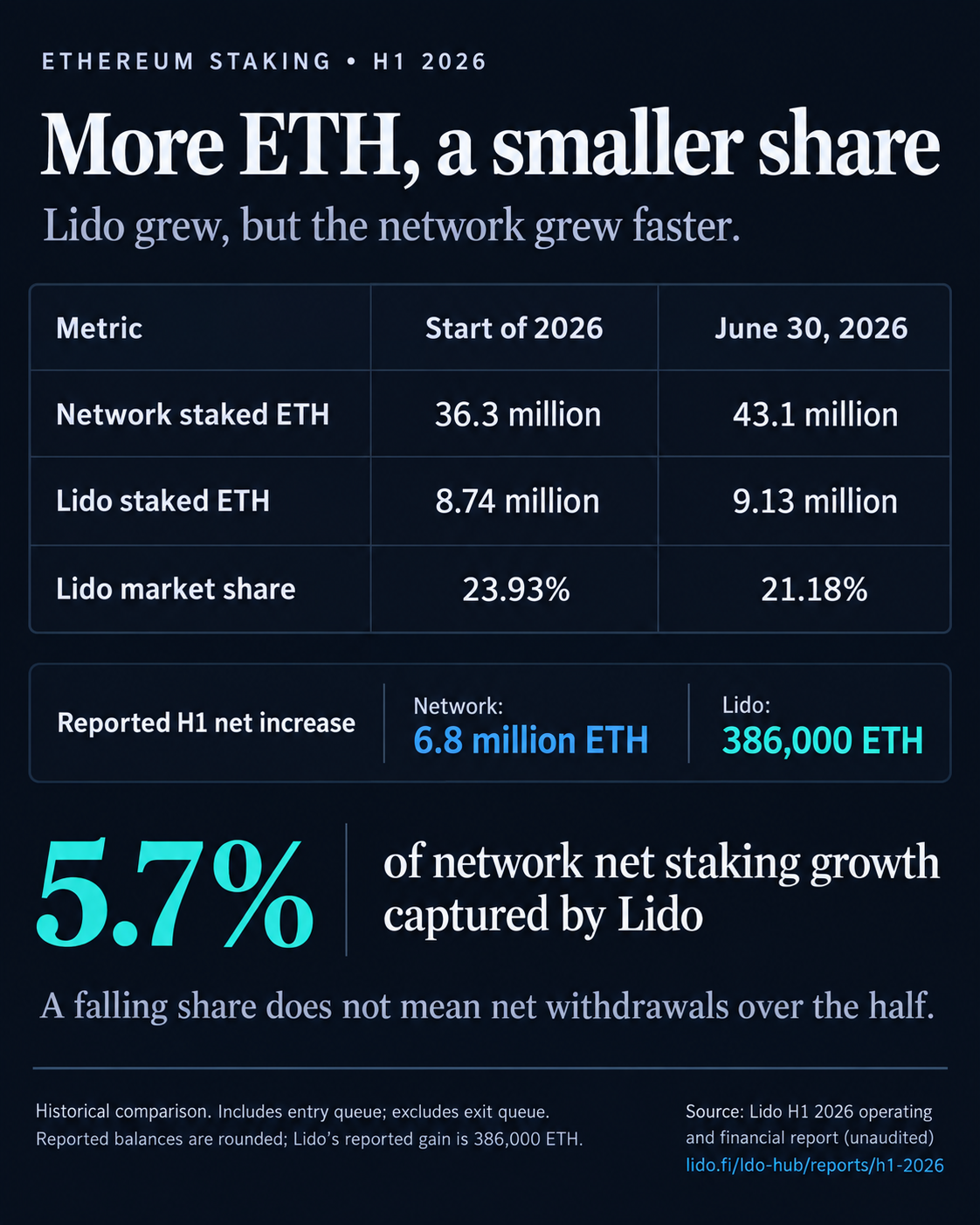
Lido’s H1 operating and financial report puts total staked ETH at 43.1 million at June 30, compared with 36.3 million at the start of the year. Lido added 386,000 ETH over the half, reaching 9.13 million ETH from a rounded opening balance of 8.74 million.
That gave Lido about 5.7% of the network’s 6.8 million ETH increase. Its reported market share fell from 23.93% to 21.18%.
These are historical figures that include ETH in the entry queue and exclude the exit queue. They show dilution despite positive net growth over H1, even though individual months had outflows. June 30 is the cutoff for this comparison.
Lido attributes much of that dilution to institutional capital entering other routes. In its market breakdown, the institutional segment expanded from 25.9% to 35.3% of staking during H1.
The same report lists Bitmine at 11.5%, Coinbase at 10.9% and Binance at 7.9% at June 30. Those labels describe different positions in the staking chain. Its separate 3.1% entry for Grayscale explicitly runs “via Coinbase,” so adding the figures as independent pools of owners would double-count exposure.
The economic distinction is simpler than the rankings. An institution can earn Ethereum staking rewards through another provider without generating a Lido protocol fee. Network growth then benefits that staking route while diluting Lido’s share of the total.
Institutions also bring business through Lido. On Aug. 13, Lido announced that Sharplink was deploying $200 million of ETH through its protocol, with wstETH to be held with Anchorage Digital. The planned allocation illustrates how institutional custody and Lido staking can work together.
The product chosen determines which fees the DAO can earn. Lido also offers stVaults, staking vaults with their own fee terms. Lido’s August operator update says qualifying stVaults retain a 0% Lido infrastructure fee through Oct. 31. The campaign applies to identified node operators running stVaults with more than 250 ETH in total value locked.
The waiver is limited to the infrastructure fee for eligible vaults; other fees and Lido products have their own terms. An increase in these eligible balances can expand adoption while contributing zero revenue from the waived fee.
Lido’s H1 report gives an effective DAO share of staking rewards of 6.15%, up from 4.96% in December, within an unchanged 10% protocol fee. The division between the DAO and operators matters as much as the headline fee. That reported effective share describes the H1 period-end economics; individual products today have their own terms.
A simple sensitivity calculation shows the scale. Assume another 100,000 ETH becomes active, earns 2.59% annually, and pays the DAO 6.15% of those rewards. At an assumed ETH price of $2,500, it would generate about 159 ETH, or $398,000, in annual DAO staking revenue before other adjustments.
This sensitivity example holds its inputs constant. Actual revenue depends on active stake, reward rates, ETH’s dollar price and the fee terms that determine what the DAO retains. Winning deposits and earning income from them are separate commercial steps.
The cost of reaching active staking also influences the choice of product. The Validator Queue snapshot on Sept. 9 showed 1,931,206 ETH waiting to activate, with an estimated delay of 33 days and 13 hours. It displayed 43.0 million ETH already staked and a 2.59% annual reward rate.
For a new deposit joining the back of that queue, a constant 2.59% rate over the displayed wait implies roughly 0.24% of principal in delayed reward opportunity, before fees and compounding. The estimate measures potential rewards delayed under those assumptions; actual rewards and waiting times can change.
An existing liquid-staking position can offer exposure to a pool’s rewards immediately, subject to custody or platform terms, pricing and liquidity. That changes the investor’s experience without making the underlying validators exempt from Ethereum’s activation queue.
Existing validators have another option. Lido’s consolidation guidance explains how most source stake can keep earning while target validators in stVaults await activation. Initial target deposits and a subsequent transfer delay remain.
The queue therefore imposes different costs on fresh deposits, existing liquid positions and migrating validators. For Lido, the commercial question is whether the liquidity and migration options attract balances on terms that eventually produce DAO income.
How DAO income becomes buyback capacity
For LDO purchases, the chain runs from stake that earns fees to DAO revenue, then to the surplus permitted by NEST’s reserve formula. Funding and execution conditions determine whether that permitted amount becomes a market purchase. Its unaudited H1 accounts report $27.51 million in gross staking revenue after rewards paid to stETH holders, but $15.71 million in net staking revenue after deductions. Total net DAO revenue, including Earn, was $15.94 million.
The report attributes the main dollar-revenue reduction to ETH price weakness. Staking still generated a positive $6.73 million product-level result. Across the DAO and foundations, $14.33 million in foundation expenses left a $1.61 million operating surplus before a $6.06 million Kelp-related one-off produced a $4.45 million total loss.
Those distinctions prevent market-share dilution from becoming an explanation for every financial shortfall.
More recently, DefiLlama’s Sept. 9 snapshot showed Lido revenue of $101,935 over 24 hours, $696,955 over seven days and $2.71 million over 30 days. These dashboard figures offer income context. NEST determines eligibility through its own on-chain revenue accounting.
Under implemented LIP-36, NEST subtracts a $109,589 daily reserve, roughly $40 million annually, from tracked revenue and applies a 50% surplus share to a signed cumulative budget. When that budget is negative, later surplus must rebuild it before spending can resume.
The initial ETH price floor is zero. The H1 report’s roughly $2,730 ETH break-even illustration depends on stake, rewards and the DAO’s fee share. It describes a possible daily revenue balance, while the contract also carries forward past deficits. A price move alone leaves that accumulated accounting balance to be rebuilt.
NEST also needs funding and operational eligibility. Allocations are capped at $50,000 a day and $10 million per fixed 365-day window. These are maximum permitted allocations, with actual spending subject to the budget and other eligibility conditions.
The allocator held about 41 stETH in the Sept. 9 data. Blockscout’s transfer records showed a single 41-stETH funding transfer on Aug. 28 and no outbound allocation transfer. The records showed funding waiting in the allocator, consistent with the skipped allocation at the Sept. 9 checkpoint.
Lido’s reported acquisition of 10,025,866 LDO for 1,591 stETH belongs to a separate discretionary program, whose second batch completed in July. Those purchases were made under the discretionary program, separately from NEST.
NEST’s treasury-only launch design sends acquired LDO to the DAO treasury. The tokens remain DAO-owned. NEST provides neither a token burn nor an automatic distribution to holders.
For LDO holders, the useful indicators are the stake that generates fees, the DAO’s retained reward share and the cumulative budget available for purchases. Institutional growth can improve those economics when it reaches Lido on paying terms. The Sept. 9 checkpoint shows how a larger Ethereum staking market can coexist with a funded buyback mechanism still waiting for spendable surplus.
Source: CryptoSlate