



FILTERED RESULTS
FILTERS
MCap $2.8T -2.8%24h Vol $107.4B -100%Fear & Greed 71/100Alts Index 53/100
BTC.D 58.9% +0.1%Stable.D 9.3% +0.2%ETH.D 11.0% -0.3%Others.D 20.8% 0%
SAND$0.0803+22.44%•MET$0.4138+22.37%•RAY$2.436+10.22%•FLUID$2.055+6.73%•GEOD$0.2991+4.84%•AIOZ$0.1148+4.28%•MANA$0.1055+4.03%•NEAR$5.274+4.03%•NPC$0.0215+3.26%•BEAM$0.00256337+3.1%•
MINA$0.0908-25.09%•BP$1.053-16.35%•CAP$0.0735-14.79%•MARSCOIN$0.0974-14.79%•FIL$1.022-11.89%•DRV$0.3630-11.6%•USELESS$0.2015-11.29%•ARB$0.1824-10.92%•APT$0.7444-10.88%•UNI$7.729-10.79%•
•
·
·
FILTERED RESULTS
Market Overview: BTC : $83440 ETH : $2570.6 BNB : $767.09 SOL : $116.38 Market Cap :Total : 2.85T DeFi ...
Coinbase Premium Gap Reaches Record Low as Bitcoin Trades at Discount in the US
3,209.69 #BTC ($267,549,576) aggregated flows from miners to exchanges @cryptoquant_aler...
Moomoo Adds Crossover’s Crypto Execution Network for US Retail Traders
ESMA Responds To MiCAR Consultation
Braumiller October 2026 Newsletter
SEC Proposes Crypto Custody Rules for Investment Advisers and Regulated Funds, Including a Path to Self-Custody
Pudgy Penguins Team to Shutter Ethereum Layer 2 Network Abstract
Tokyo-Listed Bitcoin Japan Buys more BTC, Expands Bitcoin Treasury as Dilution Risk Grows
Ethereum falls 6%, leaving $1.35 billion in long bets at risk of liquidation
As Japanese institutions sell ¥2.6 trillion in foreign debt, here’s what Bitcoin investors need to watch
Bitcoin price has risen 84% since January 2024 while Treasury yields climbed
Tom Lee said BitMine $BMNR will stop buying ethereum:native at a 5% supply hard cap,
turtledotxyz AND GSR LAUNCH hare_xyz - THE CREDIT DESK FOR ONCHAIN FINANCEGSR IS COMMITTING...
Africa’s Bitcoin Directory Reports 180 Active Projects Across 23 Countries in Q3 2026
The US government address transferred out $165 million worth of assets over the past 24 hours,...
$WHUF listed on Coinbase spot・
1,000 $BTC (83,331,879 USD) transferred from #Binance to #Kraken...
Tether signs an MoU with Kazakhstan’s central bank and Alatau City to...
RobinhoodApp adds $25M in $ BTC to its corporate balance sheet....
Coinbase Institute Says Stablecoins Could Power AI Agent Payments
3,236.84 #BTC ($269,812,193) aggregated inflows to #Binance ...
NEAR co-founder Illia Polosukhin said users no longer need centralized exchanges for "a
Black Thursday revisited: MakerDAO keeper exploited for $500K
API3's AirnodeHub Lets AI Agents Find, Pay For and Verify Data on Their Own
Fidelity Treasury Fund Moves Onchain as DigiFT Expands Institutional Access
SuiNetwork ANNOUNCES 40 MILLION TPS RECORD IN LIVE BASECAMP ATTEMPT ...
Two wallets withdrew 114.9M $龙虾 ($6.9M) from #KuCoin and #Gate today, accounting for 11.49% of the...
Nasdaq Composite Today: Index Slips To 27,499 After Second Straight Record Close
Bitmine Chairman Tom Lee Says ETH Purchases Will Stop at 5% of Circulating Supply, Holdings...
Solana Company CEO Says China Reopening Could Spark Another Crypto Supercycle
Bitcoin Price Gets A Fresh Treasury Buyback Test
Fed Minutes: Most Officials See One More Rate Hike Before Year-End as Likely Appropriate
Justin Drake: ECDSA could be cracked within months in worst case, advises large holders to migrate assets to new addresses
Hyperliquid dev team address successfully redeems 3.75 million HYPE unstaked 7 days ago
Pudgy Penguins parent firm shuts down its own blockchain
The SEC Just Approved 3x Bitcoin ETFs – But is the Product Built to Decay?
Hyperliquid Confirms Singapore Registration as MAS Says Exchange Falls Outside Its Jurisdiction
Bitcoin’s Next Move Hinges on $84,000
Pokemon Collector Found Guilty in $55 Million Crypto Hack Case
Winklevoss Twins Prep Zcash ETFs as Privacy-Coin Trade Surges
Google Lets You Build a Video Game by Typing a Description
Crypto Trader Frogman Loses Over $4M in Wallet Hack in Singapore During TOKEN2049
$PONS listed on Coinbase spot・
Charles Schwab Survey Reveals 64% of Millennial Crypto Owners Plan to Increase Holdings
657 $BTC (54,763,314 USD) transferred from unknown wallet to Coinbase Institutional...
Hacker Stole Over Half Million Dollars from MakerDAO through Vulnerability in 2020 Contract
Tether Will Explore Issuing a Tenge Stablecoin and Tokenizing Assets in Kazakhstan
Polygon taps TRON’s $94 billion stablecoin supply for seamless cross-border transfers
Gate bets all-in-one money app is crypto’s biggest consumer trend this year and next
Bigger Blocks Are Coming to Ethereum
RWA Perps Explode to $5.78B in Unprecedented Open Interest
Black Friday and Crypto: Do Retail Spending Trends Affect…
DOJ Cites Bitcoin Fog Ruling in Fight Against Roman Storm…
Russia’s largest bank Sberbank has been approved as a crypto custodian...
Kalshi’s 15-Minute Gold Markets Generate Nearly Twice…
CertiK Unveils Brand Upgrade at TOKEN2049 Singapore, Expanding Trust Infrastructure for the Digital Economy
Sherwood Completes Agentic Finance Beta Ahead of Robinhood Chain Mainnet Launch
Stove Finance and Uniswap Labs Collaborate to Expand Onchain Access to Global Equities
Sui Sets Record for Highest Verified Throughput Settled to a Blockchain: 40 Million Transactions Per Second
US Government Moves $103 Million in Seized Bitcoin and BNB, But Hasn't Said Why
Tom Lee says BitMine will "STOP" buying ETH at 5% "hard cap." said on stage at...
Bitcoin Price Falls Below $84,000 as $487 Million in Longs Liquidate
Quantum-Safe Quantus Launches QTC Token Trading via Near Intents
Bitcoin Price Erases October Gains: Why $81,300 Is Now the Critical Level
Ripple Secures Major Institutional Win As $35 Billion Titan Brevan Howard Taps Ripple Prime
5% of People Own BTC… But 8% of Countries Already Have a Plan to Buy It
Hunter Biden Says Thin Liquidity Drove $LAPTOP’s Launch Crash
Ethereum Researcher Drake Flags ECDSA Risk for Crypto Holders
Inside EQIBank’s $84M seizure


EQIBank, used by Tether, had 80% of its assets frozen as part of a seizure targeting Capstone Limited, according to reporting from the Financial Times.
According to the reporting, the relationship between Tether and EQIBank was related to Marlin Capital Partners.
This reporting further claims that Marlin Capital, which has been serving as an investment advisor for Tether, has invested in EQIBank. It also reportedly promised additional investment in EQIBank if it could successfully help Tether open an account at Singapore-based DBS.
EQIBank did claim in a filing that it had a relationship with a firm called Clarency “that provided correspondent banking through DBS Singapore.”
The bank was apparently relying on a firm called Capstone Limited to help it place deposits in the US and maintain relationships with US-based banks.
According to a complaint for forfeiture filed in July, Capstone was allegedly misrepresenting the nature of its business to banks, including Wells Fargo, JPMorgan Chase, and Citibank.
It claimed it was an “application development service,” rather than a money services business.
Capstone Limited is registered as a money services business with the Financial Crimes Enforcement Network (FinCEN). However, it’s only registered in Montana, not in California where it actually operated, and it didn’t highlight that this was its business with the banks.
This registration was emphasized when Capstone Limited was negotiating with EQIBank, apparently including “a signed agreement between Dominica Bank 1 and Capstone dated August 20, 2024.”
It stated that Capstone “is a FinCEN-registered technology development company and money service business.”
The complaint also alleges that Capstone Limited’s Montana entity wasn’t incorporated until September 2024, so couldn’t have been FinCEN-registered.
According to the complaint, Capstone ended up moving hundreds of millions of dollars through its accounts.
Specifically, it states, “Of the $337 million withdrawn from Wells Fargo x7500 almost two-thirds appeared to go to hundreds of individuals and entities on behalf of Cryptocurrency Company 1/Cryptocurrency Exchange 1.”
Another is a Chase account that sent out “international transfers” that “appeared to be sent to individuals and entities on behalf of Cryptocurrency Company 1/Cryptocurrency Exchange 1.”
Cryptocurrency Company 1 is described as “a foreign entity that issues a “stablecoin” pegged at one-to-one with a matching fiat currency.
Individuals associated with Cryptocurrency Company 1 are also affiliated with Cryptocurrency Exchange 1. According to Cryptocurrency Company 1’s public statements, its holdings of US Treasury securities would rank it as among the world’s largest holders.
These would likely be Tether and Bitfinex.
Capstone was also apparently receiving “US Treasury securities belonging to a foreign cryptocurrency company” that were transferred to a securities account in the name of Capstone.
This seizure represented a serious problem for EQIBank, which claimed in a filing that the funds that had been frozen were “roughly 80% of the monetary assets of the bank.”
The filing also outlines how as a result of the seizures “the FSU has placed the Bank under enhanced supervision and has warned the bank of further action, including potential liquidation.”
It adds, “The bank faces a resulting material liquidity crisis. If the bank fails, years of work by its directors, officers, and founders since 2018 will be destroyed.”
Further adding to the strangeness around this seizure, the EQIBank filing includes assets that weren’t included in the government forfeiture.
Specifically, EQIBank believes it had more held in one of the accounts than the government seized, though it noted that this may be “because it appears that Capstone, using the portal, may have misled the bank as to the amount of funds held for EQIBank at certain banks.”
It also mentions funds at Barclays Bank and Clear Bank that aren’t mentioned in the public government seizure.
Kotaro Shimogori’s high-risk payment processing
In many places, Capstone would claim to be led or operated by Mary Jeanne Thompson, but according to the complaint, Thompson told the FBI that “she did not have much to do with Capstone.”
The complaint further notes that “[h]er husband, Kotaro Shimogori… actually operated Capstone.”
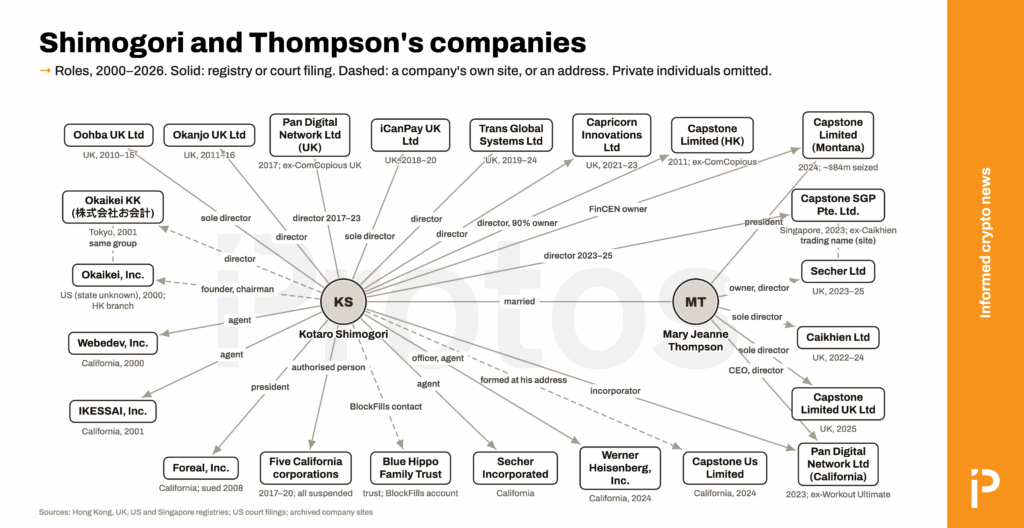
Shimogori has a long, and controversial, history in the payments processing industry.
In the 2000’s, Shimogori became the agent for Ikessai, Inc. days after it (along with Shimogori himself) was named in a lawsuit (later dismissed) that alleged breach of contract related to a payments agreement.
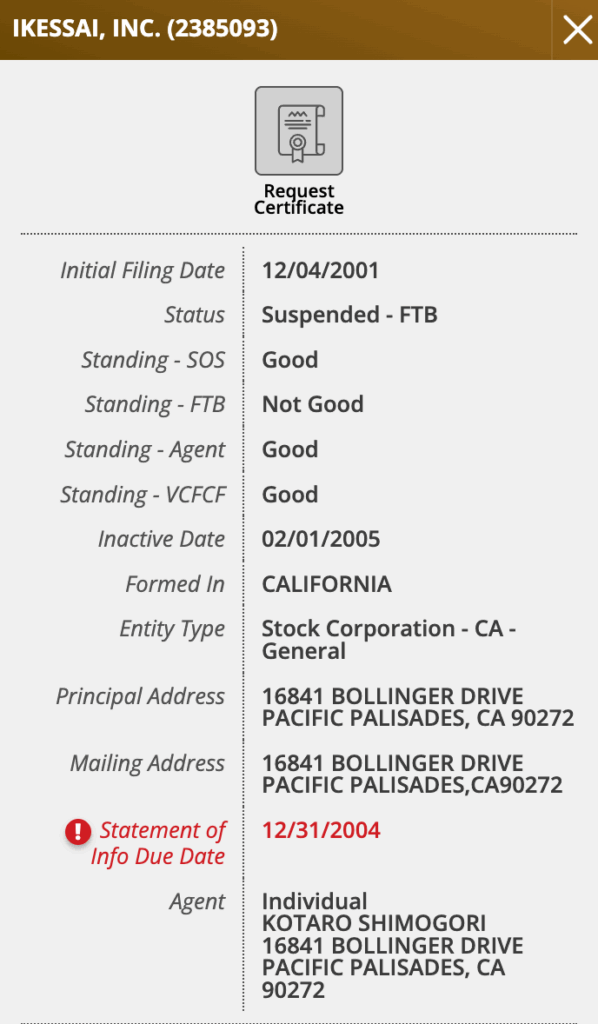
This suit also identifies Shimogori as the chief executive of Okaikei, Inc., another payments firm.
During this time, Shimogori’s website had a page dedicated to “card authorization and settlement.”
Also in the aughts, Shimogori was the president for Foreal, Inc. This firm was also sued, in this case for contractual fraud and eventually a default judgement was entered against it for $589,097.47.
Shimogori and Thompson had recently declared bankruptcy, which listed a $500,000 claim related to that lawsuit.
The creditor from that lawsuit is also included in the discharge list.
However, this couldn’t keep Shimogori down.
In 2011, a firm called TechnoUnicorn Ltd was formed in Hong Kong. The firm would later be renamed ComCopious Limited before becoming Capstone Limited.
This isn’t the Montana-registered Capstone Limited that was registered with FinCEN and used by EQIBank. Nor is it Capstone US Limited, which is directed by a George Thompson and incorporated at the same address Shimogori gives as his correspondence address for Trans Global Systems Ltd.
It’s also not the Capstone SGP Pte. Ltd. incorporated in Singapore where Shimogori was a director, or the Comcopious California led by Shimogori, though the name overlap is obviously fascinating.
Shimogori is a director for this Hong Kong-based entity and owns 13,500 of the 15,000 shares.
Back when this firm was called ComCopious Limited, there was an icanpay.cn.com website that attributed its copyright to “COMCOPIOUS, LIMITED” which advertised that “if your business falls into one of the high risk merchant industries” then “our proprietary system allows for your application to be approved within minutes.”
ComCopious Limited (the Hong Kong one and the California one), along with Shimogori, was sued and sued and sued again in suits that alleged fraud, conversion, and breach of contract.
These lawsuits provide some insight into the type of client that Shimogori’s firms were working with, and as we would expect from their advertising they were high-risk.
The plaintiffs in the “Life-FX” suit are described as:
- a firm that “markets biochemical compounds online to companies and scientists engaged in non-clinical scientific research, particularly in the fields of cognitive, metabolic and longevity enhancement.”
- a firm that “operates a legal online dispensary for medicinal cannabis and cannabis-related products.”
- firms “that lawfully market marijuana seeds online.”
These firms obviously represented high-risk clients considering the regulatory attention paid to these areas.
This suit also ties in iCanPay UK Limited, another firm that was controlled by Shimogori.
The “Helexo” suit has a very similar fact pattern, and in the defense’s reply in support of motion we see the allegation that “Helexo operates multiple gambling websites, which are unlawful in California.”
Again, high-risk.
Even more fascinating, Shimogori’s declaration in this suit claimed “iCanPay assisted Helexo with processing credit card transactions, and iCanPay transferred the proceeds owed to Helexo to a cryptocurrency wallet held by Helexo.”
Also troublingly, the suit alleges that “iCanPay used Shimogori’s own HSBC account… to provide iCanPay’s essential obligations.”
The “Fresh Horizons” suit again has a somewhat similar fact pattern and, again, a high-risk client.
Fresh Horizons Limited “is a British Virgin Islands gaming company” that, according to Shimogori’s declaration, was providing “remote gaming services under license from the Kahnawake Gaming Commission.”
A defense memorandum also accused Fresh Horizons of operating “in a legal grey zone through a British Virgin Islands shell company.”
Suits also name Pan Digital Network Limited in the UK, formerly Comcopious UK Limited, another firm where Shimogori was a director and had significant influence or control.
Besides that UK entity, there’s also a Pan Digital Network Ltd incorporated in California, where Shimogori is the incorporator and where Thompson is listed as chief executive and director.
Pan Digital Network is being sued (filed after Shimogori resigned his directorship of the UK-based Pan Digital Network) in a suit that alleges that “Pan Digital Network Limited has operated and continues to operate the Brango Gambling Platform.”
Broadly, Capstone Limited’s most recent seizure is only a small part of his history in the high-risk payments processing industry, and the firms discussed so far may only be a portion of the full extent.
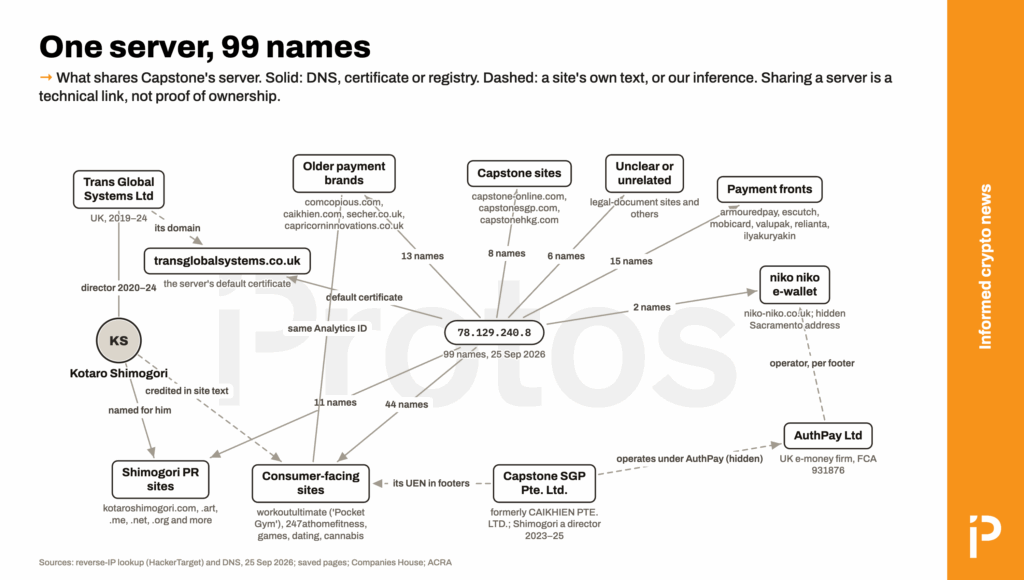
Several websites, including websites that seem related to Capstone, and Shimogori’s personal website share an IP address, suggesting shared hosting.
Shimogori’s personal website proudly advertises his design awards, his patents, and his history as an “e-commerce leader for firms like WorkoutUltimate and NIKO NIKO (advertised as “mobile banking everyone loves”).
Workout Ultimate was the previous name for the California-based Pan Digital Network Limited.
The website niko-niko.co.uk previously claimed it “is owned by Capstone Limited and operated by AuthPay Limited.”
There are no longer DNS entries for niko-niko.co.uk, however, if you ask 78.129.240.8 to resolve that name, it does still show up and does still reference AuthPay.
It also notes in the meta that “NIKO NIKO’s secure banking technology is developed with strategic oversight from Kotaro Shimogori, a fintech pioneer with extensive experience in secure payment systems and cross-cultural digital commerce.”
There are still DNS entries for nikoniko.co.uk which also references AuthPay and references Shimogori with that same text in the source.
A variety of other sites are also associated with this IP address, including some that reference names for entities that Shimogori is connected to, like ComCopious, Caikhien, Secher, Capricorn Innovations, and Trans Global Systems Ltd.
The scams and scammers
The government’s complaint for forfeiture claims that some of the funds processed by Capstone Limited were associated with scams.
Specifically, it alleges that “Chase x6970 was used to receive proceeds of impersonation fraud schemes. In such a scheme, a fraudster poses as a government or law-enforcement official to coerce a victim into transferring money. At the fraudsters’ direction, victims sent funds to Chase x6970.”
It describes several schemes and victims, including a 69-year-old who received a call from a fake FBI agent claiming that the victim “was a person of interest in a multinational money-laundering scheme.”
Another victim was told “she appeared to be involved in major crimes and would be arrested unless she posted ‘bail’ equal to a portion of her assets.”
A third victim was told by a fake FBI agent that “his name was associated with an account involved in laundering $2.38 million.”
Allegedly, when Chase reached out with questions, “they were provided with a ‘Capstone Limited – contract service agreement’ dated May 20, 2025 between Capstone and a foreign counterparty which stated Capstone was to provide “software development and related technology services;” a Capstone invoice dated November 12, 2025 billing the foreign counterparty $1,900,000 for software licensing, web development, advanced web modules and API Integration among others things; and a billing statement from the foreign counterparty charging Victim 1 $868,000 for ‘services rendered.'”
It’s also claimed, “On a call with Chase, Thompson could not answer basic questions and deferred to Kotaro Shimogori, who gave contradictory accounts of who supplied the software — Capstone or a foreign counterparty — and claimed Victim 1 purchased a medical billing system.
“Chase identified no bona fide software development work and concluded the software references ‘appear to be fictitious.'”
According to the complaint, this version of events involving software development was challenged by Capstone’s own chief operating officer (unidentified in the complaint) when he told the Miami Beach Police Department that he had “sold nine hundred thousand dollars worth of USDT Tether, TRC20 coins” to Victim 1, sent the coins to a wallet, and received a wire that was later recalled.
The “Executive Summary” the COO submitted to the MBPD stated that “US bank wires were received into Capstone’s JPMorgan Chase account for the purchase/settlement of USDT (Tether)… After USDT settlement was delivered on-chain pursuant to instructions from Capstone’s institutional counterparty, the originating wire(s) were recalled/claimed as fraudulent.'”
While it’s unclear who the COO may be, we can note that Capstone US Limited, the George Thompson-related firm that shared an address with Shimogori-related firms, named a Michael Khait as director, with an address in Miami Beach.
EQIBank and its DeFi ties
EQIBank, the Dominica-regulated bank that was relying on Capstone Limited, has been thrown into disarray with this seizure, warning in its filing that this seizure represented approximately 80% of its funds.
This bank, where Tether seems to have directed a portion of its reserves, has fascinating links, including to a cryptocurrency token.
This EQIFi project originally advertised by claiming “EQIBank, one of the world’s leading digital banks, announced today that it had launched EQIFI — A global DeFi alternative to traditional financial products.”
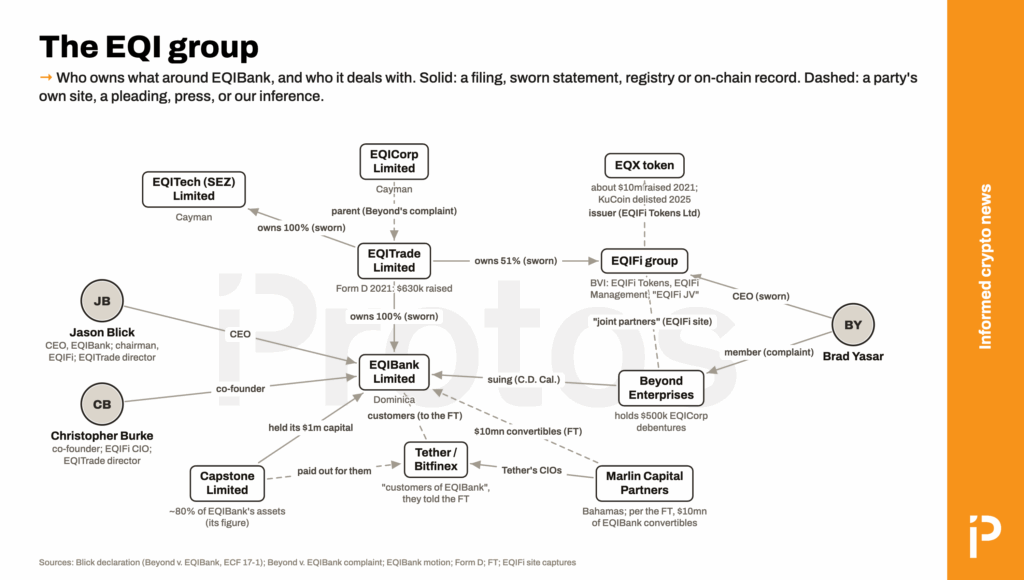
The EQIFi firms would end up issuing the EQX token, which was advertised as providing governance abilities for the EQIFi platform, as well as noting that “token holders enjoy reduced fees and better rates on trades and other services across the platform.”
EQIFi even noted that the EQX token would give you “priority access to EQIBank bank accounts.”
This token was listed on KuCoin but has been subsequently delisted.
Beyond Enterprises (sometimes Beyond Enterprizes), a firm led by Brad Yasar and tied in with this token as a “joint partner,” is now suing EQIBank, claiming breach of contract.
Interestingly, invoices filed in that suit include addresses for USDT payments, and if we compare those dates and amounts to blockchain information, it seems likely that EQIBank and EQITech (SEZC) Limited used USDT to make their payments.
This suggests that Tether isn’t just a client of EQIBank, but that EQIBank uses USDT to make payments.
Marlin Capital and Deltec Bank
Marlin Capital Partners is the firm that apparently invested in EQIBank according to Financial Times reporting and offered further investment if it was able to secure the relationship with DBS Bank.
Marlin Capital was described in a UK court filing as Tether’s “de facto financial advisor.” It lists Zachary Lyons as its CEO, advising rep, and managing rep in filings with the Securities Commission of the Bahamas.
Read more: Another Chinese money laundering scheme tied to Deltec and Tether
Lyons was also announced as the chief investment officer for Tether, succeeding Richard Heathcote, who also was an advising rep for Marlin Capital.
Both Heathcote and Lyons previously worked at BankPro, with Heathcote as CEO.
Before that, both men were also reps for Deltec Bank and Trust, an important entity in the history of Tether, providing banking services when many firms were not willing to.
Lyons is also on the board of Tether-supported Twenty One.
Crypto Capital Corp
Broadly, Tether relying directly and indirectly on payment processors that seem less than sterling is a recurring motif in Tether’s history.
The most prominent example is likely Tether and Bitfinex’s previous relationship with Crypto Capital Corp.
Crypto Capital Corp was an unlicensed payments firm that caused serious problems for Tether and Bitfinex when its funds were seized.
Read more: Crypto Capital Corp’s $850M collapse linked to Israeli mafia cocaine ring
In that story Tether and, especially, Bitfinex relied on this firm and its principals to maintain access to the US banking system.
Funds were eventually seized, related to various money laundering and drug proceeds investigations, and the resulting hole in Tether and Bitfinex’s books became a problem.
Eventually, after this problem was publicly exposed, the firms issued the Unus Sed Leo token which allowed them to raise sufficient funds to close the gap.
Now, Tether and Bitfinex have once again seemingly lost access to funds after accounts from a payment processor were seized.
The difference is that now even if the $84 million seized was entirely Tether’s, it only represents only hundredths of one percent of Tether’s reserves.
Tether told the Financial Times (FT) that it had “no knowledge of the fraudulent conduct by Capstone alleged by the DoJ.”
A lawyer for Capstone told the FT that it “denies any wrongdoing and plans to challenge the government’s civil asset forfeiture complaint and its allegations by filing a motion to dismiss shortly.”
It adds, “Capstone has co-operated with the government’s investigation and hopes to resolve this matter quickly.”
It has subsequently filed that aforementioned motion to dismiss.
Protos has reached out to Capstone, Shimogori, and EQIBank with questions, but they did not immediately respond.
Got a tip? Send us an email securely via Protos Leaks. For more informed news and investigations, follow us on X, Bluesky, and Google News, or subscribe to our YouTube channel.
The post Inside EQIBank’s $84M seizure appeared first on Protos.
Source: Protos