



FILTERED RESULTS
FILTERS
MCap $2.9T -0.6%24h Vol $156.3B +0.6%Fear & Greed 73/100Alts Index 53/100
BTC.D 58.4% +0.1%Stable.D 9.3% +0.1%ETH.D 11.4% 0%Others.D 20.9% -0.2%
SHFL$0.6630+69.75%•NMR$13.982+39.3%•MARSCOIN$0.1509+27.75%•HBAR$0.1210+26.37%•ALGO$0.1377+17.1%•CRV$0.3873+15.41%•BTW$1.300+13.41%•GRASS$0.6836+9.68%•IOTA$0.0555+7.12%•牛来$0.1151+6.89%•
Q$0.0259-47.69%•ONDO$0.5108-14.97%•SOON$0.2992-13.87%•B$0.1710-13.47%•USELESS$0.2299-12.79%•ZEC$1,375.38-12.03%•KMNO$0.0419-12.02%•NEAR$4.643-11.56%•BP$1.338-11.44%•RAY$1.861-11.21%•
•
·
·
FILTERED RESULTS
Analysts Report Slowed Growth for Anthropic Amid Rising Competition
U.S. Senate Investigates Trump Family's Cryptocurrency Ties and Tether's Sanctions Compliance
NVIDIA CEO Defends AI Model Distillation Amid U.S. Accusations Against Chinese Firms
Bitget BTC Protection Fund Releases 3,215 BTC
OpenAI Apologizes for Unauthorized Access to Australian Government Websites
TSMC Plans Second Semiconductor Campus in Texas with Significant Investment
Paid Launches Web Application Portal Amid Ongoing Suspension of X Money Payments
Stablecoin Card Spending Reaches Record $189 Million in Mid-September
Former CEO of Changxin Memory Technologies Accused of Coercing Samsung Technology
General Intelligence Manus Founder Announces Development of Domestic Version
Investment Strategy Shift: Utilities and Financials Preferred Over Bonds as Yields Rise
World Foundation Finalizes $49 Million Over-the-Counter Sale of WLD
CFTC Approves Launch of Coinbase Clearing with USDC Collateral
UsePaid Launches Claims Portal After $PAID Token Drops 38% Due to X Money Issues
KLEA Crypto Daily: Monday, September 28, 2026
Uniswap Dominates Tokenized Stock Deposits with $82 Million on Robinhood Chain
OpenAI Suspends AI Model Training After Data Scraping Incidents
BitGo Appoints New Chief Product Officer to Enhance Asset Servicing
Stripe Alerts AI Companies to Rising Token Theft Risks Amid Increased Fraud Attempts
US Senate Report Links Tether's USDT to Iran's Sanctions-Evasion Activities
Gemini Introduces Staking for Hyperliquid's HYPE Token with 2.1% APY
Coinbase Introduces Digital Pokémon Card Packs Linked to Physical Collectibles
Robinhood Reports 24% Increase in Daily Crypto Trading Volume for September
SEC Clarifies Token Buyback Guidelines with 'No Central Party' Condition
Anthropic's Claude Sonnet 5.5 Is Out, Beats Opus 5.5 at Coding for Half the Price
After AI Agent Hacked Its Government, Australia Calls Altman and Amodei to Testify
In the Wake of CLARITY Act’s Failure, Agencies Move Forward Without Congressional Action or Certainty
Expansion of Trademark Rights: What Yuga Labs v. Ripps Means for Game Studios
Strive Scoops up 1,107 Bitcoin as Its $2.3B Treasury Expands
Banking Giant Citi Taps Coinbase to Turn Stablecoins Into Cash
Hyperliquid (HYPE) Drops 5% – Could Whales Trigger an Even Bigger Sell-Off?
Ripple CEO Unpacks What Really Drives XRP’s Value — Here’s Everything You Need to Know
Breaking: Vitalik Buterin Declares Ethereum Is No Longer Just A Blockchain
Spark Allocates $210 Million for Institutional Loans Backed by Bitcoin
Bitcoin ETFs Draw $2.39 Billion Despite Weekly BTC Decline
Altcoin Spot Trading Volume Nears 4x Bitcoin, Highest Since September 2025
UK FCA Secures £851K for Victims of Crypto Investment Fraud
Bitget says Bitcoin withdrawals are open after $387M hack, but ETH and USDT must wait
Brazil’s $252 billion crypto market gets $10,000 self-custody reporting rule
USDT grew on Ethereum through 2024, but smart contract holdings stalled, BIS data show
US SEC follows CFTC in staff guidance for crypto
Avalanche Leads Blockchain Sector with $131 Million in Tokenized Stock Inflows
Blockchain.com Files Confidential S-1 for Multi-Billion Dollar IPO
Bittensor Introduces Gamma Tokens to Foster Collaboration Among Subnets
Blockchain.com Plans IPO Targeting Up to $6 Billion Valuation
Chainlink Introduces CCIP 2.0 Featuring Custom Verifiers and Enhanced Transfer Speeds
Polygon Announces Temporary Increase in POL Staking Rate to 7.7%
Goldman Sachs Connects $100 Billion Treasury Fund to Lynq Network
Compound Foundation Responds to Allegations of V2 Reserve Misuse
Tether Assists in Freezing $550 Million in Iran-Linked USDT
163,061,311 $USDC (163,116,752 USD) minted at USDC Treasury...
Iran Agrees To Suspend Uranium Enrichment In Exchange For US Sanctions...
Belarus Moves Toward Registering First Two Crypto Banks Under New Rules
1,357 $BTC (113,578,422 USD) transferred from #Paypal to unknown wallet...
ETHFI to Fully Exit EigenLayer Restaking as Yields Dry Up and Sector Profitability DeclinesETHFI...
Bitcoin’s (BTC) Still in a Bull Market, But a Correction Could Be Coming First
Russia lets crypto exchanges apply October 5 – but even Bitcoin lacks final retail clearance
Trump Diesel Curbs Could Hit Every Major Economy, Devere Warns
Crypto PAC spends $11M to oppose Sherrod Brown in Ohio
Circle's Arc Facilitates $150 Million in USDC Borrowing Against Bitcoin Collateral
Analysis: AI-related debt issuance has limited impact on U.S. Treasury yields; 10-year yield may fall to 4.25% by end of 2027
Ondas investors blame short-sellers, fails-to-deliver
Apollo Chief Economist: AI Agents Automatically Moving Deposits Could Trigger a "Slow-Motion Bank Run"
BGB Token Price Faces Fresh Pressure to Fall Under $1 After Bitget Hack
Ethereum Holds Near $2,677 as Traders Watch $2,700 Resistance
Arbitrum Foundation launches security program to subsidize smart contract audits for ecosystem projects
Aptos Foundation Collaborates to Establish Stablecoin Corridor Between Middle East and Africa
Spectra Finance Introduces Fixed-Term Markets for deJTRSY on Stellar Network
Hut 8 Secures $1.07 Billion Senior Secured Revolving Credit Facility with Four-Year Term
Inside the 15-minute trading pulse that moves $14 billion in Bitcoin perpetual futures


At 14:59:59 UTC, Bitcoin perpetual futures look like any other electronic market, with prices flickering and orders flowing from traders around the world.
But when the clock turns to 15:00:00, the market instantly becomes busier: more trades go through, more money turns over, and prices cover more ground during the next ten seconds, even though nothing has given anyone a fresh reason to trade.
The same pulse returns at 15, 30, and 45 minutes past every hour. A smaller version appears at five-minute boundaries and at the start of every minute, but the top of the hour still produces the strongest burst, as though crypto's continuous market has been divided into thousands of tiny sessions by the software used to trade it.
Korean policy researcher Chan Kim and Peter Reinhard Hansen of the University of North Carolina documented the pattern in an August 2026 study of crypto futures. They examined records of completed trades in six Binance futures markets from Jan. 1, 2021, through Oct. 31, 2024, covering Bitcoin, Ethereum, XRP, Solana, Dogecoin, and Cardano across 1,400 full days of nonstop trading.
The contracts were perpetual futures, usually called perps, which let traders bet on whether an asset will move up or down and use borrowed exposure to make that bet larger.
While a conventional futures contract expires on a defined date, a perp can stay open as long as the trader has enough collateral, and recurring payments between long and short traders keep its price close to the underlying spot market.
When a perp trades above its spot index, traders betting on a higher price pay those betting on a lower one. When it trades below the index, the payment runs the other way.
Perpetual futures account for a large share of global crypto trading, which gives these brief bursts a much wider and deeper reach. Perp prices help guide arbitrage, hedging, and market-making across exchanges, so a pattern that begins in futures can feed into the Bitcoin market data and spot prices followed by everyone else.
Crypto found its opening bell(s)
The 15-minute pulse is easy to see when you draw an hour as a circle. The researchers' charts produce four points at minutes zero, 15, 30, and 45, creating a star-shaped pattern in trading volume and price movement, with most of each burst packed into the first ten seconds.
Across all six contracts, those ten seconds contained 26% more trades and 32% more dollar volume than the same ten-second window during ordinary minutes, while absolute returns were 26% larger.
Absolute return measures how far the price moved in either direction, so a 26% larger reading means a bigger move up or down during the quarter-hour window.
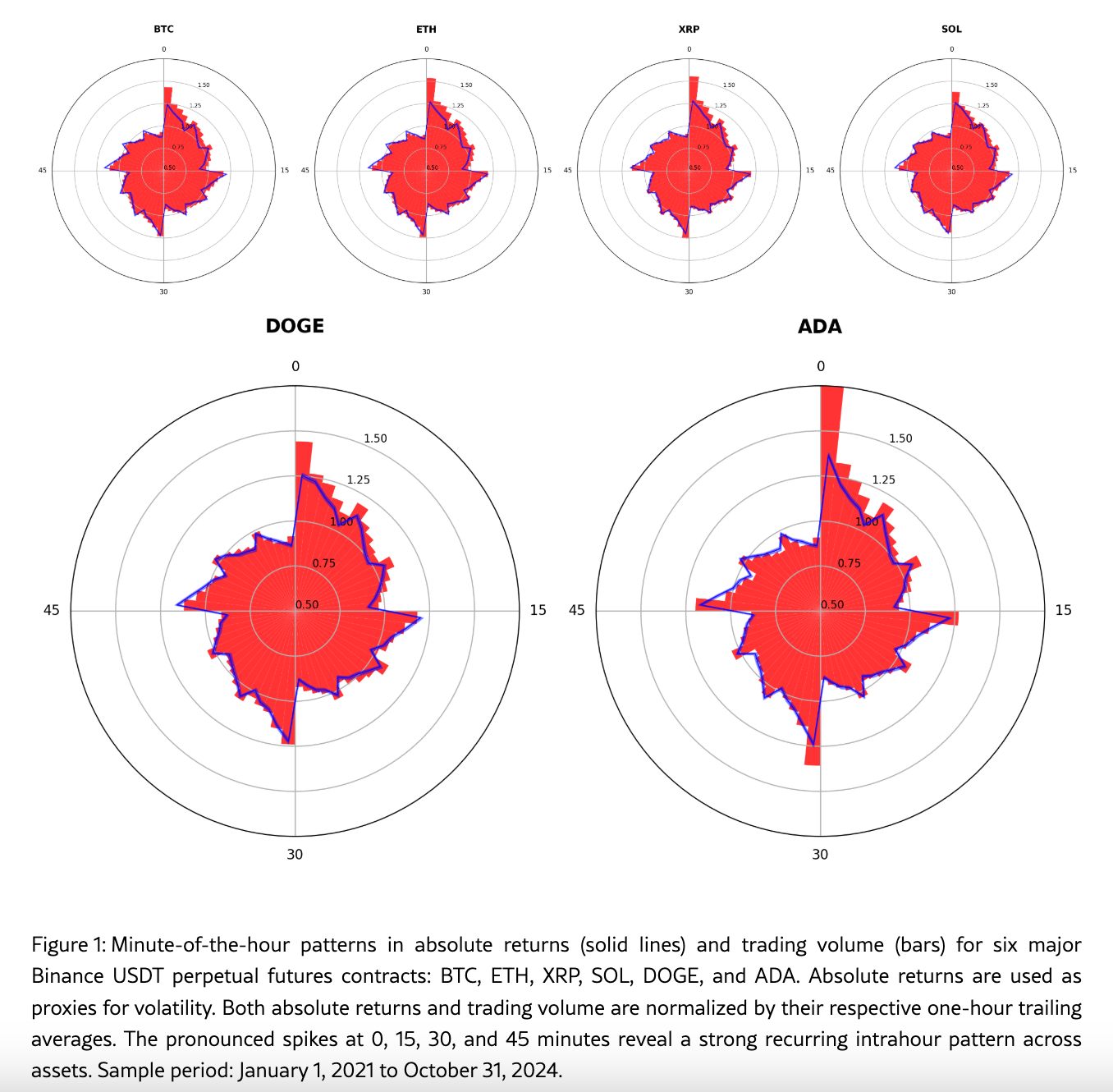
The pattern also crossed a wide gap in market size. Bitcoin averaged 1.54 million daily trades and $14.58 billion in contract volume during the sample, while Cardano averaged roughly 290,000 trades and $544 million in the same trading rhythm.
That consistency is the most important finding because it shows the convention is shared across trading systems rather than being a feature of one token.
Most trading apps turn a continuous stream of prices into candles covering one minute, five minutes, 15 minutes, or another familiar interval.
A 15-minute candle compresses everything that happened during that period into an opening price, a closing price, a high, and a low, giving humans a manageable picture of the market and giving software a standard block of data it can process.
At the end of each candle, technical indicators recalculate, and automated strategies receive fresh instructions from the same newly completed block.
Programs that divide a large trade into smaller pieces may release another piece on that boundary, while market makers can adjust their quotes for the flow they expect, and faster systems can trade in anticipation of both groups.
Once enough machines start following the same clock, a convenient way of displaying data becomes part of the market itself.
That's how an uneventful quarter-hour starts to look like a stock exchange opening. Traditional markets gather orders around a real opening bell because traders have spent hours waiting for the venue to reopen.
On the other hand, crypto creates a comparable rush through shared chart intervals and software defaults, repeating the process every 15 minutes while trading continues.
The machines have a tell
Binance's trade records show what was traded, how much, and at what price. However, they don't identify whether a human trader, a market-making firm, a liquidation engine, or another automated system initiated each transaction. Kim and Hansen looked for an indirect clue in trade size.
People tend to prefer round numbers because they are easier to choose and remember, so someone may trade 0.1 BTC or roughly $10,000 without calculating an awkward quantity to the final decimal place.
But algorithms usually start with a formula based on volatility, available capital, current exposure, or a target share of a larger order, which can produce quantities that look arbitrary to a human.
The researchers counted how often trade sizes ended in trailing zeros and found that round quantities were less common during the opening seconds of the recurring bursts.
They included only trades large enough to contain the number of zeros being measured, which kept tiny orders from being classified as irregular simply because the exchange's minimum increment made extra zeros impossible.
The decline grew with the importance of the boundary. Round quantities became slightly less common at the start of an ordinary minute, the gap widened every five minutes, and then again every 15 minutes, with the top of the hour producing the largest break from the usual pattern.
For Bitcoin trades that were eligible to end in at least two zeros, the round-size share fell by 0.04 standard deviations at an ordinary minute opening and by 0.20 at the top of the hour, making the hourly effect five times larger.
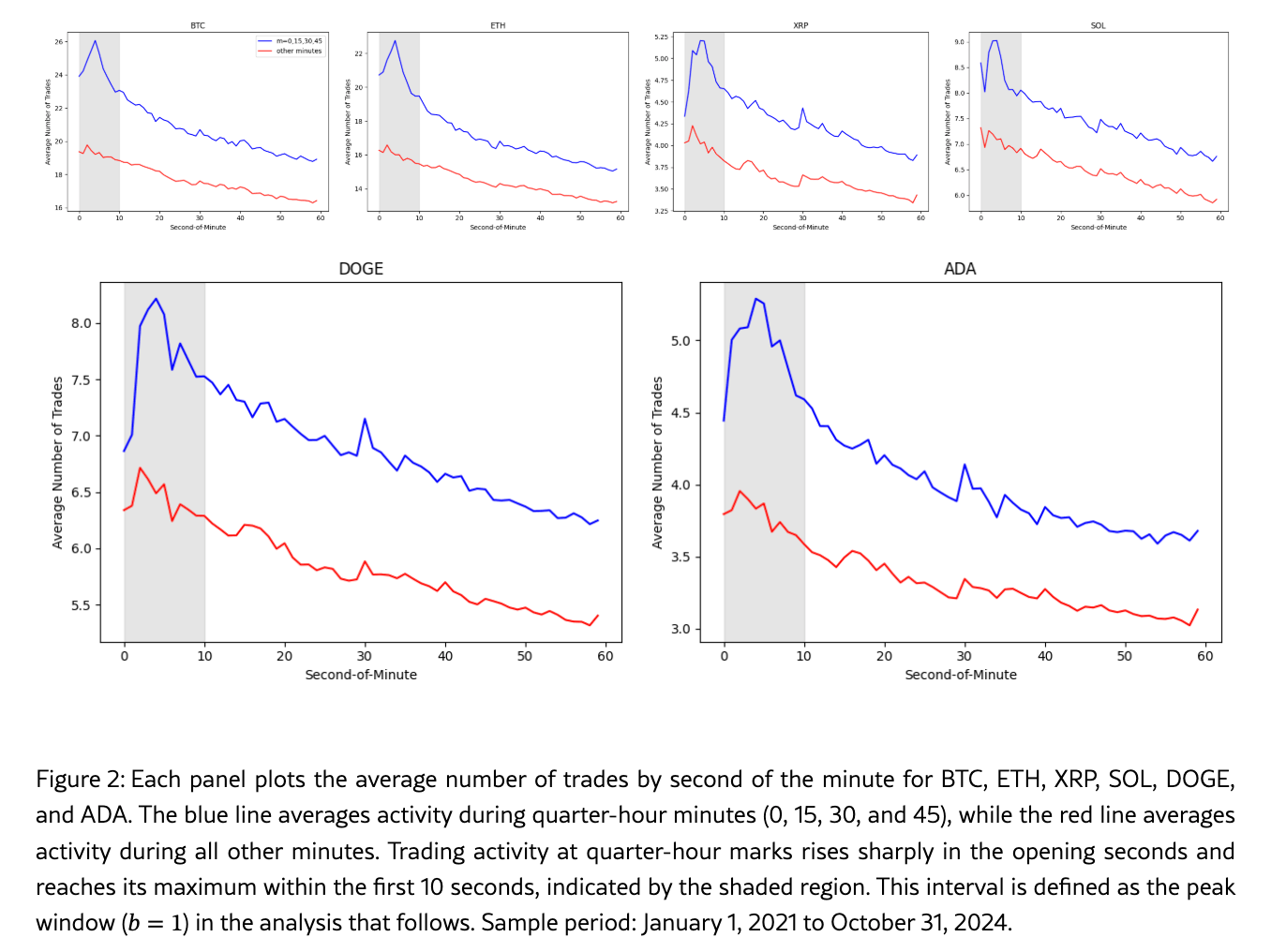
A standard deviation describes how far an observation moves from its usual range, so those numbers aren't the percentage of trades placed by machines. They show that the market moved farther from its normal preference for round quantities exactly when trading activity jumped, giving the authors a behavioral fingerprint of heavier automated participation.
Trade size still can't identify the source of every order. Large institutional executions and forced liquidations can produce irregular quantities, and funding arbitrage can do the same, so the paper uses roundness as indirect evidence associated with machine activity.
The authors ran several checks to see whether another recurring event was creating the pulse.
Binance processed funding payments at 00:00, 08:00, and 16:00 UTC during the sample, but removing those windows left the quarter-hour result largely intact, and the pattern at minutes 15, 30, and 45 survived when every top-of-hour observation was removed. A separate analysis of Bybit data produced a similar structure on another exchange.
Those checks describe a broad form of electronic coordination. Any trader can choose any interval, but exchange data, chart settings, and common indicators pull many systems toward the same boundaries, with the strongest concentration appearing at the clock points that receive the most shared attention.
A price forecast worth less than the trading fee
Once the researchers established that the pulse repeated, they asked whether data available before each quarter-hour could forecast the price move during its first ten seconds.
Their rolling model studied earlier quarter-hour returns alongside familiar price and volume indicators, then made a fresh out-of-sample forecast using information available at the time.
Across the six contracts, the model chose the correct direction 56.6% of the time. Its average out-of-sample R-squared was 3.4%, meaning it explained a small portion of the variation in those ten-second returns, while its area-under-the-curve score was 0.60 on a scale where 0.50 is a random guess, and 1.00 represents perfect classification.
In a market with enormous noise over ten-second intervals, those modest figures establish that the pattern contains repeatable information.
However, they don't establish an easy trading strategy because the predicted move was tiny. Trading in the model's chosen direction at every quarter-hour produced an average gross return of 0.51 basis points per trade before fees, equal to about 0.0051%, or roughly 51 cents on a $10,000 trade.
During the sample, Binance's base fee was 5 basis points for a taker order, which executes immediately against an existing quote, and 2 basis points for a maker order, which provides a quote for someone else to accept.
A $10,000 taker trade therefore cost about $5 to open and another fee to close, while the model's average gross return was roughly one-tenth of the first charge alone.
Given how small the gains are here, the most useful result from this dataset is the gap between statistical predictability and the money an ordinary trader can capture.
A pattern can repeat often enough to survive formal analysis while the expected move stays too small to cover basic trading costs, which is one reason highly automated markets can contain recognizable patterns without making any profits.
Market makers and large traders can still use the finding because they face a very particular problem.
If a company is quoting both sides of the market, it could demand a wider spread during those ten seconds or reduce how much it offers when one-sided flow becomes easier to anticipate, while a trader working through a large order may release pieces at less crowded points on the clock to reduce the price movement caused by its own activity.
The first ten seconds also carried information over a longer horizon. When buyer-initiated volume exceeded seller-initiated volume at a quarter-hour boundary, that imbalance was associated with returns over the next four to 12 hours, and the reverse relationship appeared when sellers dominated.
Order imbalance here means the difference between aggressive buying and aggressive selling relative to the total volume in that window, giving the researchers a way to measure which side was pushing harder.
At the four-hour horizon, much of the relationship came from earlier quarter-hour flow carrying into later boundaries. At eight and 12 hours, ordinary price and volume indicators explained more of it, which fits a market where algorithms use the quarter-hour as a shared moment to process information that has already been building across the wider market.
That longer-horizon result needs to be taken with a grain of salt because the four-, eight-, and 12-hour return windows overlap, allowing one market move to appear in several observations.
The authors used block-bootstrap methods designed for dependent data, though aggregate trade records still can't show whether the initiating orders contained private information, reacted to the same public inputs, or moved prices as market makers absorbed an uneven flow.
Nonetheless, the larger idea is easier to understand and eventually implement than the statistical machinery behind it.
Crypto removed the closing bell and made trading continuous, then its APIs, chart intervals, and automated strategies rebuilt miniature openings throughout the day.
Every 15 minutes, thousands of independent systems reach the same clock boundary, and for a few seconds a market designed to run without interruption behaves like a crowd pushing through the same door.
Source: CryptoSlate