



FILTERED RESULTS
FILTERS
MCap $2.8T 0%24h Vol $52.2B 0%Fear & Greed 61/100Alts Index 61/100
BTC.D 59.7% -0.1%Stable.D 9.4% 0%ETH.D 11.0% 0%Others.D 19.9% +0.1%
CKB$0.00200265+39.29%•S$0.0605+26.78%•GRASS$0.8278+23.84%•W$0.0217+23.16%•PLUME$0.0227+20.48%•CARDS$0.3172+15.25%•STRK$0.1186+14.75%•BAT$0.1599+13.57%•CASHCAT$0.1228+10.9%•NEAR$5.876+10.86%•
APEPE$0.00000129-11.27%•BP$1.115-9.2%•KAIA$0.0518-8.22%•DRV$0.5065-7.49%•Q$0.0289-6.99%•TIA$0.5774-4.53%•AKE$0.0261-4.53%•PONS$0.3544-3.81%•IMX$0.1922-3.21%•NIGHT$0.0487-2.42%•
•
·
·
FILTERED RESULTS
Starknet considers leaving Ethereum for a quantum-resistant Layer 1
OpenAI raises GPT-6.1 Sol default context length to 500,000 tokens
133,800,000 $USDC (133,843,217 USD) transferred from #Aave to Unknown Whale 1...
AVAX Token Surges Nearly 50% in Four Weeks, Outperforming Bitcoin and Ether
China Sees Explosive Growth of AI-Powered ‘One Person Companies’
Ledger attack spreads to EU, AI finds ’18 trillion XRP’ bug: Hodler’s Digest
Telegram Opens Its Money Wallet to More of Its 1 Billion…
A trader netted $1.28 million on new 1,000x exchange Papertrade by moving ETH prices on
Trader Gains Over $1 Million on Papertrade's Launch, Then Loses $450,000
Papertrade’s Wild Weekend Ends With 93.7% Open Interest Wipeout
Wells Fargo Reports Tuesday: Will Its Kraken Crypto Talks…
Coinbase and Robinhood Futures Arms Now Hold More Client Money Than the US Retail Forex Pool
London Man Gets 2.5 Years for SIM-Swap Crypto Theft
Hackers Allegedly Steal Up to $93 Million via Compromised Ledger Reseller
Some Aave loans sit near liquidation with collateral that can take hours to cash out
Amazon reportedly in talks to acquire AI startup Decart for about $7 billion
Solana’s 200ms Slot Upgrade Is Live, but First Epoch…
Top Trending Coins (Today) 1. TAUFA 2. TRUMP 3. S 4. STRK 5. NEAR 6. HOODCAT 7. W 8. PENGU 9. QTC...
*CANADA JAN. GDP RISES 0.1% M/M; EST. 0.0% ...
User Exposes Hidden Hardware Implant in European Ledger Wallet
XRP’s next Wall Street expansion comes with an unexpected complication from Ripple
XRP Ledger Fixed a Bug From 2015 That Could Have Created…
Solana Dominates Tokenized Equities Trading with 65% Market Share
Monetary Authority of Singapore Places Hyperliquid on Investor Alert List
Russia’s Moscow Exchange Pilots Crypto Trading for December Launch
Ledger Confirms Hardware Implant as Tampered Wallet Reports Allegedly Spread to Europe
Lightning apps using unpatched LDK risk Bitcoin theft from a reconnect lie
Ledger Investigates Hardware Implant Reports Linked to Southeast Asian Reseller
CFTC Unveils New Framework for Crypto Trading Amid Legal Concerns
Bought a Ledger From a Reseller? 5 Checks After the $86…
Everyone wants SCOTUS to take up prediction markets: State of Crypto
XRP Ledger developers disclosed a decade-old payment engine bug that could have minted
Some Kraken futures limit orders can still fill after a successful cancel
US threatens to block weapons supplies to Ukraine over attacks on...
Ledger Confirms Draining Cases Linked to CryptoBilis-Sold Devices
Bitcoin Price Eyes $85K, but Momentum Has Yet to Show Up
Ledger Reports $72 Million in Losses Linked to Compromised Devices from Reseller CryptoBilis
Tokenized Stocks Show Real Demand But Remain Volatile and Illiquid, IMF Finds
Saylor teases Strategy Bitcoin buying after ending September with STRC buybacks
Tokenization Hits $65 Billion, but the IMF Warns of New Vulnerabilities
Bitcoin ETF Weekly Outflows Hit 3-Month High, Ethereum Funds Extend Losing Streak
Bitcoin hedge funds face a liquidation trap when their collateral is split across markets
BTC breaks above $84,000, up 0.16% on the day
Starknet (STRK) traded at $0.1128, up 50.47 percent, at…
4,499 $BTC (377,172,944 USD) transferred from unknown wallet to unknown new...
*S&P 500 OPENS UP 1.1%, NASDAQ GAINS 1.3% ...
Bitcoin, Ethereum and Solana ETFs All in the Red for October
Papertrade Addresses Price Manipulation Concerns Amid Protocol Adjustments
Kyrgyzstan Orders Liquidation of Gold-Backed Stablecoin Issuer and Crypto Exchange
Liquid Bitcoin Redemptions Remain Frozen Amid Reserve Coverage Issues
Papertrade Implements Stricter Trading Limits Following Manipulation Claims
Clarity's failure could speed crypto innovation while shielding incumbents
Tokenized stocks can carry the same rights without the same trading protections
Liquid Network peg-outs remain frozen 35 days after Elements exploit drained nearly 4,000...
PaperTrade responds to fairness and manipulation concerns: queue mechanism ensures fairness, some users manipulating BBO could not sustain profits
Liquid Network at 86% Backing as Bitcoin Redemption Freeze Drags On
President Trump declares 'energy ceasefire' between Russia and Ukraine
Analyst: Bitcoin may need to break through $84,000–$85,000 to determine its next move
Trump Says Russia And Ukraine Have Reached ‘Energy Ceasefire’...
IMF Reports Lower Liquidity and Higher Volatility for Tokenized Stocks Compared to Traditional Stocks
PeckShield Links $3.89 Million Ledger Wallet Theft to Binance Deposits
Bybit's Weekly Platform Updates General• Keynote with Ben: new products + upgrades on Oct 13• Ask ...
Ledger supply chain attack suspected of spreading to Europe, user reports hardware implant found in device from official reseller
Ripple ETFs Defy Crypto Slump With Another Green Week but XRP Price Sinks
ESMA Wants Proof Tokenised Collateral Can Be Cashed Out in a Crisis
XRP ETFs extend a 13-week inflow streak as Bitcoin, Ethereum and Solana funds shed $1.25 billion
Trump Announces 'Energy Ceasefire' Agreement in Russia-Ukraine War
Cheaper AI Could Make Computing Power More Expensive — Grayscale
Tom Lee says Ethereum "should top $5,000" by the end of 2026...
Optimism’s Unichain deal will put more chains under one operator


Optimism is expanding its role as the operator of Ethereum-based chains for other brands. Unichain, Uniswap Labs' Ethereum layer-2 chain, plans to transfer its production sequencing, public node access, monitoring and incident response to Optimism under its October 9 migration announcement.
The planned testnet move on Oct. 13 and mainnet move on Oct. 29 extend the operating strategy set out by Jing Wang in Optimism's Ink announcement: product teams build their applications and ecosystems while Optimism runs the infrastructure beneath them. Soneium's September agreement follows the same division of labor as Ink's earlier June plan; both chains use the OP Stack.
For users, the consequence reaches beyond who answers an outage call. A common provider can bring protocol expertise and coordinated maintenance, but it also becomes a common organizational dependency. Each chain's deployed contracts determine whether users can get a transaction included and recover funds during a provider failure.
Unichain moves from support toward operations
Unichain already had an OP Enterprise relationship. Optimism's enterprise introduction, in its version updated July 31, says Uniswap Labs operates Unichain with the Mission Critical add-on. Read alongside the October announcement, the change is an expansion from support into responsibility for production operations.
Uniswap Labs says the migration preserves the chain ID, contracts, balances, applications and Uniswap v2, v3 and v4 deployments. It also says Unichain remains a Stage 1 rollup with permissionless fault proofs and its existing contract-upgrade governance. The production operator changes while the chain and its upgrade authorities remain in place.
Soneium's Sept. 30 announcement assigns the Optimism Foundation and OP Labs support for deployment, sequencer operations, node infrastructure, upgrades, monitoring and incident response. Soneium keeps its roadmap and engineering involvement, including ongoing work on the chain itself and its Tokenized IP products. The announcement does not specify a cutover date.
Ink offers an earlier version of the same strategy. In her June 23 announcement, Wang described an arrangement in which the Ink Foundation could concentrate on ecosystem growth while Optimism operated and improved the network. The plan targeted an August cutover and included mainnet and testnet sequencers, RPC, the explorer, monitoring and incident response.
A later Optimism guide published Sept. 7 describes Ink's infrastructure as operated by the Foundation through OP Labs.
The reliability promise has an operational price
OP Enterprise is Optimism's chain infrastructure and support service. Its tier definitions explain why the operating model matters. Under Self Managed, the customer runs the infrastructure and controls its sequencer and nodes; Optimism supplies support and monitoring. Under Fully Managed, OP Labs runs the sequencer, batcher, proposer and chain infrastructure, and handles security patching.
Those components perform different jobs. The sequencer orders transactions, the batcher submits transaction data to Ethereum, and the proposer submits claims about the resulting chain state. Moving those day-to-day roles to the protocol developer can reduce the work a partner coordinates internally. Sequencing, data submission and state proposals become provider responsibilities; Ethereum settlement and the contracts that accept proofs remain separate.
Soneium's agreement promises a 99.9% monthly uptime target and around-the-clock on-call incident response. The Mission Critical add-on advertises a 99.95% uptime SLA, a 15-minute initial response to the most serious incidents and status updates every 30 minutes. Unichain's earlier relationship explicitly included that add-on.
These are service commitments, not measured improvements in uptime. The 15-minute target covers an initial response; recovery can take longer.
The rationale is a direct organizational path between operating a chain, identifying a protocol problem and applying a patch. The trade-off is that distinct branded chains increasingly rely on the same organization for sequencing, maintenance and incident handling.
A provider-wide process problem could affect several customers. The announcements establish a shared operator but do not disclose whether cloud regions, signing keys or other infrastructure are shared, so correlated technical failures remain a possibility rather than an observed outcome.
Inclusion survives sequencing failure; exits differ
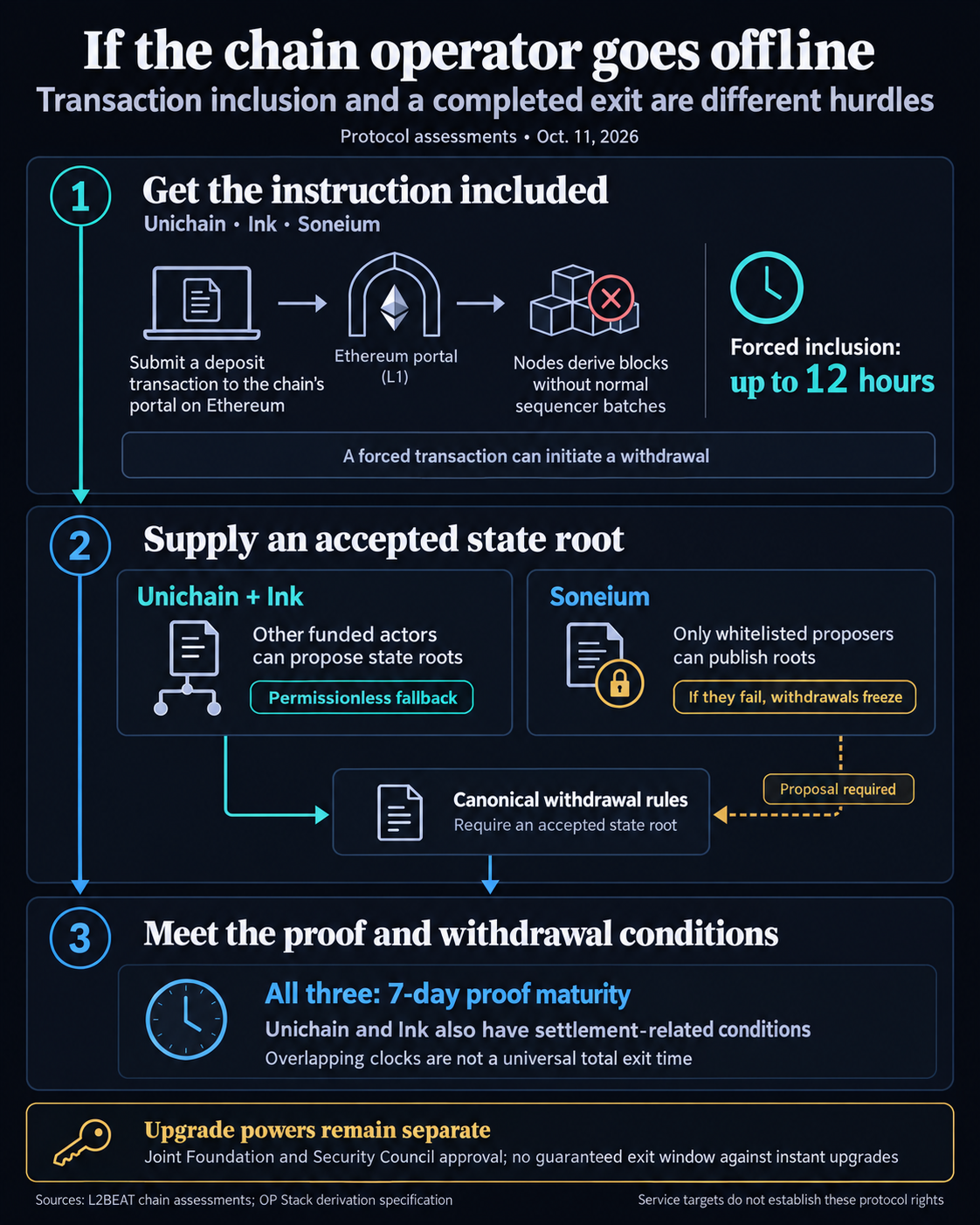
Ethereum supplies a fallback below the managed service. Current L2BEAT assessments separately list forced transaction inclusion through Ethereum for Unichain, Soneium and Ink, with up to a 12-hour delay.
The OP Stack derivation specification and forced-transaction guide describe how it works: a user submits a deposit transaction to the chain's portal contract on Ethereum. When the sequencing window expires, nodes can derive blocks containing those transactions without normal sequencer batches. A forced transaction can initiate a withdrawal.
That preserves a route around an unavailable or censoring sequencer. Money becomes available on Ethereum only after the withdrawal's separate proposal and proof conditions are met, with permissioned dependencies still possible along the way.
| Chain | Managed-operations disclosure | If the usual proposer fails |
|---|---|---|
| Unichain | Oct. 9 plan; testnet Oct. 13, mainnet Oct. 29 | Permissionless state-root proposals provide a fallback |
| Ink | June plan targeted August; September vendor guide describes managed operation | Permissionless state-root proposals provide a fallback |
| Soneium | Sept. 30 Fully Managed adoption; no precise completed cutover date | Whitelisted-proposer failure freezes withdrawals |
L2BEAT rates Unichain and Ink as Stage 1 and says other actors with sufficient funds can propose state roots. Their canonical exit paths permit others to do the usual proposer's work, provided funded actors submit accepted roots and the applicable proof and withdrawal conditions are met.
Soneium has a different dependency. Its currently respected super permissioned game has no functional onchain dispute process, according to L2BEAT, and only whitelisted proposers can publish roots. If those proposers fail, withdrawals freeze. Forced inclusion can get a transaction into the derived chain; it cannot supply the missing withdrawal proposal authority.
The withdrawal assessments for Unichain, Ink and Soneium also retain a seven-day proof-maturity period for all three chains. Unichain and Ink have additional settlement-related conditions: at least three-and-a-half days for root settlement and three-and-a-half days after settlement. Proof inclusion can precede settlement, so those clocks should not be mechanically added into a universal withdrawal time. Soneium retains withdrawal delays despite its respected game lacking an onchain challenge process.
Optimism operations do not erase upgrade powers
Production operations, contract-upgrade authority and asset custody are separate questions. Uniswap says its governance arrangement persists. L2BEAT's current assessments show joint Foundation and Security Council approval for upgrades on all three chains, with no delay on regular upgrades and no guaranteed exit window against those instant powers.
An Ethereum fallback during sequencer failure therefore does not guarantee an opportunity to leave before an unwanted contract change. Stage 1 preserves meaningful operator-independent paths, but retains powerful upgrade authorities.
Unichain's promised native interoperability remains a future feature. Soneium's announcement expressly excludes interoperability. Ink's June plan describes one-day withdrawals as a proof-system rollout, while its current withdrawal assessment still retains seven-day proof maturity.
CryptoSlate's September Upgrade 20 coverage examined the technical preparation for future interoperability. Outsourcing production operations is a separate development, with its own question of who maintains the chain and handles failures.
The next dated milestones are Unichain's Oct. 13 testnet and Oct. 29 mainnet migrations. Their completion would extend Optimism's strategy from selling protocol support to operating another established production chain. The reliability case will then depend on performance in service, while users' recourse will continue to depend on the specific inclusion, proposal and upgrade rules beneath each brand.
Source: CryptoSlate