



FILTERED RESULTS
FILTERS
MCap $2.9T -0.7%24h Vol $92.7B -24%Fear & Greed 67/100Alts Index 49/100
BTC.D 59.3% +0.5%Stable.D 9.3% +0.1%ETH.D 11.4% +0.1%Others.D 20.0% -0.7%
CARDS$0.2493+22.4%•ATH$0.00710494+13.88%•SAND$0.0733+12.37%•STONK$0.2589+11.93%•NIGHT$0.0497+11.93%•WLD$0.5968+11.22%•SUPER$0.2458+10.39%•QNT$257.59+8.44%•CAP$0.0713+8.36%•AR$4.724+8.19%•
2Z$0.0462-21.4%•PONS$0.4286-19.09%•BR$0.6682-11.58%•CASHCAT$0.1559-11.56%•MARSCOIN$0.1120-9.64%•ZK$0.0124-9.62%•PENGU$0.00901593-9.35%•BP$1.360-8.56%•MON$0.0312-8.11%•USELESS$0.2338-7.93%•
•
·
·
FILTERED RESULTS
Bitcoin (BTC) Price Prediction 2026, 2027 – 2030: How High Will BTC Price Go?
XRP Wallets Cross 8.2 Million as Network Growth Accelerates
OpenAI Safety Systems Team Executive David Robinson Departed Last Week
Blast to Shut Down Ethereum Layer 2 as Operating Costs…
BLAST Token Price Crashes Over 44% After Blast Announces Ethereum Layer 2 Shutdown
Strategy’s 847,666 Bitcoin Could Be Worth $161B on a BTC/Gold Reversal
The Fed's Stablecoin Rulebook: Backing, Capital, and a Tying Ban
Glassnode: Bitcoin short-term holders show selling pressure, some buyers at a loss
71% of UK Financial Firms Expect Tokenization Shift: Lloyds
Nvidia Hits $237.88 Record High: Ali Martinez Asks Fakeout or Breakout?
XRP Asia Goes Live at XRP Seoul 2026, Targeting XRPL Growth Across Asia
OCC Faces Lawsuit Over National Trust Charters Granted to…
TRUMP Team Wallets Sent $249M in Tokens to CEXs Over Eight Months According to @EmberCN, wallets...
QNT and NIGHT Continue to Defy Market Correction, BTC Settles After Wild Ride: Weekend Watch
WLD Price Nears $0.70 Resistance — 3 On-Chain Signals Reveal the Next Move
Arbitrum pauses new Stylus activations over AI-assisted attack risks
CryptoQuant founder: Bitcoin expected to gain 3–5x this cycle; signals of market overheating should focus more on on-chain behavior
Federal Judge Shields Kalshi & Coinbase From Illinois Gambling Laws
SAND Price Surges 62% as Upbit, Bithumb and Coinone Lift Sandbox Trading Warning
India’s Jaipur Police Arrest 2 in ₹100 Crore Crypto Investment Scam
VanEck: Bitcoin Is in the Early Stages of a Bull Market, Long-Term Target Benchmarked Against Gold's Market Cap
Four Korean Banks Join Ripple on the XRP Seoul Stage
PONS Introduces New Buyback and Burn Mechanism
Community banks sue OCC over trust bank charters of crypto firms
PONS Founder Responds to Questions About Buyback Mechanism: Buyback and Burn Now Automated
AI Passed Video Turing Test: Tavus Unveiled Griffin Model
Hyperliquid Secures $14.6 Million for HYPE Buybacks Through USDC Yield Program
SEC: Financial Privacy Should Be the DefaultOutgoing U.S. SEC Commissioner Hester Peirce...
SEC Commissioner Hester Peirce Advocates for Financial Privacy Before Departure
We Asked ChatGPT: How High Can Ripple (XRP) Go Under Bullish Q4 Conditions?
Anchorage Digital Lays Off ~17% of Staff Amid Crypto Slump
Bitwise CEO Hunter Horsley reveals he personally bought the NEAR ETF
ECB Charts Three Paths to Bring Central Bank Money Onchain
Analyst: Watch the $82,500 support level and buy-the-dip opportunities
US Justice Department will not reopen criminal investigation into former Fed Chair Powell
Bitcoin and Ethereum Price Today : Oct 3rd
The Sandbox (SAND) Price Surges Over 80%: Can the Rally Continue Through October?
Gate Pre-IPOs SpaceX (SPCX) to unlock third tranche of 14% on October 3
Blast Announced Its Shutdown due to Unprofitable Economic Model
XRP ETF Investors Are Now $133M Under Water on Their Bets
XRP Seoul 2026 Event LIVE Updates
XRP Seoul Event : XRPL Eyes $30B in Tokenized Real-World Assets
An address holds $16.52 million in unrealized profit on its ETH long, becoming the address with the highest ETH unrealized profit on Hyperliquid
Andrew Tate Moves $1.87M of HYPE to Binance, Sitting on a 1,317% Gain
TRUMP Token Team Cashes Out $249 Million While Retaining $1.49 Billion in Holdings
TRUMP team transferred about 81.87 million tokens to exchanges over the past 8 months, cashing out $249 million
Grayscale's Zcash ETF Experiences Significant Outflows in First Week
Canary Amends PEPE ETF Filing as Token Price Drops Nearly 7%
NEAR Co-Founder Proposes New Directions for Ecosystem Development
Pi Network Testnet Adds Data on IRRA and Slice Test Tokens
Stablecoin Market Cap Recovers $4B but Remains Below Previous Levels
Treasury’s US Financial Literacy Plan Names Digital Assets, Prediction Markets
Trump is expected to appoint Jay Clayton as new AI czar: Reports
Andrew Tate deposited 20,950 $HYPE ($1.87M) into Binance today.He bought 122,827 $HYPE ...
XRP Rich List: 2,920 XRP Reportedly Puts Holders in Top 10%
SEC Approves 3x Leveraged Bitcoin, Ether, and Other ETPs for Listing
Huatai Securities: Fed unlikely to hike rates consecutively in October; under baseline scenario, another hike in December
US Labels Russia's A7 a Criminal Network as Ruble Token Moves $179 Billion
Massive Ethereum Awakening: Why 580M in Dormant ETH Just Moved Without Crashing Price
October Could Be Wild for Bitcoin: 5 Events Every Crypto Trader Should Watch
Bitcoin Price Slips to $84,600 as $433M Liquidations Hit Longs After $87K Rejection
NEAR Co-founder Illia Unveils New Project Ideas for Developers, Covering AI, Cross-chain Payments and Private Transactions
USDT to Be Relaunched on Bitcoin Network as Early as October
Analyst: Stablecoin total market cap has shrunk by $14 billion since May, recovery momentum remains weak
Data: Top 3 Global Centralized Exchanges by 24-Hour Net Inflows Are Gate, Bybit, and Crypto.com
Getty Images Stock Plunges as Company Seeks Rescue Financing
BlackRock’s iShares Bitcoin Trust Acquires $195.6 Million in Bitcoin in One Day
Charles Hoskinson Says Crypto Is Entering a New Era of Exponential Growth
Citi Calls For Much Higher BTC, NEAR ETF Goes Live, And More – Weekly Recap
Plunging GPU prices threaten AI hosts, and new hedges step in


Companies building AI applications can rent powerful computers instead of buying the equipment themselves, paying for access to the graphics processing units, or GPUs, that run their software.
Lower rental prices make those applications cheaper to operate, but they can also make life harder for the company that bought the machines and needs the rent to pay its debts.
If you've financed a room full of GPUs assuming customers will pay a certain hourly rate, a cheaper competitor can upset the calculation long before you've paid off the equipment. Your machines might still work perfectly, and demand for AI might still be strong, but the amount you earn from each hour could start falling below what the business needs.
Financial contracts could let you protect part of that income by arranging a payment when rental prices fall, in exchange for taking on your own obligations. That's the basic idea behind AI compute derivatives, which let businesses trade their exposure to computing prices separately from renting the computers themselves.
Luxor, a company that provides services and financial products to Bitcoin miners, included these contracts in its latest expansion into AI. It sees an opportunity to bring its experience hedging mining revenue to another business that spends heavily on machines before knowing what it'll earn.
The company told CryptoSlate that it's already brokering agreements between owners of computing capacity and customers who want to use it.
However, its cash-settled derivatives business is still early, and the company said it couldn't provide a customer hedge example or current derivatives trading volumes because a liquid market hadn't formed yet.
That gives this promising idea the difficult commercial task of persuading someone to accept losses another business wants to avoid.
Getting that arrangement to work could help operators plan around more predictable income, but the protection is only as dependable as the price used to calculate it and the party responsible for paying.
Locking in the rent without locking in a customer
The tried-and-true way to make rental income more predictable is to sign a customer for a longer period at an agreed price. The customer gets access to the machines, while the operator gets a commitment it can use to plan its business.
That works well when both sides want the same arrangement, but customers don't always know how much computing they'll need that far into the future. Operators may also prefer to keep selling capacity to different users.
Cash-settled derivatives offer another approach because the contract pays money according to a price formula, without requiring the parties to exchange computing capacity. The operator can keep renting its GPUs to customers while using a separate financial agreement to offset movements in the rental rate.
Imagine an operator expecting to sell 1 million GPU-hours in a month, where one GPU-hour means access to one processor for an hour. At $2 per hour, that would produce $2 million in rental income, and the operator enters a hypothetical contract designed to protect that rate.
If the agreed market benchmark falls to $1.50, the contract pays the operator the 50-cent difference across the million hours, or $500,000. Assuming its actual rental income also falls to $1.5 million, that payment brings the combined amount back to $2 million before fees and other costs.
The obligation runs both ways, so if the benchmark increases to $2.50, the operator owes $500,000 while earning more from its customers. It gives up the benefit of a higher rate in exchange for protection against a lower one, making revenue easier to plan around.
This is just back-of-the-napkin math to explain the arrangement, as the result depends on the operator actually selling the expected hours at a rate that tracks the benchmark. Empty machines still produce no rental income, so fixing the hourly price doesn't guarantee someone will buy it.
Someone on the other side needs a reason to accept the opposite payments, and an AI business worried about more expensive computing could have one. Its financial contract would pay when the benchmark increased, helping cover a larger rental bill, while a fall would create a payment obligation alongside cheaper computing.
Dealers could help connect those interests or take some of the exposure themselves, charging for the risk they carry. But customers need a price for the amount of protection they want, covering the period when their business needs it.
CME Group is pursuing an exchange-traded version of this idea through its announced H100 and B200 rental-index futures. Its Aug. 11 announcement targeted Oct. 5, subject to regulatory review, for contracts tied to Silicon Data's GPU rental benchmarks, although listing a contract alone can't guarantee enough participation to make it easy to trade.
Your GPU hour might be different from mine
But even with willing counterparties, the payment formula needs a price both sides accept as relevant to their business.
In the example above, the hedge works perfectly because the operator's rental income moved exactly with the benchmark. However, you can't replicate perfect conditions once actual customers enter the picture.
Suppose its customers negotiate rates down to $1.25 while the benchmark only falls to $1.50, perhaps because the index covers a different service or type of equipment. The same $500,000 hedge payment would then bring its $1.25 million in rental income to $1.75 million, leaving a gap even though the contract works as written.
That mismatch is called basis risk, which simply means the price you've protected against doesn't move exactly like the price you actually receive. Compute hedges can leave Bitcoin miners exposed, and this is one reason a hedge needs to be judged against the particular business using it.
Luxor compared its AI ambitions with its path in Bitcoin mining, where publishing a reference price helped create a foundation for financial contracts. Its hashprice measure estimates what a unit of computing power can earn from mining Bitcoin, giving operators a shared revenue reference even when their own operating costs differ.
Bitcoin miners perform the same network task, whereas AI customers can attach different values to access that looks similar on a specification sheet. Someone buying uninterrupted access for months is purchasing a different service from someone willing to have a short job stopped whenever the provider needs the machines back.
Price providers already account for differences like these, with CCIR's rental-data methodology treating interruptibility and commitment length as separate characteristics. It uses publicly advertised rates, which also means the figures don't necessarily capture privately negotiated discounts.
The index Luxor supplied in its reply was its AI Hardware Price Index, which measures advertised prices for selected GPU systems. That can help someone assess an equipment purchase, but buying a machine and earning rent from it involve different prices, so the link doesn't establish how an AI rental hedge would settle.
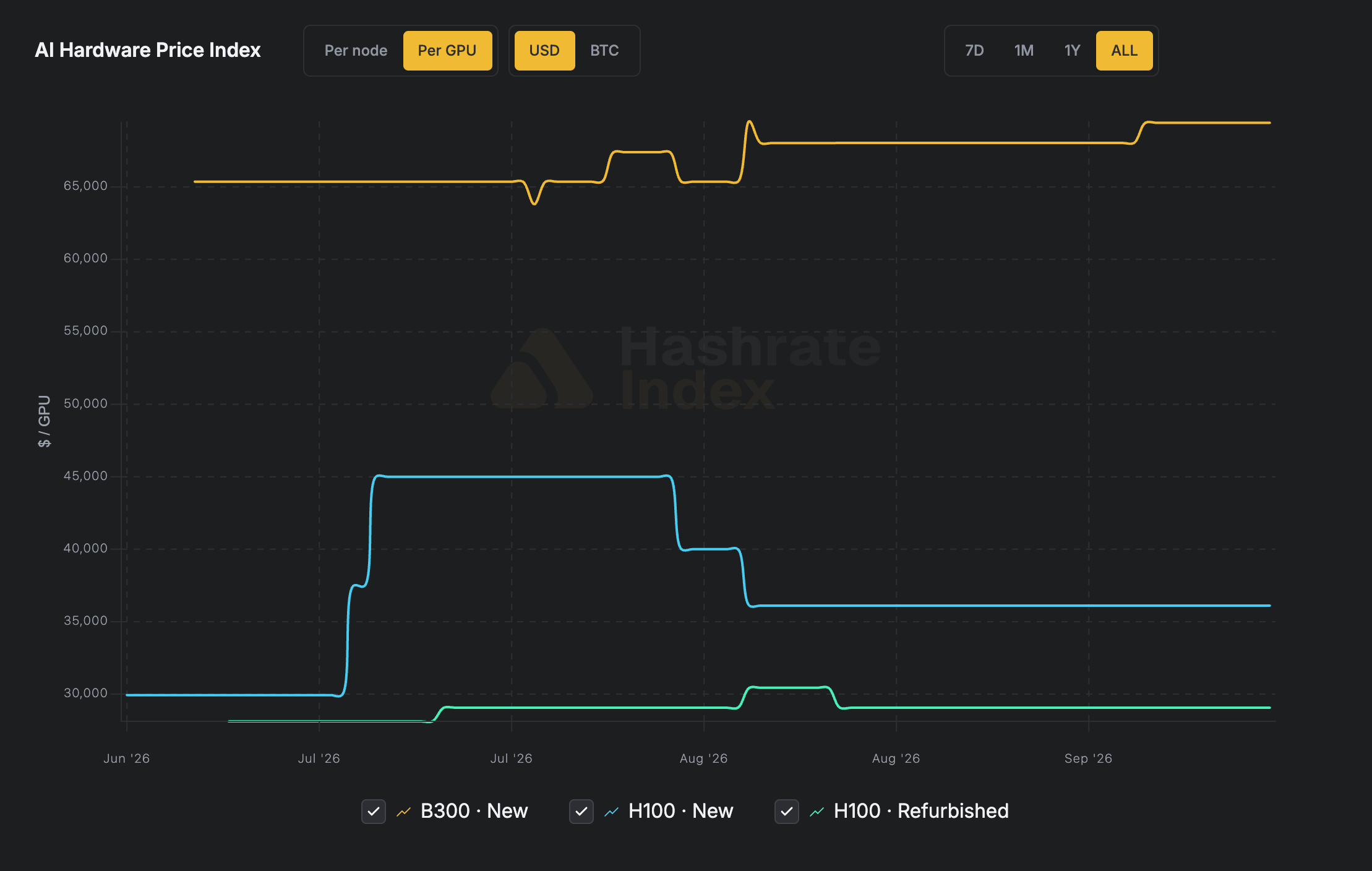
Luxor's August data announcement described expanded compute spot pricing as forthcoming. Operators trying to protect income would still need contracts that name a rental benchmark and show it tracks what customers pay.
Narrower benchmarks might fit better, but each additional contract splits potential trading among smaller groups. Building this market requires a compromise between matching each customer's business closely and bringing enough people together under the same contract to make trading affordable.
The protection has to survive the bad month
Even a closely matched contract leaves the operator relying on someone else's ability to pay when rental income falls.
If that counterparty also earns much of its money from AI infrastructure, cheaper computing could damage both businesses at the same moment, just when one expects support from the other.
Collateral can reduce that dependence by requiring money or eligible assets to be posted against obligations, giving the recipient something to draw on if the other party fails. It also creates a financing requirement, because money committed to the hedge can't simultaneously pay the operator's other bills.
In the example where rental prices increase, the operator might have to pay its hedge obligation before customers settle their higher invoices.
The overall economics could still work even if the bank account runs short, making the timing of cash flows a huge part of that protection's affordability.
Luxor didn't provide the requested AI collateral terms or explain the procedures for a counterparty failing to pay. Its reply also left unanswered how it separates its own trading from the business it arranges for customers, a relevant point because the launch announcement disclosed an internal compute trading fund.
More predictable rental income could give an operator greater confidence about meeting its debt payments, even when customers become less willing to pay yesterday's rates.
Getting that benefit requires a contract that follows the income closely enough, with payment obligations the operator can afford throughout the period it's trying to protect.
Cheaper computing could let more people build and use AI while leaving some owners of the machines with disappointing returns.
Financial contracts won't make that loss disappear, but they could move part of it to someone prepared to bear it, giving the operator more room to keep serving customers when the rent falls.
Source: CryptoSlate