



FILTERED RESULTS
FILTERS
Fear & Greed 73/100Alts Index 59/100
BTC.D 58.8% +0.5%Stable.D 9.2% 0%ETH.D 11.6% +0.2%Others.D 20.4% -0.7%
GRASS$0.6975+27.69%•CRV$0.4052+25.11%•ZBCN$0.0025005+24.82%•TEL$0.00225954+24.12%•AAVE$172.15+19.1%•NIGHT$0.0321+17.04%•SYRUP$0.2423+15.95%•CVX$2.297+15.37%•ZRO$1.712+14.72%•ETHFI$0.7765+14.64%•
AI$0.1982-9.26%•BR$0.8281-8.92%•ZEC$1,417.49-7.29%•PROM$5.906-6.66%•BTW$1.302-6.08%•Q$0.0235-5.94%•DASH$60.366-4.92%•DGAI$0.9585-4.9%•PIEVERSE$1.422-4.84%•BP$1.227-4.67%•
•
·
·
FILTERED RESULTS
NEAR Intents Blocks Over $50M in Bitget Hack Flows and Waives Recovery Bounty ShareAurora...
An #EthereumOG who bought 3,000 $ETH at $18.8 ($56.5K at the time) 8 years ago sold another 1,000...
coinbase RECEIVES CFTC APPROVAL FOR COINBASE CLEARING...
Michael Saylor Discusses Strategy for Digital Credit and Bitcoin Exposure
Cryptocurrency Trading Company Raven Secures $90 Million Valuation in Latest Financing Round
Hunter Biden Discusses $LAPTOP Token Collapse and Bitcoin Price Predictions
BNB Treasury Company CEA Industries to Rebrand as BNB Standard
State Street and Galaxy Launch Tokenized Liquidity Fund on Stellar Network
Solana Reports Significant Growth in Active Programs and Wallets in September
Moca Network Launches Moca Chain Mainnet for Digital Identity Infrastructure
BTC: Adjusted LTH MVRV Exits Shallow Stress“The 6M–10Y cohort has moved out of shallow sub-1.0...
Bitget: All Withdrawals to Face Independent ChecksBitget says it is tightening its security...
Is Michael Saylor(@saylor)'s @Strategy dumping $BTC again, or just moving funds to new wallets?Over...
sunrise ENABLES ACCESS TO chainlink CCIP-POWERED coinbase WRAPPED $ADA ON...
Blockchain.com Said To Target $500M Raise At $4-6B Valuation In IPO: BBG ...
REPORTS OF IRANIAN FLEXIBILITY IN NUCLEAR TALKS FALSE | PER PRESS TV...
Canadian crypto personality Aiden Pleterski faces fraud and money-laundering trial over alleged...
Greece gets first MiCA entrants as watchdog denies Binance-Lagarde claim
Canadian ‘crypto king’ set to represent himself at fraud trial
Ethereum schedules Glamsterdam upgrade on Sepolia for Oct. 6
BitMine could hit its 5% Ether supply target within weeks — then what?
NEAR Intents says it blocked $50M tied to Bitget hackers
Bitcoin ETF inflows leave institutional demand unclear: CoinShares
Tether says it helped freeze $550M in Iran-linked USDT this year
Apple’s $5.7 Billion Loss Has a Hidden Beneficiary
MoonPay Storms Into South Korea With a Bold New Play
Coinbase Can Now List, Broker and Clear Fully…
Bitget Exploiter Attempted to Route Stolen Funds via…
How to Set Up and Optimize a Bitcoin Node: A Step-by-Step Guide
Bybit Added TradFi Perpetual Contracts to Copy Trading
Zcash developers begin moving Tachyon code into faster private-payment software
AI agent security firm Reco raises another $55 million, bringing total funding to $140 million
Raven secures strategic funding from Coinbase Ventures and CMCC Global at $90 million valuation
Citi Launches AI Market Guide for Custody Clients
Cboe and S&P Dow Jones Indices Extend Licensing Agreement and Explore Tokenized Options
Zcash Developers Enhance Transaction Speed with Tachyon Integration
MoonPay Establishes South Korean Subsidiary to Enhance Asia-Pacific Presence
Bitget Experiences $463 Million in Withdrawals Following Major Security Breach
OURA Delays IPO Amid Market Uncertainty
QuickSwap Achieves $700 Million in Trading Volume on Base Network
Raydium Achieves Record Weekly Revenue Amid Surge in Tokenized Equity Trading
US Spot Crypto ETF Inflows Experience Significant Decline
Aave Founder Proposes Token Burn Mechanism for Aavenomics 3.0
Ondo Perps CEO Highlights US Market Potential for Perpetual Futures Trading
Binance to Delist AUCTION/USDC and VANA/USDC Trading Pairs
OpenAI Codex Team to Reopen $200 Pro Subscription with Adjusted API Costs
User Reports Inability to Withdraw 50 BTC from Solv Protocol for Over Two Months
XRP Scarcity Index on Binance Hits Lowest Level Since January 2025
Greece Registers First Crypto Providers Under MiCA Framework
NVIDIA AI Enhances Kimi Delta Attention Kernel Performance
Bitcoin Long-Term Holders Return to Profit Amid Market Adjustments
Bitcoin ETF Inflows Reach $2.4 Billion as Exchanges Experience Significant BTC Withdrawals
Altcoin Trading Volume Surges to Highest Level in a Year, Outpacing Bitcoin
China's Generative Artificial Intelligence User Base Exceeds 700 Million
Major Crypto Spot ETFs See Combined Inflows of $65 Million on September 28
Personal AI Agent Instinct Sees Rapid User Growth and Computing Power Demand
BlackRock's iShares Ethereum Trust Sees $15 Million Inflow
Ethlabs Introduces CCIP 2.0 to Accelerate Ethereum Transaction Confirmations
U.S. Bitcoin Spot ETF Records Eight Days of Consecutive Net Inflows
Ari Paul Accuses Coinbase of Concealing $25 Million Loss from BlockTower Funds
Injective Launches Innovative Stockdrop for Tokenized Stocks
Binance Launches U-based TradFi Perpetual Contracts
Bitcoin Remains Steady Above $83,000 as Zcash Experiences Significant Decline
Analysts Report Slowed Growth for Anthropic Amid Rising Competition
U.S. Senate Investigates Trump Family's Cryptocurrency Ties and Tether's Sanctions Compliance
NVIDIA CEO Defends AI Model Distillation Amid U.S. Accusations Against Chinese Firms
Bitget BTC Protection Fund Releases 3,215 BTC
OpenAI Apologizes for Unauthorized Access to Australian Government Websites
TSMC Plans Second Semiconductor Campus in Texas with Significant Investment
Solana’s 300ms speed boost to outrun trading bots might come with a hidden cost


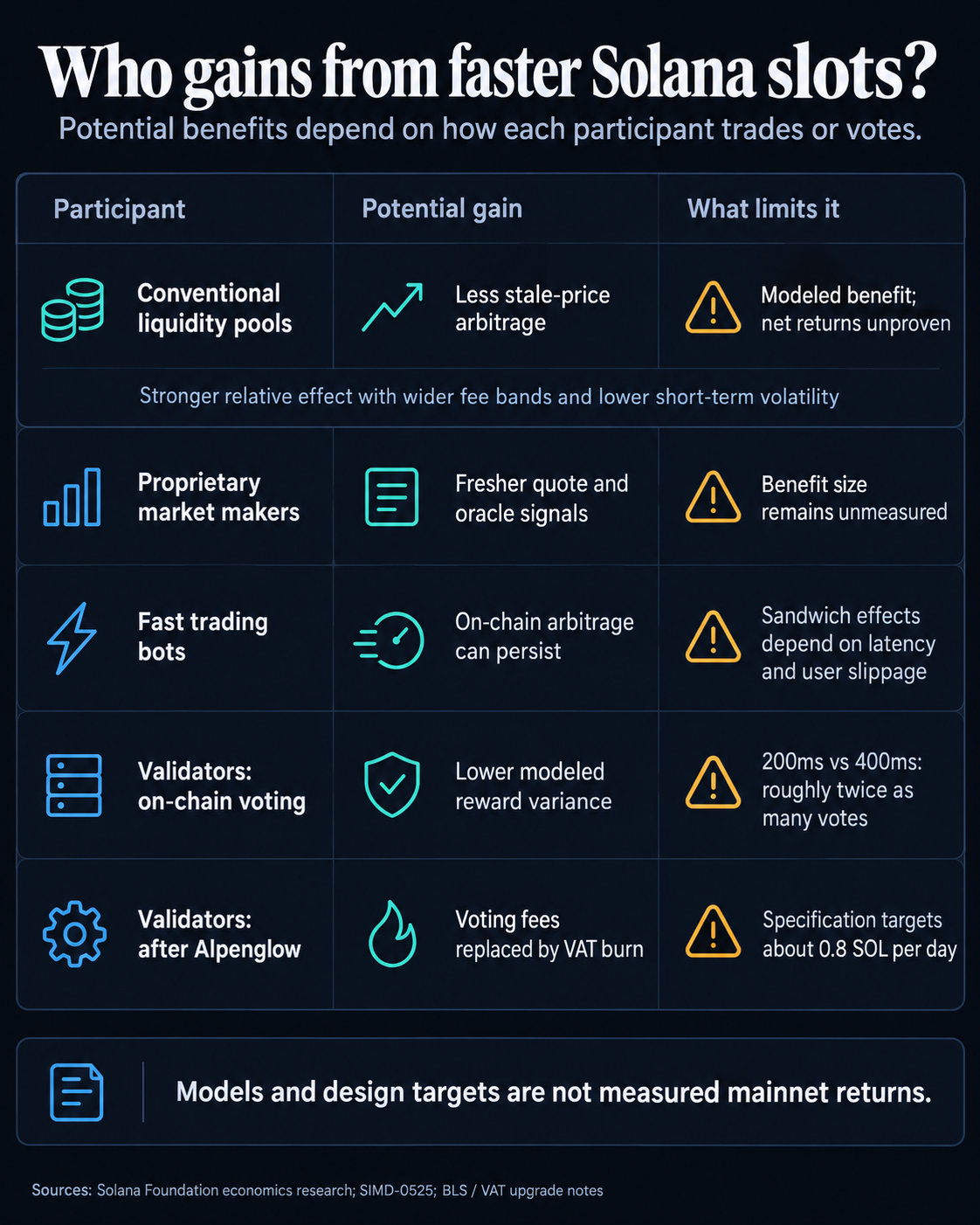
Solana’s shorter trading intervals could let liquidity providers keep more of the value that trading bots extract from outdated pool prices. Fee-charging pools whose prices lag external markets have the clearest modeled benefit.
Solana’s mainnet has reached the reported 300-millisecond slot target, shortening the intervals allocated for block production. Validator software developer Anza also issued its Sept. 8 call for volunteers to adopt Agave v4.3.
These separate upgrades change both trading opportunities and the costs of running the network.
The economic question is how much trading value remains with the people supplying liquidity after faster execution, fees, and competition between bots. A larger transaction count cannot answer it.
Faster price updates benefit pools differently
An automated market maker (AMM) lets traders swap against a pool of assets. When an external market price moves before the pool updates, an arbitrageur can trade against the outdated price. The bot captures the difference, and the pool’s liquidity providers bear the cost of that informational disadvantage.
The Solana Foundation’s August analysis applies this model to constant-product pools, a conventional AMM design. Shorter intervals leave less time for the external price to move far enough to make an arbitrage trade profitable after the pool’s trading fee.
The relative benefit is strongest when the fee creates a wide barrier compared with normal short-term price moves. With very low fees or high volatility, profitable discrepancies emerge more readily, so removing part of the waiting interval eliminates a smaller share of the opportunity.
Establishing a higher net return also requires accounting for fee income and the conditions under which trades execute.
The underlying research by Jason Milionis, Ciamac Moallemi, and Tim Roughgarden models fee-bearing AMMs with discrete, randomly arriving blocks and an external price process. It suggests less arbitrage extraction as blocks become more frequent.
For a conventional pool, the fee and the price movement it faces determine how much shorter intervals can help. A given reduction in slot time carries different implications for pools trading different assets or charging different fees.
Proprietary AMMs use quote- or oracle-driven strategies, making information freshness another part of the competition. Finer slot granularity can help these market makers assess how old a quote or price signal is.
That is a different benefit from the modeled reduction in arbitrage against a conventional pool.
The Foundation’s routing evidence illustrates the range of trading mechanisms involved. In the five-day sample described in its August research, about 36% of observed atomic-arbitrage profits came from pure on-chain venues, while more than 60% of flowing volume routed through proprietary AMMs.
Those figures describe a share of profits and a share of routed volume, and their scope is limited to that August sample of atomic arbitrage.
They nevertheless show that Solana’s arbitrage market is broader than a pool waiting for a price update from outside the chain. Reducing that external-price delay does not mean atomic arbitrage between on-chain venues will disappear, or that proprietary makers will get the same savings as conventional pools.
The Foundation’s sandwich model, which examines attacks that trade around a user’s order, finds opposing effects. An attacker has less time to react, but fewer competing trades before the user’s execution can leave more of the user’s permitted price slippage available to exploit, so a sufficiently fast attacker may still use that room.
The next stages change Solana validator costs too
The Foundation’s Sept. 4 roundup reports mainnet activation of the 300ms stage on Aug. 28, after the earlier 350ms step. Anza’s feature tracker, checked Sept. 9, still lists 250ms and 200ms as pending mainnet activation.
Under SIMD-0525, leaders retain four consecutive slots. At the proposed 200ms endpoint, one leader’s nominal window would last 0.8 seconds, compared with 1.6 seconds at the original 400ms target. That limits how long one leader can maintain an ordering policy before another gets a turn.
Per-slot work budgets shrink proportionally, keeping the corresponding capacity per second roughly steady. The gain for trading is more frequent opportunities to incorporate information and a shorter period of control by one leader.
The Agave v4.3 schedule is a separate timeline. As of Sept. 9, the 25% volunteer request on Sept. 14, general adoption recommendation on Sept. 21, and resumption of mainnet feature activation on Sept. 28 remain tentative targets.
Alpenglow’s consensus activation remains a separate step. The Foundation also distinguishes the BLS and validator-admission prerequisites activated in July from the later switch to Alpenglow consensus.
For validators still submitting votes as on-chain transactions, faster slots create a recurring expense. In the Foundation’s model, voting once per slot at 200ms means roughly twice as many vote transactions over the same elapsed time as at 400ms.
Smaller validators can face larger absolute net voting costs because they have fewer opportunities to recover fees while producing blocks. More frequent leader opportunities make modeled rewards less variable, but the simulation does not show that faster slots mechanically increase expected revenue.
Alpenglow's design replaces on-chain voting fees with a burned Validator Admission Ticket (VAT). The current slot-time specification scales that ticket from 1.6 SOL per epoch at 400ms through 1.4, 1.2, and 1.0 SOL at the intermediate stages to 0.8 SOL at 200ms.
Because epochs keep the same number of slots and become shorter, that scale targets roughly 0.8 SOL per day. Carrying a flat 1.6 SOL fee into every shorter epoch would miss the scaling in the current specification.
Preserving execution capacity per second also does not preserve every operational margin. Validators have less time for propagation and leader handoffs, and on-chain voting and gossip activity can increase.
Those costs affect a different participant from the liquidity provider whose pool may lose less to stale prices.
For liquidity providers, the meaningful test is whether comparable pools retain more trading value after fees and execution costs. For proprietary makers, it is whether fresher signals improve the quotes they can deliver.
Measured results by pool type will determine how much value each group keeps.
Source: CryptoSlate