



FILTERED RESULTS
FILTERS
MCap $2.9T -0.3%24h Vol $116.5B +20%Fear & Greed 72/100
BTC.D 58.5% -0.2%Stable.D 9.1% 0%ETH.D 11.3% -0.1%Others.D 21.1% +0.3%
SAND$0.0642+45.62%•CARDS$0.2493+22.4%•NIGHT$0.0479+21.29%•ATH$0.00683179+16.47%•SKY$0.0923+15.17%•WLD$0.5662+14.83%•GALA$0.0026331+14.63%•MANA$0.1022+14.26%•SUPER$0.2291+11.94%•STONK$0.2589+11.93%•
2Z$0.0471-15.54%•CAP$0.0762-12.42%•BR$0.6682-11.58%•SOON$0.3843-10.19%•BP$1.360-8.56%•FF$0.1162-8.28%•QNT$246.05-7.07%•LIT$3.679-6.81%•KNTQ$0.3160-5.93%•STX$0.3634-5.43%•
•
·
·
FILTERED RESULTS
BNY in talks with Kraken parent Payward over infrastructure partnership
Tether’s $190 Billion USDT Stablecoin Is Coming Back to…
Nvidia Hits Record High as Market Value Reaches $5.7 Trillion
IMF Approves $138 Million Loan for El Salvador Following Bitcoin Waiver
Solana ETFs Overtake XRP Funds With $1.91 Billion in Assets
Blast Shuts Down Ethereum L2 as Operating Costs Exceed Revenue
UPDATE: $3.8 million stolen in NEAR Intents exploit has been returned in full, General
NEAR Intents Recovers $3.8 Million Following Exploit Incident
Once a $2 billion Ethereum layer-2, Blast is shutting down after assets plunge 98%
BTC drops below $85,000, down 0.40% on the day
Possible next crypto czar, Jay Clayton, began crypto's regulation-by-enforcement at SEC
Stablecoin Market Reaches $300.9B as Tron Gains $5B in Q3
Grayscale Says AI Crypto Sector Gained 54% in September
199,998,916 $USDT (199,965,116 USD) transferred from #Binance to unknown wallet...
Ethereum Foundation Launches zkAPI for Private AI Payments
NEAR Intents Identifies $3.8M Hacker, Gives Them 48 Hours to Return Funds
Bitcoin Rejected at $87K Despite Soft PCE and Jobs Data as QNT, NIGHT Explode: Weekly Crypto Recap
Ethereum Price Faces A Critical $0.040 ETH/BTC Test
Crypto AI Sector Surges 54% as Investors Chase Agent Economy
Evernorth's $1 Billion XRP Treasury Clears Its Final Hurdle to Nasdaq
Centrifuge Launches Tokenized Treasury and Credit Funds on Arc Blockchain
Bitcoin Heads Higher on Macro Moves: Where Does BTC Go Next?
Bitcoin Price Taps $87K as SEC Moves to Unlock Institutional Custody
Aave Labs Proposes Transition to DAO Governance for Brand Management
Centrifuge Launches Three Tokenized Funds on Arc Platform
Aave Labs Proposes Cayman Foundation for Aave Brand and IP Management
250,000,000 $USDC (249,952,500 USD) minted at USDC Treasury...
Why Did Blast Decide to Wind Down Its L2?
AAVE Climbs 9% as Founder Questions EU Stablecoin Yield Rules
THORChain Activates Zcash Pool as Native ZEC Trading Awaits
Citi Keeps a $2,100 Target on SanDisk After Micron’s…
Chainalysis says a $387 million Bitget theft is linked to North Korea, with stolen XRP swapped...
71% of UK finance leaders expect tokenization to reshape financial services: Lloyds
Ex-NCA Officer Must Pay Back $2.4M After Stealing Seized Bitcoin
Chainalysis Associates $387 Million Bitget Hack with North Korea
NEAR Intents General Manager Confirms Full Recovery of $3.8 Million from Hack
226,544,889 $ENA (55,142,564 USD) transferred from Coinbase Institutional to unknown...
Drift Opens DFX Claims at 1 Cent Per Token After April Exploit
Unpatched Eclair Bitcoin Lightning nodes could crash again every time they restart
5,292 $BTC (452,404,047 USD) transferred from unknown wallet to unknown wallet...
Kalshi Reports 84% Chance Fed Holds Rates in October
Blast Announces Shutdown of Layer 2 Due to High Costs
2,398 $BTC (205,122,184 USD) transferred from #Coinbase to unknown wallet...
Blast said it will wind down its Layer 2 network because operating costs exceed revenue
Zano Attacker Minted 36.9 Million ZANO and 1.8 Quadrillion…
Ripple Partner SBI Completes Takeover of Japanese Exchange Bitbank
Dormant Ethereum Wallets Activate as Exchange Balances Remain Stable
929 $BTC (79,408,478 USD) transferred from unknown wallet to #Coinbase...
Ethereum rises 70.8% in Q3, its strongest quarterly performance since Q1 2021
Total crypto liquidations hit $393 million in past 24 hours, mostly shorts
Zondacrypto Probe Deepens as Poland Forms Seven-Prosecutor Team
Aave Founder Challenges EU Push to Tighten Rules Around DeFi
Bitcoin briefly hits $87K as weak US jobs data sends bond yields lower
https://t.co/pruCGYtyfP https://t.co/AaLrvd52coSource: The Block…
Bitget Hack: How AI Helped in Tracing $387 Million Across Chains
Blast to Shut Down After Raising $20 Million From Paradigm and Others in 2023Ethereum Layer 2...
Morpho Surpasses $500 Million in Deposits on Circle’s Arc in Two Weeks
1,070 $BTC (91,528,781 USD) transferred from unknown wallet to #Coinbase...
Grayscale's AI Crypto Sector Surges 54% in September, Outperforming Broader Market
Hyperliquid Expands HYPE Token to Multichain Ecosystems via Wormhole
Layer 2 Network Blast to Cease Operations, Users Urged to Withdraw Assets by October 26
Drift exploit victims can now claim recovery tokens, but cashing out at launch getsm
A wallet unstaked 956,600 SOL, worth about $116 million
SEC’s Hester Peirce Departs After Shaping US Crypto Policy for Eight Years
956,610 $SOL (115,617,329 USD) stake unlocked at unknown wallet...
Ethereum Price Analysis: ETH Bulls Eye $3K Again – Can They Finally Break Through?
Bull Market Targets for BTC, ETH, XRP, and SOL: Analyst
Why an $88 billion bank reserve drop doesn’t prove a Bitcoin liquidity squeeze – yet
Stellar's Tokenized Real-World Asset Market Reaches $4 Billion
Why Strategy’s STRC calculator shows $210 for a share it can redeem at $101


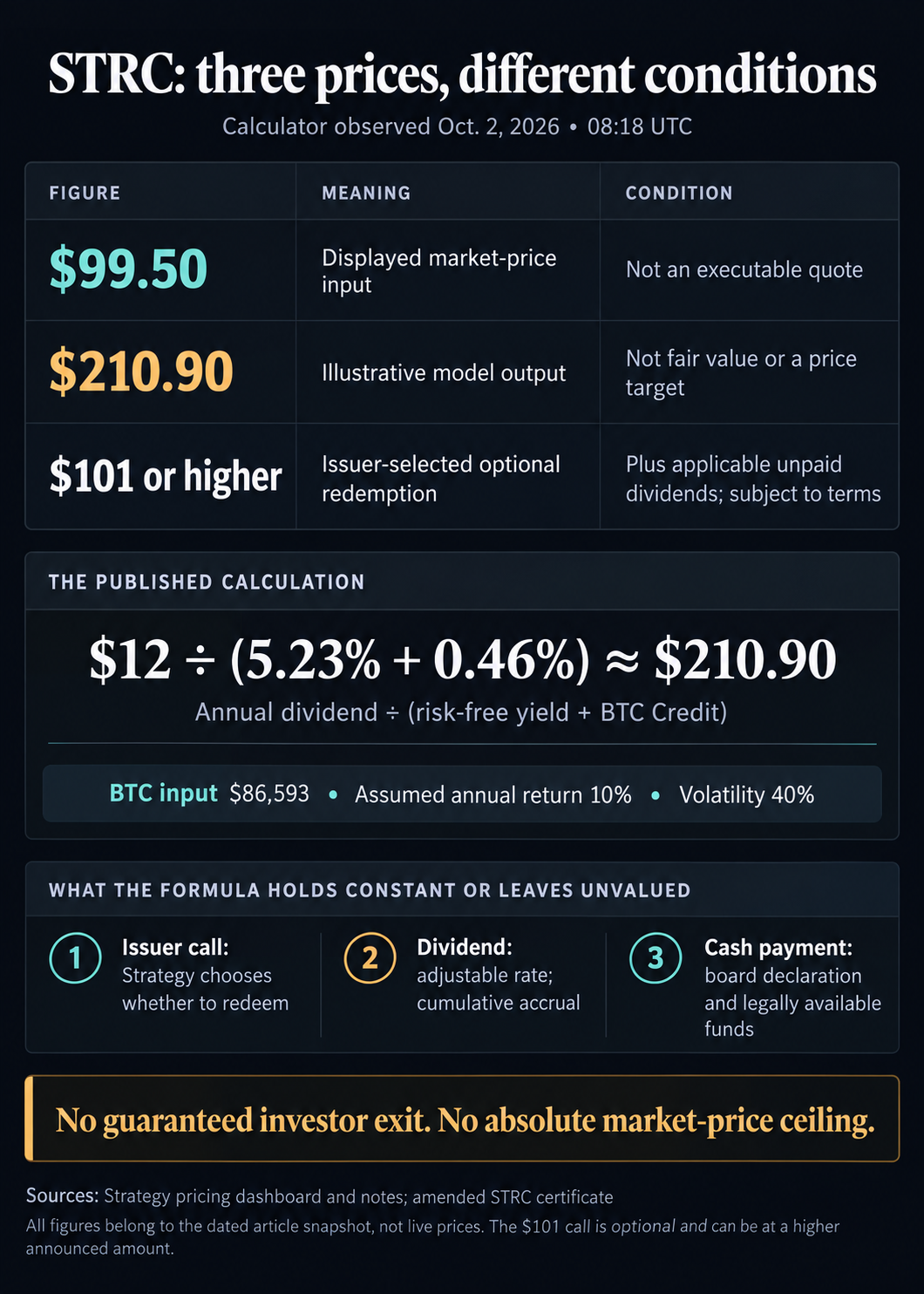
Strategy’s Bitcoin credit calculator produced an illustrative STRC price of $210.90 on Oct. 2, while displaying a market-price input of $99.50 for the perpetual preferred stock. The issuer also retains the option to redeem shares at $101, or a higher amount it chooses, plus applicable unpaid dividends.
That gap exposes the limits of the calculation. The published formula holds the current dividend constant and replaces the market’s credit spread with a modeled Bitcoin spread. It contains no explicit valuation of the issuer’s call option or a path for future dividend resets. Strategy’s pricing dashboard separately discloses those features and warns that the call can make Derived Price diverge substantially from realizable market prices.
For buyers, the calculation is a view of the security under selected assumptions. It does not establish that STRC is worth more than twice its displayed market price, or that a holder can collect either the model output or the redemption amount on demand.
How the calculator reaches $210.90
At approximately 08:18 UTC on Oct. 2, the dashboard used a Bitcoin price input of $86,593, an assumed annual return of 10% and volatility of 40%. Its STRC row showed a 12.06% effective yield, a 5.23% risk-free yield and 46 basis points of BTC Credit, Strategy’s modeled credit spread.
The published pricing formula divides the annual dividend by the sum of the risk-free yield and BTC Credit. Using a $12 annual dividend and the displayed inputs gives:
$12 ÷ (5.23% + 0.46%) ≈ $210.90.
The arithmetic reproduces the rounded output. The row’s market spread, the extra yield above the risk-free rate represented by the displayed market price, was 684 basis points. BTC Credit is the model’s estimate of that credit spread. Substituting 46 basis points for the much larger market spread lowers the formula’s discount rate and raises its output. Rounded yield inputs need not reproduce the displayed market spread exactly.
The formula makes the economic mechanism visible. Holding other inputs constant, a larger dividend raises the numerator, while a smaller modeled spread lowers the denominator. Keeping a high current dividend and using a much smaller spread can produce a large illustrative price without any change to the rights holders actually own.
Strategy expressly says the output is neither a fair-value determination nor a price target. Its assumptions include full scheduled payments and a simplified treatment of Bitcoin coverage and claims. The dashboard also warns that displayed market prices can be stale and are not executable quotes. The numbers are a dated snapshot, with Bitcoin-linked model inputs capable of changing after observation.
The output therefore cannot identify why the market price differs from the calculation. Issuer options, payment risk, trading conditions and the model’s assumptions all affect the comparison; the entire gap cannot be assigned to the call right.
Under STRC’s amended certificate of designations, Strategy can elect optional redemption at $101 per share or a higher amount it announces. Applicable accumulated unpaid dividends and compounding are added, with adjustments for declared dividends payable separately to record holders.
A partial optional redemption must leave at least $250 million of stated amount outstanding and uncalled when notice is provided. The redemption date follows the notice by between three business days and 60 calendar days. These terms govern an issuer action, rather than an ordinary holder right to cash out.
If Strategy exercises the option, the holder receives the contractual redemption payment instead of continuing to own the dividend-paying share. That possibility matters when reading a calculation that capitalizes the current dividend without explicitly valuing a call.
But the $101 figure neither promises a redemption nor imposes an absolute secondary-market price ceiling. Strategy can choose not to call, and the certificate permits a higher announced amount. A buyer also cannot assume the company will redeem merely because STRC trades below that level.
The three prices describe different things: $99.50 is the dashboard’s market input, $210.90 is an assumption-driven output, and $101 plus applicable dividends is a potential issuer-selected redemption payment. Each comes with different conditions.
The numerator is adjustable too. STRC’s current rate does not promise the same cash income indefinitely.
For each monthly reference period, ordinary rate reductions are constrained by a 25-basis-point allowance plus specified declines in one-month term SOFR, a SOFR floor and conditions covering prior accumulated dividends. Those dividends must be paid, or fully declared with sufficient consideration set aside. The restrictions limit discretion; they do not remove it.
STRC dividends accumulate cumulatively. Cash payment still requires board declaration and legally available funds. An accumulated entitlement and cash received on a particular date are different considerations for someone relying on the income.
The payment calendar has already changed from the monthly schedule described in the July 2025 offering announcement. The amended certificate effective June 30, 2026, established twice-monthly payments, while retaining monthly reference periods for rate resets.
Strategy’s Oct. 1 filing reports that its Sept. 30 action maintained the 12% annual rate for periods beginning Oct. 16 and declared a $0.50 payment for the semi-monthly period ending Oct. 31.
The daily-dividend proposal awaits an Oct. 28 shareholder vote. If approved and adopted on time, with dividends declared by the board, the planned first daily record date is Nov. 1 and first payment Nov. 2. Payments would follow record dates on the next business day.
More frequent payments would change when income arrives. They would not create a daily redemption right, lock in the dividend rate or guarantee principal stability.
Bitcoin coverage does not replace dollar capacity
Strategy’s Bitcoin holdings and its cash-payment resources answer separate questions. Bitcoin coverage concerns assets relative to claims under the model’s assumptions. Dividends payable in dollars require dollar capacity when payment comes due.
In its Sept. 28 reserve update, Strategy reported a $5.02 billion USD Reserve and a separate $1.00 billion USD Cash balance as of Sept. 27. The reserve supports preferred dividends and debt interest; USD Cash serves broader treasury and capital-allocation purposes.
During Sept. 21–27, the company used $22.1 million of the reserve for preferred dividends and $48.1 million of USD Cash to help fund STRC repurchases. Those are dated balances and uses, rather than a guarantee of future payment coverage. The broader cash pool should not be treated as interchangeable with the designated reserve.
Claim priority also matters. Debt and STRF sit above STRC, while STRK, STRE and STRD are junior preferred claims. Bitcoin is not pledged directly to STRC holders, and additional senior claims or other liabilities can affect the assets available to them.
Michael Saylor’s Sept. 29 explanation of digital credit describes Bitcoin capital and dollar liquidity as distinct parts of the structure. He presents reserve management, financing and discretionary repurchases as tools, while stating that repurchases do not guarantee a price floor. Those are management choices and objectives, rather than assurances embedded in the calculator.
Earlier CryptoSlate coverage examined third-party dividend-durability modeling and Strategy’s buyback allocation. The issuer’s own price formula adds a narrower question: how much can buyers learn from replacing one spread while holding other inputs constant?
The answer is bounded by what the formula includes. Changes in the declared rate alter the income being capitalized; a call changes how long a holder owns that income stream; reserve decisions and senior claims affect payment capacity. At the Oct. 2 snapshot, the calculator’s large gap to the displayed market price resolved none of those contractual and payment questions.
Source: CryptoSlate