



FILTERED RESULTS
FILTERS
MCap $2.8T +0.6%24h Vol $62.9B +21%Fear & Greed 69/100Alts Index 57/100
BTC.D 59.7% -0.1%Stable.D 9.3% -0.1%ETH.D 11.1% +0.1%Others.D 19.9% +0.1%
W$0.0301+71.24%•RSR$0.00239604+49.16%•CKB$0.00200265+39.29%•S$0.0591+24.67%•ZRO$2.421+22.3%•GRASS$0.8076+19.64%•PLUME$0.0222+15.81%•CARDS$0.3172+15.25%•VVV$25.154+13.26%•FIL$1.239+12.55%•
APEPE$0.00000129-11.27%•BP$1.115-9.2%•CFX$0.0638-7.85%•KAIA$0.0497-7.63%•DRV$0.5065-7.49%•STRK$0.1037-7.25%•Q$0.0289-6.99%•AKE$0.0261-4.53%•ORCA$2.328-3.54%•NEO$2.588-3.16%•
•
·
·
FILTERED RESULTS
Bitcoin Price is $4K Away From Wiping out the Next Wave of Shorts
Ledger Confirms Hardware Implant Attack, Says Its Systems…
Bitcoin ETFs Return to Inflows on October 9, but Ethereum…
CZ Outlined the Key Rules for Safely Storing Cryptocurrencies
Trader bought STONK two months ago, still holds a $617,800 position after partial cash-out, with a 21x return
Genesis Digital Assets to Transition into AI Data Center Following Major Investment
ENS Labs Proposes Transition to ENSv2, Halting New ENSv1 Registrations
ENSv2 Activation Proposal Aims to Stop New ENSv1 Registrations
The US Department of Justice Has Launched a Review of Binance for Potential Violations of Its $4.3B Settlement Agreement
Bitwise CIO Matt Hougan’s Top 4 Altcoin Picks for Long-Term Growth
DATA Network Moves to Sui With $30M Foundation Investment
Filecoin (FIL) Price Gains 15% Ahead of Largest Supply Reduction
Ledger wallet implant exposes a gap in its authenticity check
France Backs Stablecoin Swap and Crypto Exit Taxes, Then Rejects the Budget
XRP Ledger Fixes Decade-Old Bug That Could Have Minted…
Papertrade Faces BBO Price-Manipulation Allegations…
Pando Finance is set to list its Solana ETF on Hong Kong Stock Exchange on Oct. 13,
Ethereum Foundation-Linked Wallets Send Another 4,393 ETH…
Ethereum Price Jumps Above $2,500 as $48 Million ETH Gets Liquidated
Film Hurricane Founder Unveils Innovative Text-Based Virtual Environment Model
Global watchdog flags stablecoin risks, AI threats ahead of G20
South Korea’s Jeonbuk Bank Launches First Bitcoin-Backed Corporate Loans
Binance to List ZCS and Other USDT-Margined TradFi Perpetual Contracts
Why the USSR Stopped Drilling at 12,262 Meters Came Down to an Unexpected Limit
UK Freezes Assets of Taizi Group Financial Officer Amid Fraud Investigation
Stock Market Today [LIVE] : KOSPI Stock Crash
Bitcoin Price Today: BTC Back Above $84K as ETF Selling Eases and Shorts Unwind
Cambodian Prince Group Treasurer Li Tian's RMB 170 Million London Mansion and Luxury Watches Frozen by UK
Stock Market Crash Warning as Valuations Echo the Dot-Com Bubble
French lawmakers have backed a proposal that would require holders of self-custodied...
Solana Policy Institute President Warns of Long-lasting Crypto Regulations
Hong Kong to List Second Solana Spot ETF on October 13
BTC falls below $84,000, up 0.11% on the day
SWI Group Raises €800M to Turn FTX-Backed Bitcoin Miner Genesis Digital Into AI Data Centres
This Week in Crypto Law (October 11, 2026)
3iQ Secures In-Principle Approval for Category 4 License in Abu Dhabi
CreditEase-related companies under investigation for suspected illegal activities, Beijing Chaoyang police file case
DATA Network to migrate to Sui, retire own chain
Pando Finance Launches Second Solana ETF on Hong Kong Stock Exchange
$RSR listed on Upbit spot (KRW)・
Senate Democrat Presses Cantor Fitzgerald Over Its $10 Billion Tether Stake
UPBIT Lists Reserve Rights (RSR) with KRW and USDT Trading Support
Yushu Technology Founder Reflects on AI's Potential at China International Industry Fair
110,000,000 $USDT (109,925,200 USD) transferred from Tether Treasury to #Bitfinex...
Tampered Ledgers Reported in Europe as CZ Says Hackers Bought the Reseller
Billionaire investor Adam Weitsman said he bought 117 Pudgy Penguins over weekend to
Billionaire Adam Weitsman Acquires 117 Pudgy Penguins Amid Collection's Challenges
Bitcoin shrugs off ETF outflows to trade above $84,000 as oil falls
French lawmakers back reporting rule for crypto wallets over $112K
CFTC's Caroline Pham Advocates for Broad Regulatory Authority Over Commodities
Wuwen Xinqiong Secures 2.3 Billion Yuan in Series C Financing
Recruiters Flag a Worrying Interview Trend as Gallup Puts Engagement at 23%
Crypto Week Ahead: CPI, Evernorth’s XRPN Nasdaq Debut, US Bank Earnings
Star Xu: Hyperliquid's Matching Engine Is More Market Maker Friendly OKX founder Star Xu @star_okx...
Analyst: Bitcoin weekly close above $83,000, bulls still in control
Maelstrom CIO Arthur Hayes said his new project, FLOP, will launch its testnet in a few
Samsung Electronics Develops New zNAND Models for AI Storage Solutions
Spot Bitcoin ETFs Saw $681 Million in Net Outflows Last Week; Spot Ethereum ETFs Recorded $542...
HYPE Spot ETF Saw Net Outflows of $9.4269 Million Last Week
XRP Spot ETF Sees Net Inflow of $11.3068 Million Last Week
Ethereum spot ETFs saw $542 million in net outflows last week, with BlackRock's ETHA leading at $477 million
Three Consecutive Weeks of Net Inflows Come to an End, Bitcoin Spot ETFs See $681 Million in Net Outflows Last Week
Jeonbuk Bank Introduces South Korea's First Bitcoin-Backed Loans for Corporations
NEW: South Korea's Jeonbuk Bank has started offering bitcoin-backed loans, according to Edaily
Bitcoin’s Security Faces a 76% Risk by 2046, AI Model Predicts
The newly created wallet 0x1389 withdrew another 600,007 $UNI ($4.61M) from #Binance an hour...
New wallet withdrew about 600,000 UNI worth $4.61 million from Binance an hour ago
Tencent to Launch "Yuanbao Assistant" App
Binance Launches KGST/USDT Zero Trading Fee Campaign (2026-10-14)At Binance, we regularly review our...
Aave’s USDG rollover plan has a yield below most quoted borrowing rates


Aave’s proposed USDG rollover would let borrowers carry their stablecoin debt into a new fixed-yield USDG position, but the replacement collateral currently yields less than three quoted borrowing rates. That leaves leverage and separately administered rewards central to whether extending the trade makes financial sense.
The proposal concerns Pendle principal tokens, or PTs, on the X Layer network: holders of the token maturing Oct. 29 would move into a replacement maturing Feb. 25, 2027. In its Oct. 8 assessment, risk provider LlamaRisk said the February token’s on-chain yield alone fell short of USDT0, USDC and USDG borrowing costs. GHO was the cheaper exception in that assessment’s Oct. 7 snapshot.
TokenLogic’s proposal would enable a flash-loan transaction that temporarily repays debt, replaces the old PT collateral, borrows again and repays the flash loan. OKX would develop that integration separately. The Aave listing and separate OKX integration would both need to be implemented.
An Oct. 10 refresh preserves the gap. Pendle’s market API reported a February PT implied annual percentage yield of about 2.98%, with data updated at 21:09 UTC. Aave’s X Layer market display, retrieved at 21:11 UTC, showed variable borrowing APYs of 4.12% for USDT0, 5.87% for USDC and 3.75% for USDG.
The readings show why transaction convenience and investment profitability are separate questions: a rollover can preserve access to borrowing while resetting the collateral’s yield at the new purchase price.
A Pendle PT is a discounted claim on an accounting asset at maturity. For this USDG market, LlamaRisk describes redemption as one PT for one USDG. The purchase discount determines the return from holding to maturity, while ordinary PT holders give up the underlying variable yield and points to the corresponding yield token, or YT, under Pendle’s mechanics.
Borrowing to buy more PT increases exposure to that discount. The strategy earns positive incremental carry when the acquired PT return exceeds its financing cost. When borrowing costs exceed the asset’s return, each additional borrowed increment reduces the position’s return before rewards and costs.
That relationship looked different in LlamaRisk’s August review. Using Aug. 18 data for the October maturity, it quoted a 3.19% PT yield against borrowing rates of 0.45% for GHO, 1.37% for USDT0 and 2.69% for USDG. The review described positive carry.
The Oct. 7 snapshot for the February replacement quoted a 2.79% PT yield against 4.48% USDT0, 4.10% USDC and 3.67% USDG borrowing rates. GHO, at 0.93%, still borrowed below the PT yield. The comparisons span different maturities; existing October PT holders retain their original purchase yield.
There is also a distinction between a quoted funding comparison and an allowed borrowing route. LlamaRisk’s recommended new Aave borrowing category, E-Mode 9, lists USDT0, GHO and USDC as borrowable assets. USDG is absent from that proposed list, so its rate provides a cost comparison rather than proof of eligibility for the February configuration.
How leverage and rewards change returns
The 2.98% annualized PT yield corresponds to about 1.11% gross appreciation over the roughly 137.1 days from the Oct. 10 snapshot to Feb. 25. The annual figure should not be mistaken for the cash return available over that shorter holding period.
A standalone PT-and-debt illustration shows how leverage changes the outcome. It holds the displayed borrowing APYs constant through maturity, excludes rewards, transaction costs and retained YT, and assumes no rebalancing. Two times exposure means assets equal twice starting equity and debt equals that equity; five times exposure means debt equals four times starting equity.
Using the APY convention in Pendle’s calculation documentation, the illustration converts each annualized rate into a return over the same holding period. It then subtracts the debt’s interest cost from the PT position’s appreciation.
| Funding comparison | Borrow APY, Oct. 10 | Return on equity at 2x exposure | Return on equity at 5x exposure |
|---|---|---|---|
| USDT0 | 4.12% | +0.69% | -0.56% |
| USDC | 5.87% | +0.05% | -3.11% |
| USDG, comparator only | 3.75% | +0.83% | -0.02% |
The table shows illustrative total returns through Feb. 25. Without borrowing, the same PT position earns about 1.11% before costs. At two times exposure, the return on the investor’s own capital can still cover the negative spread on the borrowed portion. At five times exposure, financing consumes more than the gross PT gain in all three examples.
Actual borrowing rates can change throughout the holding period. Actual purchase prices also determine effective PT yield, and the Oct. 8 assessment listed 0.05% taker fees for the February pool’s AMM and orderbook. Slippage, network fees and any applicable flash-loan charge further affect the transaction. A thin positive result can disappear after execution costs.
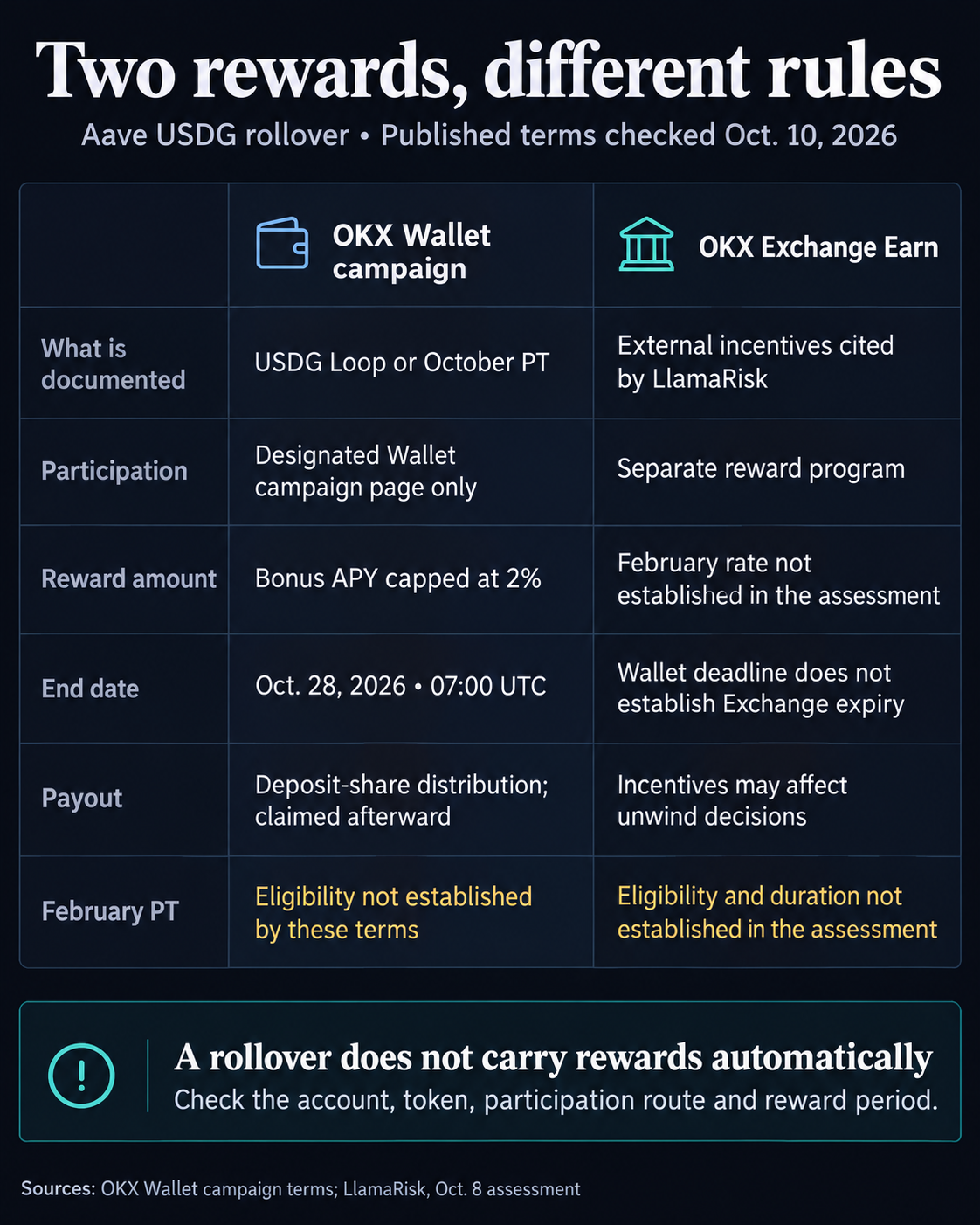
LlamaRisk attributes participating loop users’ profitability to external OKX Exchange Earn incentives. It also says an end to those incentives would likely encourage users to unwind.
The public OKX Wallet bonus announcement describes a separate program. It names USDG Loop or PT-USDG-29OCT2026 supplied to Aave through the designated Wallet campaign page, with bonus APY capped at 2%. Transactions through Aave or other third-party websites do not qualify.
The Wallet campaign ends Oct. 28 at 15:00 UTC+8, or 07:00 UTC, with rewards claimable afterward. Distribution depends on eligible participants’ deposit shares, and the actual payout may be below the announced 490,000 USDT reward pool.
Those terms cover the October token. February reward eligibility and the separate Exchange Earn expiry require their own terms.
The standalone illustration also differs from an actual OKX Wallet product. Its Loop FAQ says PT Loop can leave YT separately in the user’s wallet, outside the displayed Loop position value. Those retained tokens, product rewards and execution costs must be included when assessing the wallet’s total return.
OKX Wallet’s FAQ also says a PT position does not automatically redeem, unwind, renew or roll over at maturity. PT promotional rewards stop then under those Wallet rules, and a new-term subscription depends on product availability.
Rollover limits and the October exit
LlamaRisk’s Oct. 8 recommendation also differs from the initial plan. It calls for new E-Mode 9, with a 91.48% loan-to-value limit, a 93.48% liquidation threshold and a 35 million PT supply cap. The existing E-Mode 7 threshold cited in the assessment is 94.66%. A position carried into the replacement configuration would therefore need to fit its recommended borrowing and liquidation limits if those parameters are implemented.
LlamaRisk reported 66.03 million October PT units supplied as collateral in its Oct. 8 review. The Aave display retrieved Oct. 10 showed 59.79 million October PT units supplied and $61.12 million of borrowing across the entire X Layer market. The borrowing figure covers the entire market, while the collateral figures cover October PT only.
A Sept. 9 borrower review reported 55.1 million USDT0 debt, representing 98.7% of the reviewed PT cohort’s debt, and a median health factor of 1.03 among top suppliers. That September snapshot shows how heavily the reviewed cohort relied on USDT0 and how little room its top suppliers had before liquidation.
The February pool had approximately $1.42 million of reported liquidity. A migration’s executable size depends on available quotes and acceptable slippage.
The proposed October PT loan-to-value reduction to zero after maturity concerns borrowing headroom. Under Aave’s liquidation mechanics, eligibility depends on health factor falling below one, with collateral value, debt and liquidation thresholds determining that factor.
The choice at the October maturity is consequently an economic one as well as an operational one. A borrower can preserve debt exposure through a supported migration only if the configuration and integration are available. Whether extending the position pays depends on the new entry price, actual funding costs, leverage and reward eligibility, rather than the ability to move collateral in one transaction.
Source: CryptoSlate