



FILTERED RESULTS
FILTERS
MCap $2.8T -0.8%24h Vol $43.5B -7.2%Fear & Greed 61/100Alts Index 55/100
BTC.D 59.8% +0.6%Stable.D 9.5% +0.1%ETH.D 11.0% +0.1%Others.D 19.7% -0.8%
STRK$0.1117+56.9%•CHIP$0.0669+28.43%•CFX$0.0654+27.55%•SENT$0.0240+22.12%•TIA$0.5833+19.87%•ZK$0.0160+14.68%•AERO$0.9799+14.51%•S$0.0480+12.24%•Q$0.0311+12.13%•币安人生$0.5906+10.64%•
CARDS$0.2752-9.46%•ORCA$2.353-9.05%•STONK$0.1363-7.7%•BR$0.4945-6.94%•KAIA$0.0533-5.27%•SAND$0.0649-5.25%•MET$0.4156-5.24%•SOON$0.3028-3.68%•RAY$2.322-3.48%•AAVE$166.76-3.46%•
•
·
·
FILTERED RESULTS
Ledger Probe Finds Hardware Implant as Reported Crypto…
Bitcoin $ BTC has a larger market cap than Bank of America and Bank of China...
Ledger Confirms Hardware Implant Attack, Says Its Systems Were Not Breached Ledger said an...
BitMine Completes $350 Million Stock Buyback, Largest in Crypto History
Tether Froze THORChain's USDT Without Warning, Then Reversed Three Hours Later
Experts Assessed Risk of AI-powered Crypto Wallet Hacks
Viral Altcoin Defies Market Slumber With 53% Surge, BTC Calms at $83K: Weekend Watch
CITIC Securities: High earnings growth in US stocks may no longer be concentrated only in leading tech companies
Bitfinex Sees Surge in Ethereum Long Positions to Four-Year High
Papertrade Faces Allegations of BBO Price Manipulation on HyperEVM X user @Dr_bobo54 alleged that...
Ledger Incident Attacker Transfers 2,990 ETH into Tornado Cash
A 1960 Population Model Pegged Nov. 13, 2026 as ‘Doomsday’
Ledger Discovered Hardware Implant in User’s Device amid Investigation into Theft
Vitalik Buterin Highlights AI's Role in Accelerating Ethereum's Development
Microsoft CEO: The superintelligence era cannot rely on AI "black boxes"; external control and audit systems are needed
Analyst Warns of Potential Risks from Ledger Dealers Following Security Incident
COLDCARD Issues Warning About Phishing Attempt on Official X Account
CFX Cryptocurrency Surges Over 35% in 24 Hours
Ethereum's 24-hour trading volume overtakes Bitcoin, market speculates link to PaperTrade
South Korea's AI stock frenzy cools: trading volume plunges 70% from May peak, foreign investors accelerate exit
US Treasury Secretary Bessent Rebuts Warren: Treasury Buyback Program Is Not "Unprecedented"
Crypto Inflows Reach $50 Billion as JPMorgan Flags Building Q4 Momentum
Weekly: Elon Musk Tops $1T, USDC Lands in Samsung, $1B Probe into Chinese Syndicate, and AI’s Threat to Cryptography
A Bitcoin address dormant for nearly 16 years has been reactivated, holding 0.05 BTC
A dormant address containing 0.05 $BTC (4,152 USD) has just been activated after 15.9...
Argentina's Central Bank Reaffirms Crypto Ban, Says Economic Fragility Insufficient to Support Integrating Crypto Assets into the Banking System
Argentina’s Central Bank Rejects Near-Term Crypto Banking Integration
China’s Gold Buying Spree Accelerates as Central Banks Keep Stockpiling Bullion
Bitcoin companies are learning that holding forever takes cash
LUMIA has surged 100% recently.6 wallets opened 3x longs on a total of 11.7M $LUMIA ($1.9M) on...
TOKEN2049 will hold its first conference in the US in June 2027.
CFTC proposals aimed at separating prediction markets from casino gambling
COLDCARD Reports Phishing Incident Linked to Official X Account
135,000,000 $USDT (134,951,400 USD) transferred from unknown wallet to #Spark...
JPMorgan Plans to Double European Assets Under Management to $2 Trillion Within Five Years
220,000,000 $USDT (219,909,800 USD) transferred from unknown wallet to unknown...
US Moves to Seize $1 Billion in Iran Crypto: 'We Know Where It Is'
101,980,745 $USDT (101,950,864 USD) transferred from #Aave to unknown wallet...
Bubblemaps Estimates Crypto Influencer Ethan Made $125K Through 49 Token CalloutsBlockchain...
US Treasury Secretary Defended Government Bond Buyback Program
Fake Ledger websites and Google ads target recovery phrases as researchers probe suspected $86M...
Crypto Influencer Allegedly Profited $125,000 from Token Promotions
Chinese Communist Party Calls for a National Blockchain Network
South Korean stock market turnover has plunged 70% from its late-May peak
Bitcoin Price Under Pressure as Houthis Attack Saudi Arabia and Trump Signals US Involvement
BTC, ETH, XRP Crash Sparks Whale Accumulation as Buy Signals Appear
Microsoft CEO: Enterprises should treat AI models as potential insider threats and build an "emergency brake" system to prevent agents from going out of control
Russia classifies crypto miners under the fourth power supply reliability category, allowing authorities to cut power at any time without negotiation
SpaceXAI renamed to SpaceXSI, official account now shows "SpaceX Super Intelligence"
Stephen Hawking’s Warning That AI Amplifies the Illusion of Knowledge
Risk of Price Manipulation Identified in PaperTrade Documentation
Michael Saylor :AI will amplify the scarcity of premium assetsIn a September 28, 2026 Binance...
ETH falls below $2,500, down 0.48% on the day
USDC circulating supply decreased by about 800 million over the past 7 days
Musk Sees SpaceX Worth Far More Than Earth’s Economy; Saylor Is Bullish
US government's crypto holdings shrink by $16 billion from peak a year ago
250,000,000 $USDC (250,062,000 USD) minted at USDC Treasury...
Bitcoin Drawdown Analysis Maps a $74,500 Level if Losses Deepen
Whale withdraws 26,070 ZEC worth $31.93 million from Binance and Kraken
A trader created a new wallet to go 3x long on STRK, currently sitting on $1.05 million in unrealized profit
This guy made over $1M in less than a day!He created a new wallet yesterday and opened a 3x long on...
Pump.fun co-founder: Callout Rewards program to be adjusted, lowering weight of low-cap tokens and de-emphasizing trading volume
Papertrade Achieves Over 57.3 Billion USD in Transaction Volume
Filecoin Approaches Completion of Six-Year Vesting Period
Filecoin Set to Reduce Token Issuance by 75% as Vesting Schedule Ends
Patricio Worthalter(@worthalter) deposited another 4,000 $ETH($10.02M) into #Gemini 8 hours...
Arthur Hayes Sees Mega Crypto Bull Run Beyond AI Encryption Fears
STRK Reaches New Annual High, Surpassing 0.1 USD
Malaysian man's crypto wallet hacked, losing about $3.05 million in crypto assets
AI discovers XRP Ledger flaw that could mint 18 trillion tokens and put $94 billion market at risk


The decade-old vulnerability escaped years of security reviews and forced XRP Ledger
(XRPL) developers to bypass established governance procedures.
An AI agent uncovered a decade-old XRPL bug that could create trillions of XRP, prompting an emergency fix.
The vulnerability could have let an attacker generate about 18 trillion XRP through a single payment transaction, roughly 180 times the cryptocurrency's original 100 billion token supply, according to security firm Veria Labs.
Veria founder Cayden Liao said the flaw potentially threatened XRP's $94 billion market capitalization by undermining the cryptocurrency's fixed supply.
The vulnerability was reported on Sept. 22 and patched three days later. RippleX later confirmed that no unauthorized XRP was created, no funds were lost, and investigators found no evidence of exploitation on public networks. The incident was publicly disclosed on Oct. 9.
AI uncovers two interconnected flaws that survived a decade of audits
The discovery emerged from Veria's AI-powered security system, which analyzed rippled, the software underpinning XRPL, and identified two weaknesses that could be combined to bypass its monetary safeguards.
The first involved an integer overflow in the payment engine, where deliberately constructed trading offers could cause the system to miscalculate the amount a buyer owed.
Under the exploit, sellers would receive their full XRP payments while the buyer would be charged only a fraction of the actual amount. The difference would effectively create XRP that had never existed.
A second vulnerability affected the network's supply-protection mechanism. Because it relied on the same flawed arithmetic, it could fail to recognize that new XRP had been created.
The attacker would need to prepare hundreds of accounts and trading offers before submitting the payment. According to the official vulnerability report, the attack required only a few hundred XRP in largely refundable reserves and ordinary transaction fees.
The underlying payment-engine code dates to 2015, while the affected supply safeguard was introduced in 2017.
That longevity is particularly significant given the network's security history.
Liao said the XRPL codebase had undergone more than a dozen audits and security contests since 2024, including one competition with a $550,000 prize pool. Its bug bounty programs had also distributed more than $1 million.
Despite those efforts, the combined vulnerability remained undetected until Veria's AI system identified it, assembled a working exploit, and demonstrated the problem on a local network.
RippleX engineers independently reproduced the exploit and confirmed that the newly generated XRP could be spent in subsequent transactions.
Veria received a $250,000 bounty, the program's maximum. Liao described it as the largest known reward for a vulnerability discovered entirely by an AI agent.
Emergency fix bypasses decade-old governance procedures
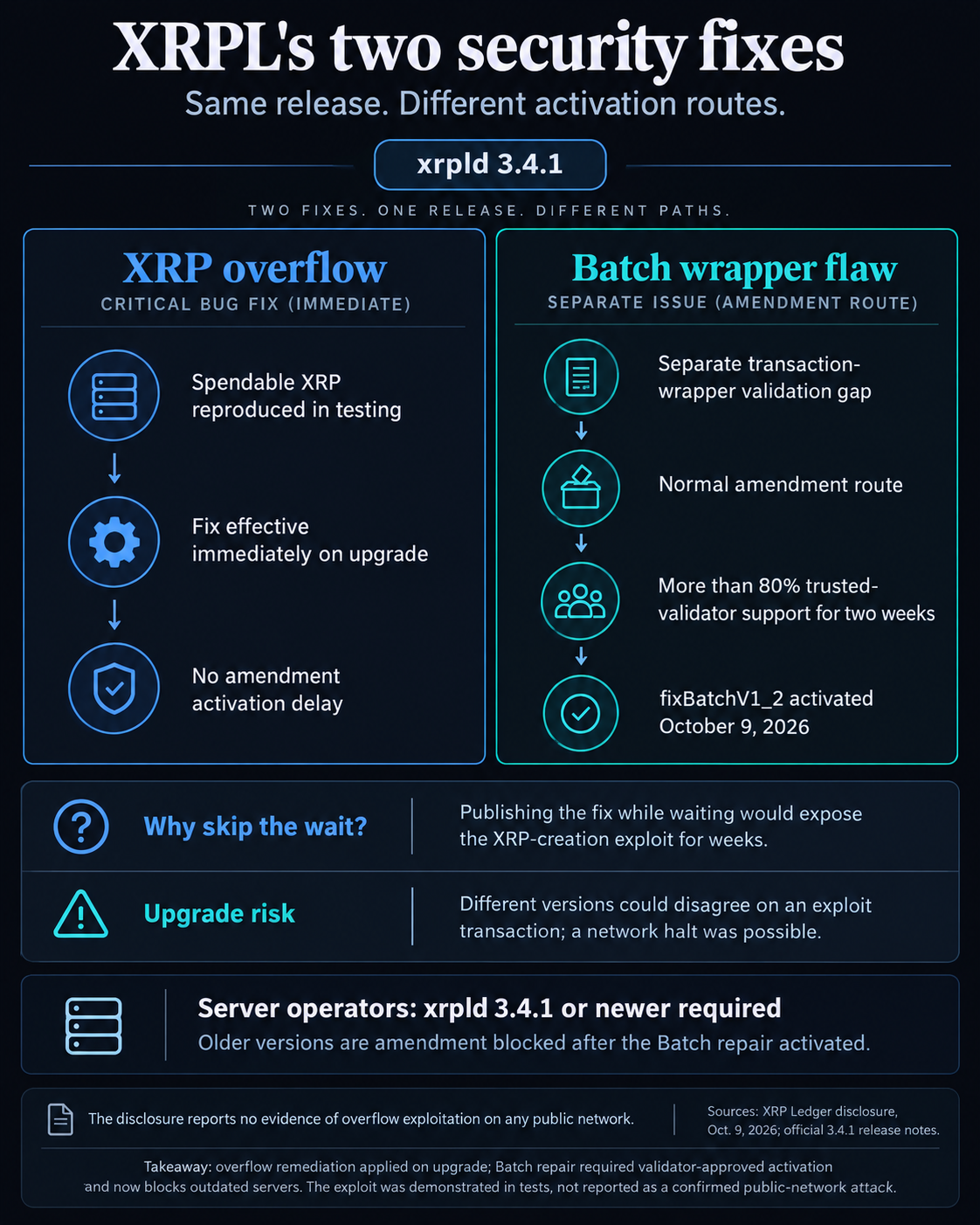
The severity of the discovery forced XRPL developers into an unusual decision: deploy a protocol-changing fix without waiting for the network's established amendment process.
Ordinarily, changes to transaction-processing rules require support from more than 80% of trusted validators for two consecutive weeks before activation.
However, developers determined that following this procedure would leave the vulnerability exposed while the network voted on its repair.
Because XRPL software is open source, publishing the fix could also reveal the exploit to potential attackers before the protection became effective.
Instead, RippleX, the XRP Ledger Foundation and validators coordinated an emergency upgrade that activated the protection immediately on servers running version 3.4.1.
The patch was initially distributed as binaries, temporarily withholding its source code to limit the risk of attackers reverse-engineering the vulnerability during deployment.
According to the disclosure, this marked the first deliberate bypass of the amendment activation process for a transaction-processing change in more than a decade.
The approach carried its own danger. Servers running different versions could disagree on whether an exploit transaction was valid, potentially disrupting consensus or halting the network.
Developers nevertheless concluded that a temporary network interruption was preferable to letting counterfeit XRP enter circulation.
More than 80% of validators on the default trusted-validator list had upgraded by Sept. 25, substantially reducing that risk.
XRPL Foundation contributor Vet said the coordinated response preserved network integrity and established version 3.4.1 as the new minimum software requirement following the activation of separate Batch-related amendments on Oct. 9.
RippleX turns to AI and formal verification after security scare
The incident has prompted RippleX to reassess how it protects critical infrastructure, particularly older software that has survived years of conventional security reviews.
J. Ayo Akinyele, RippleX's head of engineering, acknowledged that the vulnerability demonstrated the need to revisit longstanding assumptions about the network's design.
He outlined plans to expand AI-assisted vulnerability discovery, strengthen adversarial testing and increase scrutiny of legacy components, including the payment engine, consensus mechanisms and peer-to-peer networking.
The organization also plans to accelerate formal verification, a mathematical technique that proves whether software meets specific security properties.
That work will build on existing verification efforts involving XRPL's Lending Protocol and Single Asset Vault, alongside collaboration with CommonPrefix and the XRP Ledger Foundation.
Akinyele said AI is fundamentally accelerating vulnerability discovery, putting pressure on developers to find weaknesses before malicious actors deploy similar tools.
Vet echoed that concern, warning that increasingly capable AI systems could make previously obscure vulnerabilities easier to exploit.
The October 9 disclosure also introduced a specific procedural change: security findings previously classified as resolved must now be retested against release candidates before being formally closed.
Source: CryptoSlate