



FILTERED RESULTS
FILTERS
MCap $2.9T -0.7%24h Vol $105.7B -2.1%Fear & Greed 74/100Alts Index 53/100
BTC.D 59.0% +0.6%Stable.D 9.3% +0.1%ETH.D 11.5% +0.1%Others.D 20.2% -0.8%
STONK$0.2919+22.27%•NIGHT$0.0439+21.36%•CAP$0.0756+21.31%•STX$0.3822+19.81%•JASMY$0.00610677+18.34%•MON$0.0319+16.95%•VELO$0.00577998+12.51%•PROS$0.7374+9.37%•ZBCN$0.00271457+9%•KAIA$0.0365+7.4%•
AI$0.1811-13.33%•TIBBIR$0.2944-12.76%•BTW$1.158-11.27%•BR$0.7593-10.7%•BP$1.207-8.52%•QNT$277.29-7.84%•2Z$0.0587-7.6%•MET$0.2990-7.07%•ZRO$1.628-7.04%•GRASS$0.6744-7%•
•
·
·
FILTERED RESULTS
Bitwise Explained the Crypto Market’s Rise After the CLARITY Act Failed
Solana Reports Record Monthly App Revenue of $180 Million in September
Citigroup Upgrades Bitcoin Price Outlook to $113,000 Over Next 12 Months
September crypto public funding reached about $1.269 billion, up 71.1% month-over-month
MEXC Adds Another 1,000 BTC to Guardian Fund, Now Holding 100M USDT and 2,000 BTC
Micron Reported $14.1 Billion of NAND Sales. SanDisk Jumped…
Top Analyst Says XRP Could Outpace Ethereum’s ROI This Cycle
Why Sensex Crashed 1,000 Points Today: Foreign Selling, Oil Prices And IPO Rush Explained
XRP Price Prediction : How High Will XRP Price Go in October?
UK Crypto Firms Get Five Months to Apply Before FCA's 2027 Regime
Synthetic tokenized stocks are bad for American investors
Ripple quietly made Brazil the center of its XRPL tokenization push
Tokenized assets don’t always mirror traditional markets, Dune finds
EU Regulators Investigate Binance for Unlicensed Operations
NEW: Citi raised its 12-month bitcoin target to $113,000 from $82,000 and ether to $3,028 from
September crypto hack losses exceed $766 million, the highest single month of 2026
DogeOS Opens Public Testnet, Supporting EVM-Compatible App Development with Test DOGE
Peter Schiff Explained How New Economic Crisis Could Unfold
EIP-8363 co-author announces withdrawal of the proposal from consideration for the Hegotá upgrade
Bitcoin kicks off new quarter in the old $82,000-$85,000 price range
Bitcoin trapped below $86K as PCE changes cloud inflation reading
Two Dallas Men Arrested for Attempted Home Invasion Targeting Cryptocurrency Holders in San Jose
Two Dallas men were arrested over an attempted home invasion in San Jose, with police
Bitcoin Is Up, DeFi Is Recovering, So Why Doesn’t This Look Like a Bull Market Yet?
XRP price prediction at $1.49: $2.46 bull, $0.90 bear
New Perpetual Contract Listing: CTUSDT#Bybit #NewFinancialPlatform...
Ostium $23.75M Hack Recovery: 3,321 Wallets Repaid, 345 LPs Face $1,000 Choice
Hawley–Murphy AI Bill Targets Agent Hacking Liability as Crypto Risks Emerge
Bitcoin holds above $83K as rally on lower US inflation data fades
The mysterious whale who previously sold 167,855 $ETH ($408M) bought 3.125M $UNI ($24.2M) at an...
According to SoSoValue, US Bitcoin spot ETFs recorded a total net outflow of $149 million on...
Yann LeCun: AI Runaway Incidents Can Be Prevented Through Engineering Improvements; AMI Labs to Launch Its First Product Soon
Tokenized Credit Dominates Real-World Asset Lending in DeFi, Report Finds
Binance’s EU services face scrutiny over licensing exemption: Report
The MNT Puzzle Hunt is live! Trade, convert, DCA, and collect puzzle pieces for a share of...
Historical Trap Ahead? This Early November Event Could Derail Bitcoin’s Rally
NIGHT Explodes 26% While BTC Cools After Wild PCE Swing: Market Watch
XRP Open Interest on Binance Declines 15% from Recent Highs
XDC Network Price Prediction 2026, 2027 – 2030: Is XDC Price a Good Investment?
Asia's Next-Generation Wealthy Want AI for Payments, Humans for Planning and Crypto From Their Private Bank
Citigroup raises 12-month bitcoin target to $113,000 as ETF inflows resume
Stacks jumps 20% after Muneeb Ali is named CEO as the network expands its institutional Bitcoin...
Citi raises 12-month Bitcoin and Ethereum price targets to $113,000 and $3,028
Ethereum Staking Reward Burn Process Adjusted by Authors in Hegotá
1,297 $BTC (108,747,111 USD) transferred from unknown wallet to unknown wallet...
Binance extends USD1 airdrop campaign, with a total prize pool including 150 million WLFI and up to 2.5 million USD1
Losses From Cryptocurrency Hacks Hit $766M in September — PeckShield
MetaMask Exits Lido Validators Amid Infrastructure ‘Security Incident’
Thorchain Co-Founder: Neutral Networks Can’t Pick Who Can Transact
$CT listed on Bybit futures・
U.S. Court Dismisses Most Claims in Celsius vs. Chainalysis Case
STX Price Prediction 2026: The Two Forces Behind Stacks’ Bitcoin-Native Finance Demand
Lloyds Bank and Visa Complete ~$750,000 Stablecoin Cross-Border Settlement Pilot
Florida's payment stablecoin regulatory rules take effect today
Ministry of Public Security: Mainland and Hong Kong police jointly dismantle cross-border underground bank gang, arresting over 170 people
A SWIFT-Ripple Alliance? Why A Single Rumor Just Sent The XRP Community Into A Frenzy
Bitget Hacker Moves Stolen Zcash Into Private Pool — About…
Zcash holders approved $8.39 million in retroactive grants, including $1.5 million tied
Uranium Finance attack trial opens, prosecutors allege defendant exploited contract vulnerability to steal over $53 million
Cardano Lands AI Payment Integration as ADA Challenges Multi-Year Resistance
Chainalysis beats most Celsius claims, but ‘audit’ lawsuit survives
Michael Saylor Says Strategy Has No Fixed Target for Its Bitcoin HoldingsOn September 28, 2026,...
Bitcoin Whales Returned After Over 10 Years of Silence: In September, They Moved More Than 2,184 BTC
Bitcoin Enters Its Most Bullish Month After Massive Q3: Uptober or Redtober Next?
Solana’s $100 Support Wall Could Be Setting the Stage for a 10X Move
Korea is Moving its Stocks Onchain, Here’s What it Means
UPDATE: SBI Holdings has completed its acquisition of Japanese crypto exchange Bitbank, making it a
Chainlink Fulcrum Sets Out to Unlock Idle Institutional Collateral
EU Presses Binance Over ‘Reverse Solicitation’ Exemption for Users: Report
BIS shows why real institutional adoption on XRP Ledger won’t trigger the XRP supply squeeze holders expect


The Bank for International Settlements released a working paper on Sept. 2 describing a prototype for checking the authenticity of official statistics. The system turns a statistical file into a cryptographic fingerprint, anchors a summary of those fingerprints on XRP Ledger, and lets a recipient compare the file with the public record.
The result creates a split verdict for XRP. The prototype gives XRPL a credible institutional-style use case, while its batching design keeps the direct fee-burn pathway mechanically small. One ledger transaction can represent thousands of datasets, so useful activity can scale much faster than the number of transactions consuming XRP.
The research first appeared online through SAGE on Aug. 1; Sept. 2 marks its release as BIS Working Paper 1374. The paper presents the authors' views and says its references to firms and projects are illustrative. Its implementation remains an experimental XRPL DevNet proof of concept, and the reviewed sources disclose no commercial relationship with Ripple.
How the authentication system works
Official statistics commonly travel in SDMX, a standard for exchanging statistical data and metadata. The prototype normalizes an SDMX file and applies SHA3-512 hashing to the whole file or to individual data series. It then combines those fingerprints in a Merkle tree, a structure that compresses a large group of records into one summary value called a root.
The root is written into the memo field of an XRPL transaction. Underlying statistics and the prototype's operational stores and proofs stay off-chain. The returned SDMX file embeds the transaction reference, ordered fingerprints, and a signed verifiable credential, giving a recipient the material needed to rebuild the root and compare it with the ledger.
XRPL therefore serves as a timestamped public notary for the commitment. It does not serve as the database holding the economic figures. The open-source implementation describes itself as experimental, unsuitable for production, and unmaintained.
The authors selected XRPL for low nominal fees, fast consensus finality, and accessible developer resources. They also made the blockchain interface replaceable, so another ledger could perform the same anchoring role. That design choice makes the prototype evidence for the authentication method and for XRPL's ability to host it, rather than evidence that the method depends on XRP Ledger.
Performance results came from a single developer workstation connected to XRPL DevNet and using a synthetic SDMX corpus. In those controlled tests, median publication latency was three to five seconds and verification took one to two seconds. The evaluation excluded sustained Mainnet load, an enterprise firewall, hardware-security-module-backed signing, and adversarial conditions. DevNet uses test XRP with no real-world value, so the run produced technical measurements instead of live token demand.
Those boundaries still leave a meaningful result. A statistical publisher could provide an independent integrity check without exposing confidential data on a public ledger. The economic trade-off appears in the same mechanism: Merkle batching reduces the number of on-chain commitments needed to authenticate a large body of information.
The XRP value-capture math
XRPL's standard transaction cost normally starts at 10 drops, equal to 0.00001 XRP. When a transaction enters a validated ledger, its fee is destroyed. Network load can raise the cost, and special transaction types can carry different minimums, but the BIS paper uses 10 drops as its base case.
The fee scales with anchoring transactions, while dataset volume can be compressed into batches. The following arithmetic illustrates the gap under a constant 10-drop minimum and standard transactions:
| Activity pattern | Anchoring transactions | XRP burned |
|---|---|---|
| 1 million datasets, batched 1,000 per anchor | 1,000 | 0.01 XRP |
| 1 million individual anchors | 1,000,000 | 10 XRP |
| 1 anchor per minute for 365 days | 525,600 | 5.256 XRP |
| 1 anchor per second for 365 days | 31,536,000 | 315.36 XRP |
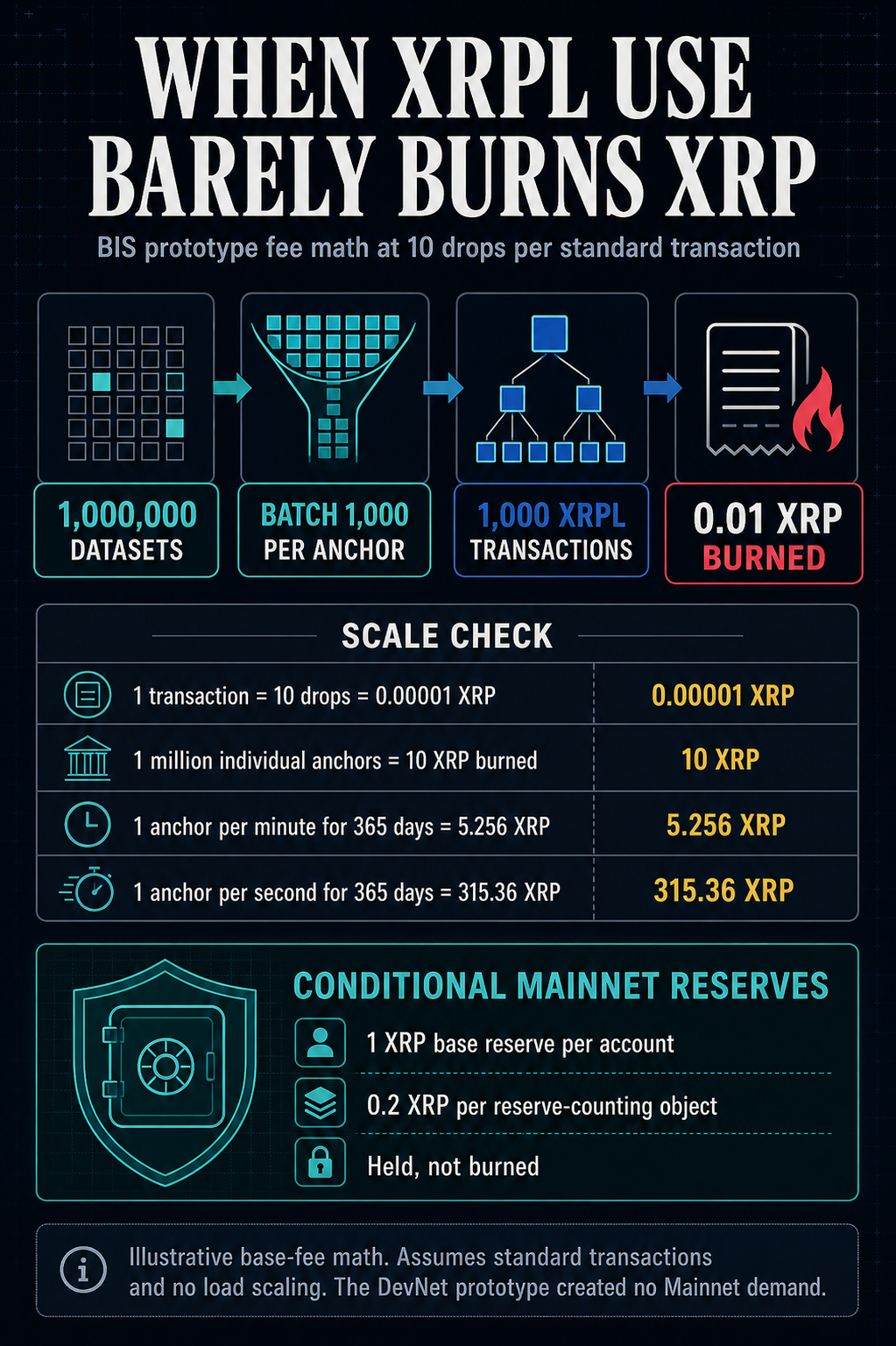
These are scale illustrations, not deployment forecasts. Actual burn would reflect how frequently publishers submit anchors, how many datasets they batch, prevailing network load, and the transaction type. The DevNet prototype generated none of this Mainnet demand.
The paper's cost model points in the same direction. It assumes a 10-drop fee and an illustrative price of $0.30 per XRP, which is a model input rather than a current quote. With a batch size of 1,000, the authors calculate an on-chain cost of $0.000000003 per dataset. Above roughly 50 items per batch, processing and raw storage dominate the chain and proof-storage costs in their examples.
Urgent releases can favor smaller batches because waiting for more datasets creates delay. Even then, the paper says XRPL's low nominal fee bounds the penalty. For XRP holders, this means production cadence matters more than the headline number of files or series authenticated.
Mainnet reserves create a second, conditional pathway. Under current XRPL reserve rules, each address must hold a 1 XRP base reserve, with another 0.2 XRP for every reserve-counting ledger object. The network holds those balances as prefunding; ordinary transaction fees are the XRP that gets destroyed.
Reserve demand grows when a deployment needs new accounts or ledger objects. A dataset does not carry its own reserve requirement, and repeated memo anchoring from an existing account does not lock another 1 XRP each time. Validator voting can also change the reserve levels. Production usage could therefore increase held XRP across many new institutional accounts, but the effect depends on deployment architecture rather than dataset throughput.
The paper supports a narrow value-capture conclusion. XRP would supply the fees and reserves for a Mainnet version, while Merkle batching deliberately compresses the recurring fee flow. Under the paper's assumptions and current fee mechanics, the direct burn channel stays small even as authenticated data volume rises.
XRP's market price can still respond to expectations, liquidity, and activity elsewhere on the network. Those forces sit outside this prototype. The BIS work establishes XRPL as a viable low-cost authentication layer under controlled conditions; material token demand would require sustained anchoring cadence, broad account creation, or other XRP-centered activity that the experiment did not demonstrate.
Source: CryptoSlate