



FILTERED RESULTS
FILTERS
MCap $2.9T +0.9%24h Vol $97.8B -9.4%Fear & Greed 74/100Alts Index 49/100
BTC.D 58.6% +0.2%Stable.D 9.1% -0.1%ETH.D 11.4% 0%Others.D 20.9% -0.1%
CAP$0.0855+27.56%•BP$1.487+23.22%•BTW$1.422+22.6%•MON$0.0349+21.31%•VELO$0.00622779+17.93%•JASMY$0.00564601+13.06%•PURR$0.1621+10.81%•SKY$0.0835+9.22%•ZRO$1.807+8.91%•KAIA$0.0371+8.85%•
STONK$0.2313-20.63%•AI$0.1487-17.91%•QNT$259.36-12.01%•SOON$0.4270-11.97%•NEAR$4.825-10.86%•TIBBIR$0.2716-7.85%•ZEC$1,308.80-7.7%•ENA$0.2449-7.53%•WLD$0.4923-7.38%•MARSCOIN$0.1266-7.29%•
•
·
·
FILTERED RESULTS
The Federal Reserve is No Longer Projected to Hike Interest Rates This Month
Shielded Labs Launches Epoch to Develop Post-Quantum Cryptography for Zcash
Bitcoin Leads Crypto ETF Inflows as September Ends With Outflows
In response to European Commission's MiCA review consultation, Hyperliquid
Derive V3 Wants to Be the Engine of Onchain Options
OPEN ANONYMITY PROJECT, CO-DEVELOPED BY ETHEREUM FOUNDATION, LAUNCH ZKAPI FOR PRIVATE API PAYMENTS...
Meta Pushes Back on Claim That Muse AI Read a User's Messages Without Consent
Congress Considers Expanding Crypto, Stablecoin Rules for Banks
Stablecoins Offset Decline in Chinese Treasury Holdings, Says San Francisco Fed
Citi Sets $113K Bitcoin Price Target, Expects $5 Billion in Crypto ETF Inflows
Illinois’s 0.2% Crypto Tax Slips to 1 July 2027…
Introducing zkAPI: private usage credits for any API
2,044 $BTC (173,800,505 USD) transferred from unknown wallet to unknown wallet...
Coinbase to Facilitate AERO and VELO Token Migration from November 2 to 4, 2026
Another Trump memecoin dinner advertised for token's top investors
The 'Largest Pure-Play' XRP Treasury Is About to Go Public
50,000 Europeans call on EU to ease stablecoin rewards restrictions in MiCA review
100,000,000 $USDC (100,041,000 USD) transferred from USDC Treasury to unknown wallet...
NEW: Cboe is considering listing perpetual futures tied to its Volatility Index oncere is
Alabama’s New Crypto ATM Scam Refund Requirements Take Effect
Circle Urges EU to Rework MiCA Stablecoin Reserve Requirements
phantom EXPANDS TO BNBCHAIN ...
100,000,000 $USDC (100,017,750 USD) minted at USDC Treasury...
NEAR Intents hacked days after freezing stolen Bitget funds
Cboe is considering listing perpetual futures tied to its Volatility Index oncere is
OpenAI Fires Three Safety Researchers Over Alleged Leak to Outside Group
The US is sending up to 10,000 more troops to the Middle East - WSJ...
Study Reveals 69% of Polymarket Retail Accounts Experience Losses
Illinois will postpone implementation of crypto tax following lawsuit
Quant (QNT) Could Explode to $2,000: Analyst Reveals the Critical Factor
XRP Is Coming to Nasdaq: Evernorth Clears Key Vote With 473M Treasury
CRS Examines What Crypto Activities U.S. Banks Can Conduct
UK’s 2027 crypto rules could block new business with existing customers
No-Fee Crypto Trading Platforms: Which Brokers Actually…
Crypto Hack Losses Reach $2.68 Billion in 2026 as September…
Bitcoin Price Begins ‘Uptober’ With a Swing Back to $85K
Ex-BlackRock VP Says Total Crypto Market Cap Could Hit $10 Trillion This Cycle
Trump accuses Iran of being behind the flydubai incident where a co-pilot stabbed the...
North Dakota Launches Roughrider Coin on Fiserv’s Digital Asset Platform
NEAR Protocol Surpasses Avalanche in Daily Decentralized Exchange Volume
Bitcoin Buyers Remove $85,000 Sell Wall, Potential for Price Increase
How to Publish and Sell a Crypto Ebook: Platforms, Pricing,…
US Judge Dismisses $LIBRA, $M3M3 Case Against Davis, Kelsier
President Trump says he now has to make a decision on Iran, adding that either Iran signs ...
Strategy has burned through 64% of its STRC rescue fund
NEARProtocol FLIPS avax IN 24H DEX VOLUME ...
Phantom Wallet Integrates BNB Chain for In-App Trading
OpenZeppelin and T-REX Network Launch New Framework for Token Regulation
Onchain Perpetual Contracts Narrow Execution Gap with Centralized Exchanges
Odds That Anthropic IPOs By The End Of November At 61%, As Sam Altman Says He "Doesn't Have A...
Coinbase CEO: Banks May Push For ‘CLARITY 2.0’ In A Few Years
Exclusive: Edo Farina Says Peter Brandt Ignores XRP’s 100 Billion Supply Cap In ‘Fool Coin’ Jab
BTC breaks above $85,000, up 0.99% on the day
New York and Wyoming Plan Joint Crypto Exams and…
Galaxy: 69.2% of Polymarket Retail Accounts Lose Money, With $338.9M in Aggregate LossesGalaxy...
Cboe Global Markets Considers Launching VIX Perpetual Futures
ETH breaks above $2,700, up 0.64% on the day
It's the Start of Uptober. Will Bitcoin Live Up to It?
New York and Wyoming Regulators Sign MOU to Coordinate Digital Asset Oversight
5,000,000 $UNI (44,910,003 USD) transferred from #Uniswap to Coinbase Institutional...
Bitcoin ETFs Lose $149M as Fidelity Leads Broad Selling
Illinois has agreed to a six-month delay of its controversial 0.2% crypto transaction
iTrustCapital Reports Increased Bitcoin Purchases Among Clients
Bloomberg Adds Allium-Powered Stablecoin Dashboard to Its Terminal
SEC Staff Issues New FAQs on Crypto Asset Classification
Crypto’s Tax Gray Areas: Congress Aims to Clarify and Refine Tax Rules for Digital Assets
Elder Abuse Law: What Families Should Know in 2026
Why Bitcoin Is Starting Q4 on Stronger Footing Than Traditional Markets
Altcoin Trading Volume Hits 4x Bitcoin as One Trader Says He’s Out
Bond yield explosion gives Bitcoin a strong signal – is now finally Satoshi’s time?


Bitcoin’s monetary case is growing stronger as governments face more expensive borrowing, and software is becoming a buyer of services. Sovereign financing pressure gives people a reason to consider money issued outside government policy. Agent commerce gives that money another way to circulate.
The Bank of England put sovereign-bond stress and the borrowing that finances artificial intelligence in the same warning on September 30. Its financial-stability record describes an extended energy shock pushing government yields higher, while growing AI-related debt leaves more investors exposed to the technology’s fortunes.
I see a credible catalyst for hyperbitcoinization in that combination. A transition toward Bitcoin as widely used money would require people and businesses to hold it, spend it and price services in it. If they retain bitcoin for future purchases, more payment utility could reinforce demand for the balance itself.
On the same day as the Bank’s warning, Mastercard announced new trust and intelligence services for its Agent Pay program, including a score designed to identify AI-initiated transactions. That score is rolling out for testing in the United States.
September’s developments bring a widening financial-risk debate together with an active race to serve software customers. Bitcoin has a route into that race through tools built earlier this year; established payment companies are preparing to serve the same buyers.
Higher yields sharpen Bitcoin’s argument and its competition
The pressure is visible in the cost of government borrowing. CryptoSlate’s 10-year Treasury series displays a September 30 daily par yield of 5.29%. The Fed’s September 30 release reports 5.26% for September 29. The observations describe different days and should be compared on that basis.
The policy backdrop is also tighter in important places. The Fed raised its target range by a quarter of a percentage point to 3.75%–4% on September 16, under Chair Kevin Warsh, who took office May 22. The Bank of Japan set its overnight call-rate guideline at around 1.25% on September 18, effective September 24.
The Bank of England held Bank Rate at 3.75% in its September 17 announcement, although three policymakers wanted an increase to 4%. Market yields can tighten financing conditions even when a central bank leaves its policy benchmark unchanged.
Higher yields create two competing effects for Bitcoin. They make the long-term cost of financing government debt more conspicuous, which can strengthen interest in money whose issuance is independent of a government’s borrowing needs. They also offer investors a higher contractual return for holding bonds, raising the hurdle for an asset that pays no native interest.
Investors still have to weigh a bond’s contractual income against inflation and their time horizon. Bitcoin’s capped supply governs how many coins can exist; demand determines their purchasing power. The tension between income and independently issued money already examined in CryptoSlate’s bond-market coverage remains central.
Bitcoin traded at roughly $83,530 near press time, after reaching both a new all-time high of $125,000 and a low of $57,500 over the last 12 months. That volatile price can reflect many sources of demand. The monetary argument has to stand on how people hold and use bitcoin as well as what they pay for it.
The same Bank assessment described a financial system that had remained resilient, with mostly gradual market adjustments. That is the backdrop for the bullish argument: financing pressures can make independent issuance more attractive even while existing institutions continue to function.
Satoshi Nakamoto’s whitepaper begins with electronic payments sent directly between parties without going through a financial institution. Its solution replaces a trusted intermediary’s double-spending checks with a peer-to-peer network and proof of work, subject to the design’s security assumptions.
Its design gives Bitcoin a different relationship with authority. Its issuance does not expand because a government needs to refinance debt or a central bank decides the economy needs additional support. Under the protocol’s existing rules, issuance moves toward a maximum of 21 million bitcoins.
Someone seeking money outside a particular issuer’s policy decisions can choose an asset with an independently verifiable supply rule. Market volatility and custody responsibility remain the cost of that choice.
Bitcoin cannot remove an energy shortage or make borrowed capital cheap. It can offer a monetary asset whose issuance is separate from the institutions managing those problems. Treating that property as valuable is a coherent position even when higher interest rates make the asset less attractive in the short term.
Agents give Bitcoin a practical route into commerce
An AI agent cannot hand over a banknote. It can request data, receive an invoice, authorize a payment and continue its task. For commerce to work, that transaction needs little overhead, clear spending authority and reliable settlement.
Bitcoin has concrete infrastructure for that pattern. In February, Lightning Labs released agent tools that let software pay for APIs through L402, a protocol combining Lightning payments with access credentials. An API can request payment, the agent pays a Lightning invoice, and payment unlocks the resource.
This gives Bitcoin utility beyond an investor buying and waiting. A software buyer can pay for a piece of data at the point it needs it, instead of having a person arrange another subscription. A service provider can charge for individual requests. Lightning supplies the payment layer that makes small, repeated Bitcoin transactions practical.
Lightning Labs also announced Wavelength in July, an alpha toolkit intended to make wallet integration easier for developers and agents. At launch, it was open on test networks with mainnet access by invitation. Broad commercial adoption would require developers and customers to put that infrastructure to use.
Security is a design requirement here. The documented tools use measures such as remote signing, restricted credentials and spending limits; Wavelength says wallet creation and unlock keep seeds and passwords outside the agent channel. Those controls can reduce what a model can expose or spend. Intelligence alone does not make an agent a safer custodian than a human.
An agent should receive enough authority to pay for its task without receiving unrestricted access to its owner’s savings. A useful machine economy needs bounded financial authority as much as it needs faster reasoning.
Software buyers already have several other ways to pay.
Google’s AP2 framework, announced in September 2025, supports cards, stablecoins and bank transfers, using signed mandates to record what a user authorized. Coinbase’s September 22 agent announcement adds equities trading and x402 micropayments for data, models and services within user-defined limits. Mastercard’s latest testing builds another path inside established payment relationships.
For an agent buying a dollar-priced service, a dollar-linked balance can simplify budgeting. A business paying expenses in dollars may prefer to receive dollars too. As CryptoSlate’s recent stablecoin coverage explored, the rise of software buyers can extend digital-dollar use rather than displace it.
Bitcoin’s distinctive opportunity lies in the users who value independently issued money and direct settlement enough to retain bitcoin between transactions. An agent that briefly converts a dollar balance into bitcoin to make a payment demonstrates useful infrastructure. An agent or business that earns, holds and spends bitcoin demonstrates a deeper monetary choice.
Those choices may coexist. Bitcoin could become more useful for saving and settlement while dollars remain common for pricing everyday services. That would be meaningful progress for Bitcoin without meeting the stronger definition of hyperbitcoinization.
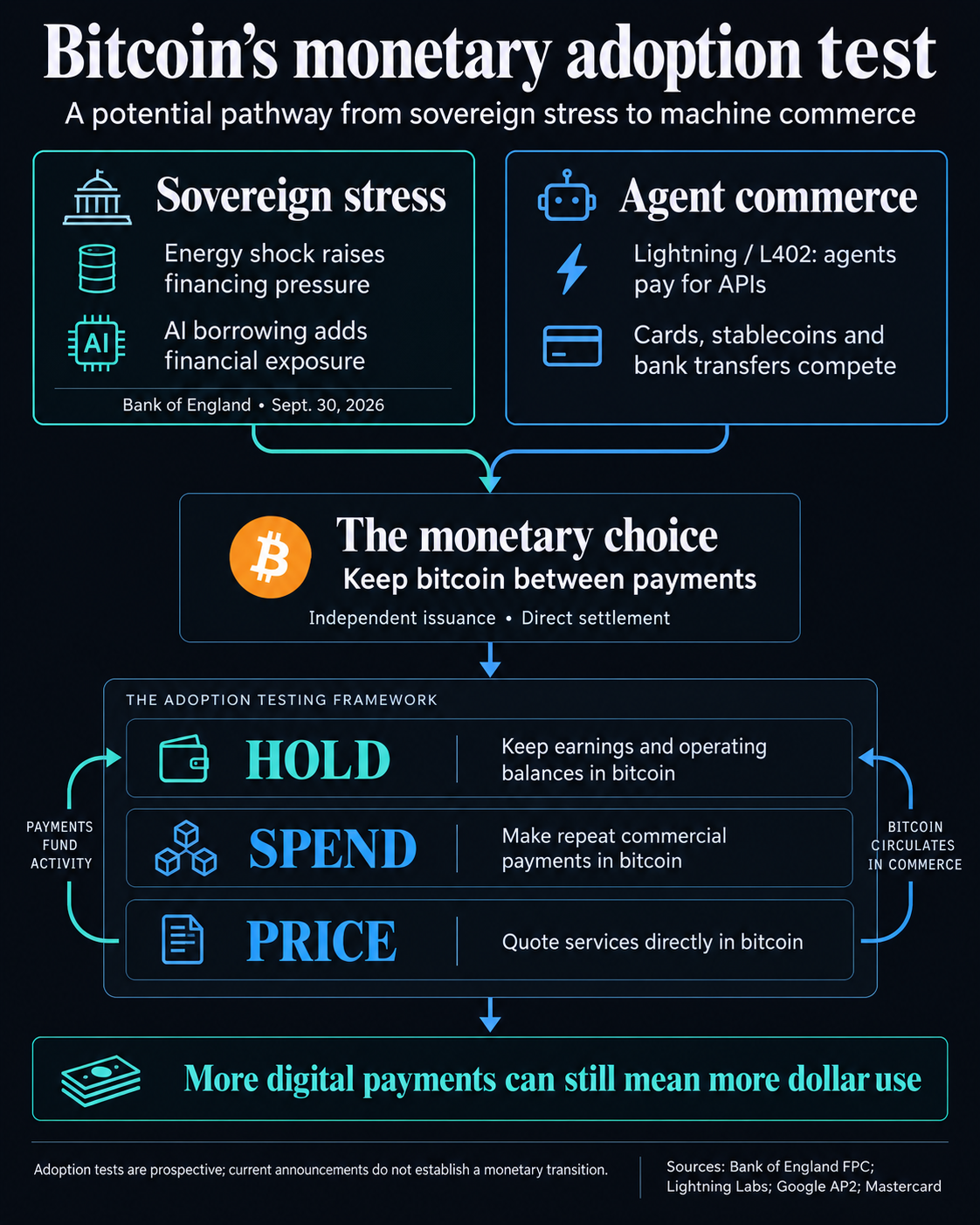
The catalyst is credible; the adoption test is concrete
Sovereign stress supplies a reason to reconsider what money people hold. Agent commerce supplies a way for digital money to circulate with less human administration. Together they give Bitcoin a more substantial opportunity than a narrative built only around the next rate decision.
AI can also intensify the financing problem. The Bank of England warns that debt-funded AI investment expands financial exposure and that disappointment in expected productivity gains could reach sovereign markets. The technology creating new payment users is being built within the same credit system Bitcoin offers an alternative to.
That is why I am bullish about Bitcoin’s monetary role. A reason to hold bitcoin and more ways to use the balance could reinforce each other. Turning that opportunity into adoption will depend on the choices people and businesses make.
The signs of that shift would be repeat commercial payments in bitcoin, recipients keeping part of their earnings in bitcoin, operating balances held in bitcoin and services priced directly in it. Those behaviors would move the argument beyond payment announcements and into monetary adoption.
If agents mainly spend stablecoins or authorized card balances, machine commerce will have modernized fiat. If businesses and their software start retaining and pricing value in bitcoin, the monetary transition will have a firmer foundation. Bitcoin’s opportunity grows when its users choose to keep the money they can now move.
Source: CryptoSlate