



FILTERED RESULTS
FILTERS
MCap $2.9T +0.8%24h Vol $102.3B -5.4%Fear & Greed 74/100Alts Index 57/100
BTC.D 58.4% 0%Stable.D 9.1% -0.1%ETH.D 11.4% 0%Others.D 21.1% +0.1%
STX$0.4109+31.78%•NIGHT$0.0418+31.37%•MON$0.0341+28.27%•TRAC$0.4869+23.47%•STONK$0.2919+22.27%•CAP$0.0732+21.07%•PLUME$0.0202+15.12%•KAIA$0.0375+11.97%•NEAR$5.463+11.73%•SOON$0.4813+11.61%•
AI$0.1811-13.33%•TIBBIR$0.2944-12.76%•BTW$1.158-11.27%•BR$0.7593-10.7%•BP$1.207-8.52%•2Z$0.0587-7.64%•ZRO$1.719-4.86%•Q$0.0233-4.65%•COMP$24.506-3.95%•DGAI$0.9450-3.51%•
•
·
·
FILTERED RESULTS
EU Regulators Question Binance's Use of MiCA Exemption to Keep Serving European Customers
AllUnity Embraces the Dollar With New MiCA Stablecoin USDAU
BitMart Offered Users Three Refund Options Amid Balance Shortfall
UK-based Lloyds Banking Group said it has completed a live pilot with Visa to settle
Binance Pay Launches USDT Payments at Millions of…
Binance Launches CTUSDT Perpetual Contract with High Leverage
Bitcoin Price Today: BTC Hits $85K, Turns Volatile After Cooler August PCE Print
a16z Crypto Head of Policy Miles Jennings said Genius Act is a foundational layer
Binance Futures to Launch CTUSDT USDⓈ-M Perpetual Contract
BPI Raises Concerns Over MSCI's Non-Operating Company Rules
Zcash Community Approves $8.4 Million in Retroactive Grants After Orchard BugZcash co-founder Zooko...
$CT listed on Binance futures・
EU Regulators Scrutinize Binance Over MiCA ‘Reverse Solicitation’ Use
MetaMask Security Incident: Staking Exits Lido Ethereum Validators, No Wallet Threat
EU Regulators Scrutinize Binance’s Use of MiCA Exemption
Binance’s EU Comeback Draws Regulatory Questions Over MiCA: FT
Ethereum DAT Position Ratio Expected to Increase, Says Bitmine Chairman
EU Regulators Question Binance's Operations Without MiCA License
Bitcoin ETF Experiences Significant Net Outflow Ending Nine-Day Inflow Streak
Fed mismanagement led to headquarters renovation cost overruns, but no one violated federal criminal law
Analysis: Long-term rise in U.S. Treasury yields may intensify competition for capital
Bitcoin think tank questions MSCI’s ‘invisible committee’ over Strategy, Metaplanet rule
Three hidden flaws in Uniswap’s StablePair hook drain LP returns
NEW: EU regulators are questioning Binance over its use of a legal exemption to continue serving
Quant Price Surges 5X in Days as Founder Wallet Moves $6.97M QNT — Can QNT Break $400?
Micron Stock: Revenue Soars 379% to $54.23B as AI Memory Demand Surges
An address builds a position of 5,000 ETH again, worth $13.43 million
Lloyds completes first stablecoin settlement pilot with Visa using USDCLloyds Banking Group, one of...
Lloyds Completes First Stablecoin Settlement Pilot With…
MetaMask Says Security Incident Is Affecting Part of Its…
Analyst: Bitcoin "Apparent Demand" Still Negative, Weak Spot Demand May Cap Upside
ETF Flows : 30 Sep 2026 BTC ETFs : -$148.7M ETH ETFs : -$59.6M SOL ETFs : -$12.5M XRP ETFs : $0K...
Bitcoin's historical October returns: 10 gains and 3 losses since 2013, with an average return of 18.52%
Ethereum's Historical October Returns: 6 Gains and 4 Losses Since 2016, Average Return of 3.29%
Singapore’s Crypto Activity Hits $284 Billion as Institutional Activity Jumps 94%
StraitsX to Bring XSGD, XUSD Stablecoins to Monad in Early 2027
Crypto hacks and exploits cost nearly $768 million in September, led by Bitget and Liquid...
XRP in October: Will Ripple’s Streak Continue After 3 Consecutive Green Months?
Real-World Assets Market Surpasses AI as Fastest-Growing Sector, Says Venture Capital Founder
Ripple Unlocks 1 Billion XRP From Escrow, Worth $1.49 Billion
Dogecoin gets DeFi testnet as DogeOS bets miners will eventually secure its apps
Zcash Founder: Zcash Distributed Over $8 Million in Retroactive Grants to Contributors
Ripple’s RLUSD Exceeds $2.4B as Monthly Market Cap Growth Tops 50%
FT: EU Regulators Scrutinize Binance’s Use of MiCA ExemptionBinance, the world’s largest crypto...
Bitcoin's soft-inflation pop to $85,500 fades as bond yields refuse to fall
Bank of England Governor Warns AI Could Trigger Financial Market Shocks
Binance Co-CEO: Tokenized Stocks Could Change Global Stock Market Access, Projected to Reach $349 Billion by 2030
EU asks Binance to explain why it continues operating after being ordered to exit
Fidelity Bitcoin ETF Sees $125.58 Million Outflow Amid September Volatility
Coinbase CEO: Banks May Be the Ones Pushing for “CLARITY 2.0” in a Few Years In an interview...
Bitcoin enters its best season after a 43% surge, with $147,000 suddenly on the math
1,487 $BTC (124,581,057 USD) transferred from #Kraken to unknown wallet...
Renzo responds to MetaMask security incident, says Basis risk and liquidity are fully verifiable on-chain
MetaMask Exits Lido Validators After Infrastructure Compromise, Says Wallets Face No Immediate Threat
Solana Executive Predicts China's Evolving Approach to Cryptocurrency Management
Dragonfly's Tom Schmidt Highlights Growth of Synthetic Dollars at Korea Blockchain Week 2026
1,270 $BTC (106,064,445 USD) transferred from #Kraken to unknown wallet...
Investment bank D.A. Davidson raises Micron Technology price target to $2,100
1,757.20 #BTC ($146,628,798) aggregated inflows to #Okx ...
Analysis: Google launches Gemini 4 to catch up with AI rivals, but internal views on its coding performance are mixed
10 Years After Sibos Shut Ripple out, Swell Draws 1,500 Finance Leaders
Stay tuned for full episode of ATB: Korea, dropping on our Youtube first later today:
Sentora Experiences Significant Outflows Following MetaMask Security Incident
1,737 $BTC (145,050,111 USD) transferred from unknown wallet to #OKEX...
1,370.97 #BTC ($114,347,349) aggregated inflows to #Binance ...
Binance to Delist U-Based Perpetual Contracts on October 5
NEW: A wallet linked to Ethereum co-founder and Consensys CEO Joseph Lubin transferred a total of
Binance Shifts Value Transfers to Solana from Tron and Ethereum
Micron Technology Projects $61.5 Billion Revenue for Q1 of Fiscal Year 2027
Ethereum builders face a choice between locking up too much cash or relying on trusted brokers


In a Sept. 8-11 Lido discussion, Commit-Boost contributor Jason Vranek argued that builders funding protocol-backed payments face costs from idle Ethereum, failed delivery, and offers they wanted to cancel.
Those costs could make trusted connections more competitive. Meanwhile, Titan Builder said it expects validators to continue reaching it through relays that organize auctions and handle publication.
An operator’s configuration helps determine which block-payment opportunities its validators can consider. For builders, the same settings help determine access to those validators.
As of Sept. 13, Ethereum.org lists Glamsterdam as testing on devnets, with mainnet expected in the fourth quarter of 2026 and no confirmed date. Lido contributors are discussing a proposed direction ahead of a future DAO vote.
Glamsterdam’s technical purpose remains distinct from those market choices. Separating consensus work from execution processing gives validators more time for heavy work, whether operators continue using relays or not.
Transaction-inclusion guarantees belong to another part of the roadmap. The Ethereum Foundation’s Sept. 7 priorities identify fork-choice enforced inclusion lists (FOCIL) as a Hegotá headliner.
That planned mechanism would let validators impose inclusion requirements on builders’ blocks.
What the payment guarantee covers
Enshrined proposer-builder separation (ePBS) formalizes the exchange between a validator proposing a block and the builder assembling its transactions.
In the proposed EIP-7732 design, which remains under Review, the proposer includes a builder’s signed commitment in its consensus block, and the execution payload containing the transactions follows separately.
The design accommodates two payment forms. A collateral-backed payment draws on Ethereum the builder has deposited into the protocol, and a trusted payment depends on the builder honoring a promise through another payment route.
That trusted payment can still be an ordinary on-chain Ethereum transfer.
The current consensus specification checks the builder’s available balance and records the collateral-backed amount as a pending payment to the designated fee recipient. Settlement uses withdrawals to the execution layer, while the recipient receives an execution-layer payment, rather than a direct increase in the validator’s effective staking balance.
For a timely proposer whose block receives the required support, the guarantee can survive the builder’s failure to deliver the committed payload.
The design also protects a builder when a proposer withholds the beacon block containing its commitment and reveals it late.
That risk allocation is the economic hinge. A proposer can protect against missing payloads, while the builder takes on exposure to paying without successfully delivering its block. Choosing a trusted payment leaves the proposer dependent on the counterparty’s promise.
Vranek’s Sept. 11 explanation identifies three potential costs. A builder must maintain ETH reserves inside the protocol to fund its payments, it must be able to cover unusually valuable blocks, and a committed payment can remain due when delivery fails, or the builder would have preferred to cancel its offer, subject to the protocol’s payment conditions.
Those costs could affect the amount a builder is willing to pay for the same block-building opportunity. Capital held in reserves to secure payments cannot simultaneously serve another use, while exposure to payment without successful delivery can also make a builder less willing to commit its maximum payment.
A trusted arrangement could reduce those costs and leave more room to pay the proposer. Whether that produces a higher payment for a proposer depends on the amounts available and the counterparty’s performance.
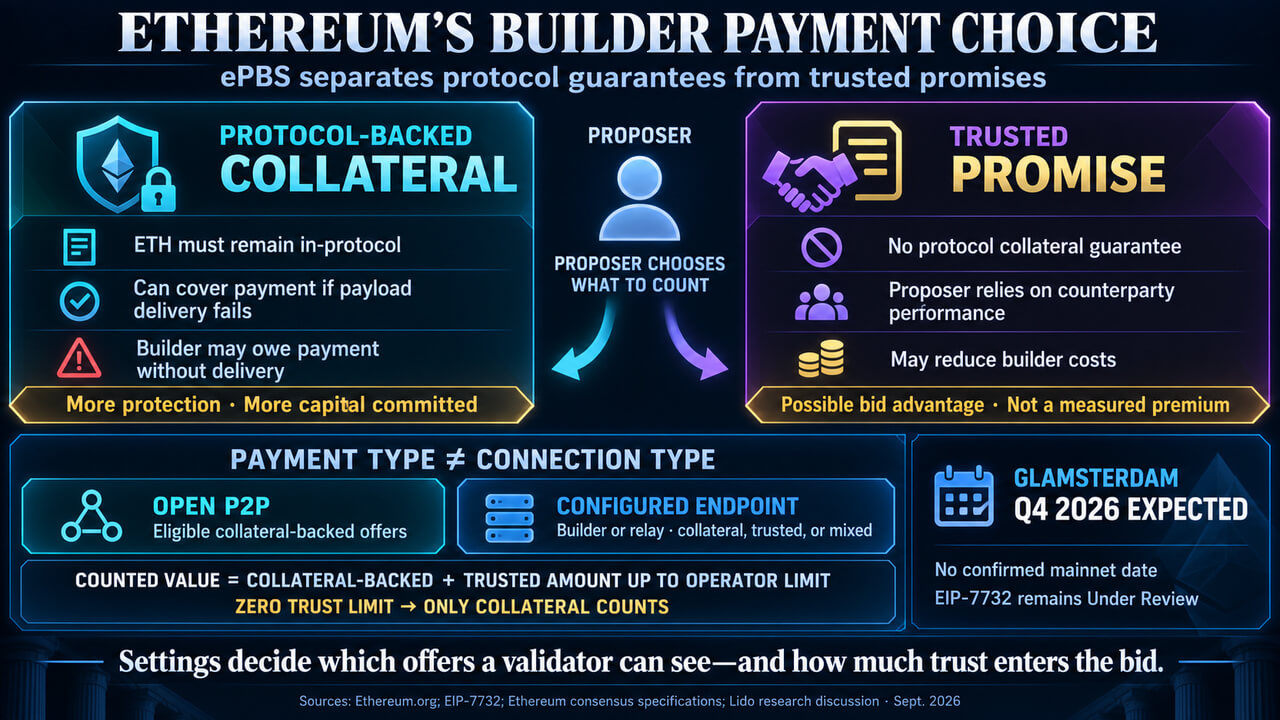
The distinction between a possible advantage and a measured premium also shapes Mike Neuder’s August analysis. He predicts that established trust between proposers, builders and relays will persist, but labels his market expectations conjectures.
In a subsequent reply, he says he expects the block-building market to remain largely unaffected, rather than necessarily become worse.
Open bidding and relay connections can coexist
Lido’s initial Aug. 22 direction divided offers by payment type: accept eligible collateral-backed offers broadly, while restricting trusted offers to a governance-approved allowlist.
Vranek’s Sept. 3 response proposed open peer-to-peer offers alongside configured builder or relay endpoints. Payment and connectivity are separate choices. Under the gossip specification, peer-to-peer offers have no trusted payment component. A configured connection can carry collateral-backed payments, trusted payments, or a mixture.
An open route lets an eligible builder reach validators without each operator first adding its endpoint, while a configured route can connect to a relay serving several builders.
Titan contributor George said on Sept. 8 that Titan does not plan to open its own direct proposer endpoint and expects validators to keep connecting through relays. He argued that relays can preserve a common auction, manage payload publication and reduce the burden of maintaining individual builder relationships.
His concern was that a builder with private access to a proposer could also watch the public relay auction and gain a last look at competing offers. In that situation, a relay offering shared access could help preserve competition.
The open bidding route also has advocates. Responding to Neuder, Justin Traglia argued that builders could register additional identities and improve connectivity to compete for proposers without configured connections.
He acknowledged latency disadvantages and the extra stake needed for additional identities. His argument leaves room for competition outside configured relationships, even if those relationships remain popular.
Even after an operator chooses its offer sources, it must decide how to value payment promises.
The builder specification lets a proposer set a maximum trusted payment to count from each builder. It values an offer by adding the collateral-backed amount to the trusted component, counted only up to that limit.
A zero limit leaves only the collateral-backed portion contributing to valuation, making trust a practical selection rule. A builder may offer a payment that the proposer’s settings don't count in full, while counting a trusted promise in full means relying on that builder to deliver.
What Ethereum operators can measure
Operators also need an accurate record of their choices. In the Sept. 8 Lido discussion, Stakely’s Paco asked that compliance be assessed against offers the proposing node observed. He also called for consistent offer sources and settings across backup nodes, plus a local-building fallback.
Paco warned that differences in offer handling across clients could increase incident-management costs and encourage operators to run fewer client types. Gabriella_S’s Sept. 9 response supported considering logging of observed offers and keeping that diversity risk in scope.
These remain policy and implementation questions under discussion.
The next meaningful evidence will come from the policy Lido puts forward, the offer-handling clients implement, and the payments available under those configurations.
An open route can broaden access, and protocol-backed settlement can reduce reliance on payment promises. A possible payment advantage for trusted arrangements will depend on how builders price that protection and which opportunities operators allow their validators to see.
Source: CryptoSlate