



FILTERED RESULTS
FILTERS
MCap $2.9T +0.2%24h Vol $86.7B -3.4%Fear & Greed 70/100Alts Index 59/100
BTC.D 59.3% -0.1%Stable.D 9.0% -0.1%ETH.D 11.3% -0.1%Others.D 20.4% +0.3%
HNT$0.6099+21.6%•BEAM$0.0024826+16.1%•FET$0.2578+15.09%•PROS$0.8248+14.97%•AKT$0.7752+14.02%•RAIN$0.0119+13.7%•ORCA$2.044+13.32%•STRK$0.0587+10.52%•DRV$0.4134+9.66%•BAT$0.1027+9.63%•
BR$0.4591-20.64%•BTW$1.179-18.64%•STONK$0.1996-14.92%•AI$0.1145-14.87%•NIGHT$0.0445-9.89%•QNT$251.47-8.6%•KITE$0.1461-6.81%•PONS$0.3910-5.99%•CARDS$0.2464-5.95%•ZRO$1.922-5.37%•
•
·
·
FILTERED RESULTS
Zcash NU7 network upgrade activated on testnet at block height 4,465,026
SKY treasury company SDEV stock surges over 700% in 15 days, now at $7.48
Why XRP Appeals to Institutional Investors, Bitwise CIO Explains
OKX Files with SEC to Launch Tokenized-Stock Trading in the US
OKX Files With SEC to Launch Tokenized US Stock Trading Platform
U.S. Digital Asset Holders Face October 15 Tax Deadline for 2025 Returns
In Q3 2026, the TVL on #Tron increased by $3.3B, up...
Binance to Block Brazil Cross-Border Crypto Transfers From Nov. 1 Without Purpose and Counterparty...
Bitwise Launches PAPY Vault on Circle’s Arc for USDC Lending
Zcash Activates NU7 Network Upgrade on Testnet
Nikkei 225 breaks above 70,000 points, up 2.5% intraday
U.S. 2025 tax year extended filing deadline is October 15; crypto traders need to verify reported information
Smart trader Frank (@frankdegods) has been buying $EDEL since Oct 1, spending a total of $191K to...
Musk: Spreading superintelligence to the stars could be seen as a successful outcome for humanity
This Week in Crypto Law (October 4, 2026)
Aptos proposal aims to enable encrypted transaction pool to reduce front-running risk, vote has not yet reached threshold
El Salvador’s $666 million Bitcoin reserve survives IMF review
Patricio Worthalter(@worthalter) deposited 4,000 $ETH($10.79M) into #Gemini 8 hours...
Ethena-linked multisig address withdrew about 117.58 million ENA, worth roughly $27.96 million, from Bybit within 9 hours
Zcash gets a Washington lobbyist to push crypto policy
BOJ Deputy Governor Shinichi Uchida: AI is both a massive positive demand shock and could reshape core parameters of monetary policy
Data: Hyperliquid whale's ETH short position has unrealized loss of over $30 million
Bitcoin Price Knocks on $87K as Uptober Bulls Smell $94K
149,600,000 $USDC (149,607,779 USD) transferred from Unknown Whale 1 to #Aave...
S&P Global Ratings has launched a new risk assessment framework for onchain lending
KLEA Crypto Daily: Sunday, October 04, 2026
Grayscale's Zach Pandl to Present Zcash Investment Case at Digital Asset Yield Summit in Singapore
S&P Global Ratings Introduces Risk Assessment Framework for Onchain Lending Vaults
SEC Commissioner Hester Peirce: Strict Regulation Ended Up Favoring "Useless" Meme CoinsOutgoing...
Nikkei 225 opens up 756.45 points, up 1.11%
149,600,000 $USDC (149,603,889 USD) transferred from #Aave to Unknown Whale 1...
Zcash Advocacy Group Registers First Lobbyist in Washington, D.C.
Crypto Weekly: ZEC Plunges as Bitcoin and Ether Hold Key Support Levels
Glassnode Identifies Key Liquidation Cluster for Bitcoin at $90,000
Ethena-Linked Wallet Withdraws $27.96 Million in ENA from Bybit
Galaxy Finds 7 in 10 Polymarket Retail Traders Lost Money
Ethereum’s past outflow charts can change when more exchange wallets are identified
Bitcoin Market Sees Divergence as European Demand Surges
Former SEC boss made AI Czar, Bitcoin may hit $600K this cycle: Hodler’s Digest
Atkins Vows More Crypto Rule Changes to Keep Markets Onshore
Coinbase's Base Network Attracts $4.7 Billion in Net Inflows in 2026
IMF Approves $138M for El Salvador After Bitcoin Accumulation Waiver
Bitcoin’s $85,000 recovery awaits proof that ETF investors kept buying after payrolls
Community Bankers Sue US Banking Regulator Over ‘Side Door’ Crypto Charters
Bitcoin ETFs Took In a Provisional $82.9 Million This Week…
*S&P 500 CLOSES UP 0.1%, NASDAQ UP 0.2% ...
ETH falls below $2,700, up 0.04% on the day
Bitcoin Core’s new fix closes gap that could redirect funds without stealing keys
Bitcoin Liquidation Map Shows $90,000 Short Squeeze Zone
Cardano Founder Tells UN Crypto Is Entering A New Era Of Exponential Growth
XRP News Today: Chart Points To $11 Long Term, But $1.66 Must Break First
Zcash Price Slides 23% as Grayscale ETF Hits Reverse
Bitcoin and Ethereum ETF Weekly Flows: The Good, the Bad, and the Concerning
New Treasury rules could change how stablecoin issuers get your dollars back
India’s local crypto exchanges get just 0.7% of inflows, Chainalysis reports
Cathie Wood Projects Bitcoin Price Could Reach Up to $2.4 Million by 2030
Polymarket CEO shayne_coplan TEASES TOKEN2049 ANNOUNCEMENT ...
There's an election next month: State of Crypto
Ripple and XRPL Foundation Launch XRP Asia in Seoul as…
4,500 $BTC (383,961,630 USD) transferred from unknown wallet to unknown new...
Ripple President Reveals Plan To Let Payment Customers Borrow Against XRP
SEC Approves Listing of Bitcoin ETF Targeting 3x Daily Futures Moves
Drift hack recovery opened near one cent per dollar lost
Security firm: Revenue Family involved in malicious authorization to steal users' USDG
Trump Taps Jay Clayton, the SEC Chair Who Sued Ripple, to Lead AI Push
What Could Decide Bitcoin’s Q4? The Fed, Bond Yields, and One Crucial Price Level
Vitalik-inspired AI payment system can send expired deposits to its treasury
Tokenized Stocks on Solana Reach $12.4 Billion in Trading Volume in 2026
NEAR Intents Recovers Full $3.8M Stolen in Omni Contract Exploit
Why Solana’s new 250ms speed boost could actually trigger network instability


Solana validator coordination now operates on a 250-millisecond target slot time. A slot is the network's target interval for a validator to produce a block, so the change gives users more frequent opportunities for transactions to land while giving validators less time to pass production from one leader to the next.
The change became effective at epoch 1037 on Sept. 18, according to the Solana engineering changelog and a Solana Compass report that placed the transition at about 05:06 UTC. One early Sept. 20 sample covering 60 one-minute windows observed about 266ms per produced slot. Epoch 1037 skipped about 0.05% of its scheduled slots.
The narrow observation window supports an encouraging first reading, not a long-term performance trend. The more important test is whether leader handoffs, transaction forwarding, repair and multiple validator clients remain reliable as Solana considers a conditional move to 200ms.
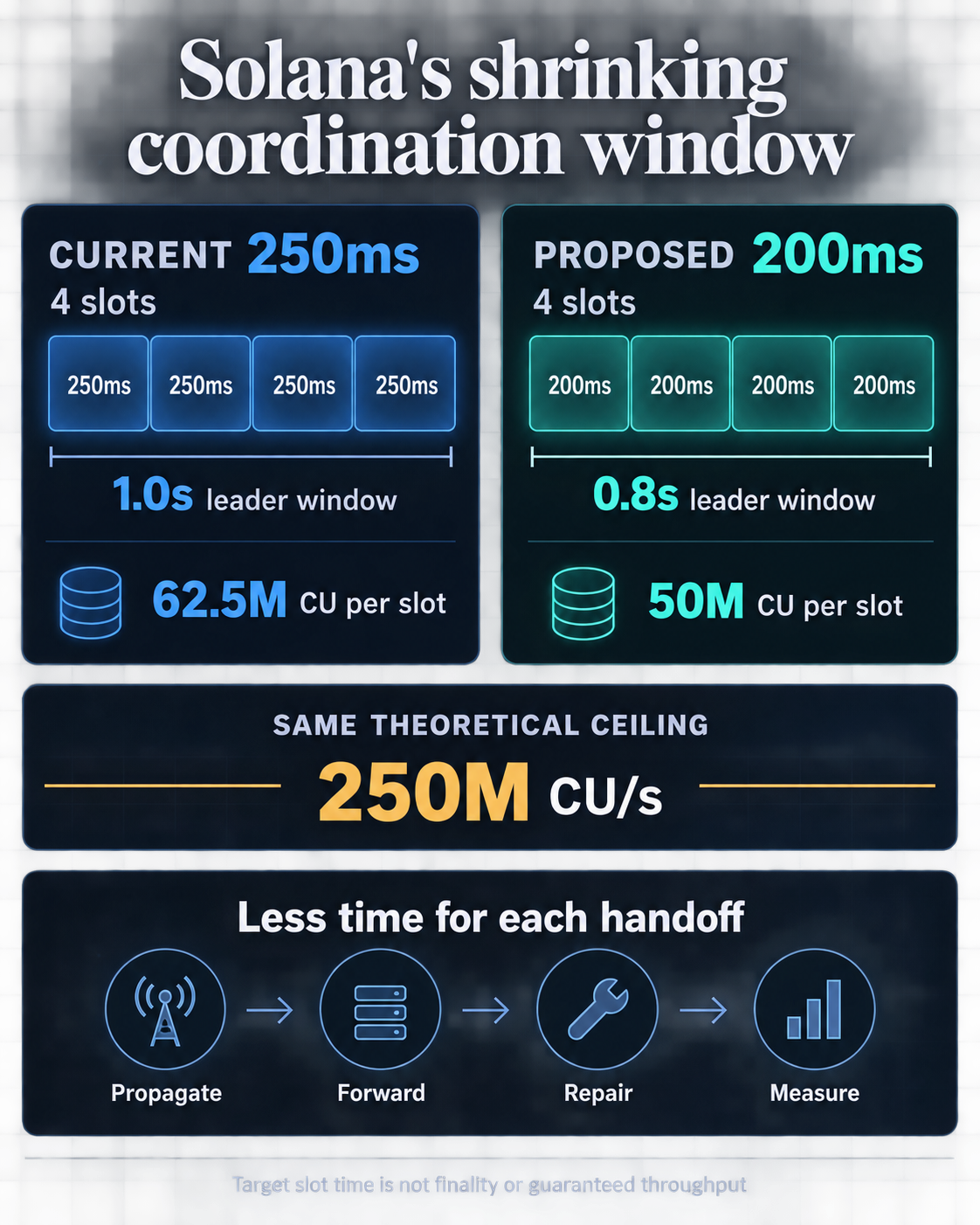
Solana validator coordination faces a tighter budget
The draft SIMD-0525 design cuts per-slot work limits as slot duration falls. The block budget is 62.5 million compute units at 250ms and would be 50 million at 200ms. Both settings leave the nominal protocol ceiling near 250 million compute units per second.
Shorter slots therefore change cadence and latency more directly than capacity. Blocks arrive more often, but each carries less permitted work. Demand, scheduling and how effectively leaders fill blockspace still determine realized transaction throughput.
Shorter leader windows tighten handoffs
The same design keeps a leader's turn fixed at four slots. That gives each leader a nominal one-second window at 250ms and an 800ms window at 200ms. Users get more frequent chances for inclusion, while validators get less time to receive traffic and begin producing after a handoff.
Geography already consumes part of that margin. A Solana Foundation engineering analysis measured a median first-slot duration penalty of about 28ms when consecutive leaders were less than 500 kilometers apart and 122ms when they were more than 8,000 kilometers apart. The larger figure equals 61% of a 200ms target slot.
The metric compares a leader's first slot with its later slots and captures more than network latency alone. It nevertheless shows the trade-off: geographic distribution can reduce common-location risk while long-distance handoffs use more of a shrinking production window.
Solana's Sept. 18 changelog identifies two ways engineers are trying to protect that window. Agave developers are working on pessimistic forwarding to the next leader when a transaction may miss its intended destination. Client teams are also testing block and transaction execution against conformance binaries across implementations and versions.
Recovery has a similar constraint. The draft proposal retains a 250ms repair-defer threshold at its 200ms stage, making that delay longer than one target slot. These are prospective engineering margins rather than evidence of a current failure, but they define the conditions under which lower latency can coexist with reliable execution.
One routing failure exposed three layers of concentration
The Aug. 12 routing failure at TeraSwitch happened before the 250ms setting and was not caused by it. It still shows how a shared infrastructure dependency can affect many apparently independent validators at once.
TeraSwitch's incident report says 12 sites lost reachability and a Miami site was removed for containment. Solana Compass measured 28.83% of network stake as delinquent for about 33 minutes. The Solana Foundation's account said blocks continued and transactions kept landing.
The network absorbed the failure without a halt, but the event also showed why validator count tells only part of the decentralization story. Independent data dated Sept. 7 put Solana's stake-based Nakamoto coefficient at 18 and its largest validator near 4% of active stake. At the hosting layer, the same date's provider report put TeraSwitch at 22.1% of active stake.
The Foundation has separately said TeraSwitch hosted 38% of stake “last year” before its share was reduced below 30%. Those figures lack a common date and method, so the Sept. 7 reading is the cleaner current snapshot rather than one point in a continuous series.
Software creates a third failure domain. A Sept. 20 stake-weighted query grouped roughly 87.4% of stake on 4.x client versions, 7.3% on 0.x and 5.3% on 26.x. Major-version numbers serve only as rough markers for Agave-family, Frankendancer and Firedancer software because they cannot separate every scheduler variant or downstream build.
The three measurements answer different questions. Validator stake shows how many leaders would need to fail or coordinate. Client lineage shows exposure to common implementation faults. Hosting share shows how much stake can disappear behind one provider or routing domain. Faster slots do not create those concentrations, but smaller handoff and repair margins can make correlated disruptions more consequential.
The evidence threshold for 200ms
The 200ms feature remained pending for mainnet on Sept. 20, with no firm activation date in Anza's feature-gate schedule. Solana's reduced-slot-time page says further reductions depend on acceptable network performance, including skip rates.
One completed epoch with a roughly 0.05% skip rate is a useful baseline. A stronger decision would rely on sustained slot duration, skip, transaction-landing and leader-handoff measurements, broken down where possible by client family and infrastructure provider. That would reveal whether a clean network-wide average hides a weaker cohort or a longer tail.
Alpenglow belongs on a separate timeline. It is a consensus upgrade targeting roughly 150ms finality, whereas slot time governs the cadence of block-production opportunities. Solana's official pages give different planning windows, from a Q3 target to an October Agave 4.3 window, and neither supplies an exact activation day.
Solana's first 250ms readings show no immediate skip-rate shock. Reaching 200ms will require the same result across a longer window and under less favorable conditions. The binding test is whether transaction forwarding, leader transitions, repair and different client implementations can keep pace when geographic and provider concentration removes part of the network's timing margin.
Source: CryptoSlate