



FILTERED RESULTS
FILTERS
MCap $2.9T +0.9%24h Vol $88.7B +92%Fear & Greed 65/100Alts Index 59/100
BTC.D 59.6% +0.9%Stable.D 9.1% -0.1%ETH.D 11.4% +0.1%Others.D 19.9% -0.9%
BEAM$0.00255171+19.69%•HNT$0.5966+17.29%•AKT$0.7856+16.89%•PROS$0.8248+14.97%•AXS$1.366+14.2%•RAIN$0.0119+13.7%•FET$0.2533+11.55%•ORCA$2.005+11.41%•GEOD$0.3150+9.97%•DRV$0.4134+9.66%•
BR$0.4591-20.64%•BTW$1.179-18.64%•STONK$0.1996-14.92%•AI$0.1145-14.87%•NIGHT$0.0444-7.56%•CARDS$0.2464-5.95%•CAP$0.0656-4.87%•SUPER$0.2491-4.57%•S$0.0407-4.26%•GRASS$0.6948-3.43%•
•
·
·
FILTERED RESULTS
Zcash Advocacy Group Registers First Lobbyist in Washington, D.C.
Crypto Weekly: ZEC Plunges as Bitcoin and Ether Hold Key Support Levels
Glassnode Identifies Key Liquidation Cluster for Bitcoin at $90,000
Ethena-Linked Wallet Withdraws $27.96 Million in ENA from Bybit
Galaxy Finds 7 in 10 Polymarket Retail Traders Lost Money
Ethereum’s past outflow charts can change when more exchange wallets are identified
Bitcoin Market Sees Divergence as European Demand Surges
Former SEC boss made AI Czar, Bitcoin may hit $600K this cycle: Hodler’s Digest
Atkins Vows More Crypto Rule Changes to Keep Markets Onshore
Coinbase's Base Network Attracts $4.7 Billion in Net Inflows in 2026
IMF Approves $138M for El Salvador After Bitcoin Accumulation Waiver
Bitcoin’s $85,000 recovery awaits proof that ETF investors kept buying after payrolls
Community Bankers Sue US Banking Regulator Over ‘Side Door’ Crypto Charters
Bitcoin ETFs Took In a Provisional $82.9 Million This Week…
*S&P 500 CLOSES UP 0.1%, NASDAQ UP 0.2% ...
ETH falls below $2,700, up 0.04% on the day
Bitcoin Core’s new fix closes gap that could redirect funds without stealing keys
Bitcoin Liquidation Map Shows $90,000 Short Squeeze Zone
Cardano Founder Tells UN Crypto Is Entering A New Era Of Exponential Growth
XRP News Today: Chart Points To $11 Long Term, But $1.66 Must Break First
Zcash Price Slides 23% as Grayscale ETF Hits Reverse
Bitcoin and Ethereum ETF Weekly Flows: The Good, the Bad, and the Concerning
New Treasury rules could change how stablecoin issuers get your dollars back
India’s local crypto exchanges get just 0.7% of inflows, Chainalysis reports
Cathie Wood Projects Bitcoin Price Could Reach Up to $2.4 Million by 2030
Polymarket CEO shayne_coplan TEASES TOKEN2049 ANNOUNCEMENT ...
There's an election next month: State of Crypto
Ripple and XRPL Foundation Launch XRP Asia in Seoul as…
4,500 $BTC (383,961,630 USD) transferred from unknown wallet to unknown new...
Ripple President Reveals Plan To Let Payment Customers Borrow Against XRP
SEC Approves Listing of Bitcoin ETF Targeting 3x Daily Futures Moves
Drift hack recovery opened near one cent per dollar lost
Security firm: Revenue Family involved in malicious authorization to steal users' USDG
Trump Taps Jay Clayton, the SEC Chair Who Sued Ripple, to Lead AI Push
What Could Decide Bitcoin’s Q4? The Fed, Bond Yields, and One Crucial Price Level
Vitalik-inspired AI payment system can send expired deposits to its treasury
Tokenized Stocks on Solana Reach $12.4 Billion in Trading Volume in 2026
NEAR Intents Recovers Full $3.8M Stolen in Omni Contract Exploit
Japan Sanctions Garantex as Russia Crypto Crackdown Expands…
Drift Hack Victims Get Their Money Back, 1 Cent at a Time
sunrise ENABLES ACCESS TO $SHIB (Shibtoken) MEMECOIN ON solana LaunchOnSF AND Pumpfun NOW...
Banking Group Sues to Block Crypto's 'Side Door' Into the Banking System
Lido’s proposed staking route needs over 13 times the default entry bond
3x Bitcoin and Ether futures funds clear SEC listing hurdle
Russia Uses Digital Ruble for Salaries After $192,000…
$6 million in wstETH drained from a Base vault controlled by an anonymous 3-of-7 SafeRead...
$6M Vanishes From Crypto Vault Controlled by 7 Mystery Signers
Binance Founder Comments on SAFU Fund's Bitcoin Profit
Base Vault Hack: $6M in wstETH Drained After Attacker Gains Whitelist Access
Billionaire Grant Cardone: Tech giants issued US$66 billion in high-yield debt to seize the AI market; yields will fall if expectations miss
Binance's SAFU Fund Surpasses $1.27 Billion in Bitcoin Holdings
Bybit's weekly platform updates General• ByPicks is live: free picks across crypto, sports and...
'Uptober' Starts Green as Bitcoin ETFs Draw $134 Million
America’s Middle Class Is Getting Crushed: Where Does Bitcoin Fit?
Ethereum's zkAPI Breaks the Link Between AI Prompts and Payers
IMF Releases $138 Million to El Salvador Despite Missed…
Greenfield Files Regulatory Complaint Against Safe Ecosystem Foundation with Swiss Authorities Over Governance Issues
Hyperliquid broker HyperLink completes $2.5 million funding round with participation from Alliance and others
RWA Foundation Reports $6.2 Billion Tokenized Credit Market Amid Holder Growth
‘More Orange Than Ever’: Saylor Stirs Strategy Bitcoin Buy Speculation
CoinW Lists SI Perpetual Contract with Up to 50x Leverage
Strive CEO Indicates Potential Increase in Bitcoin Holdings
Crypto poured years into new products. The next challenge is keeping users
Is Bitcoin’s $85K Consolidation the Calm Before the Storm Amid Rising Middle East Tensions?
The same Fed rate hike can help stablecoins and hurt Bitcoin borrowers
Trump taps intel chief Jay Clayton to lead new Super Intelligence Force
Open Standard's OUSD Stablecoin Sees Rapid Growth of $626.3 Million in First Week
Best Altcoins To Buy And Hold Till 2030: Standard Chartered’s Geoffrey Kendrick Names Top 4
Anchorage Digital Cuts 17% of Staff Months After $4.2B…
Why truly decentralized DeFi needs no legal exemption according to SEC Commissioner Hester Peirce


SEC Commissioner Hester Peirce drew a sharp line around decentralized finance on Sept. 17. She said investors need no exemption to use permissionless smart contracts for peer-to-peer trading. The SEC and CFTC actions examined here set separate limits on intermediary control.
The unresolved question is how much control a software provider can retain before it begins to resemble a regulated intermediary.
Peirce’s statement expressed her own position. A binding definition from the US Securities and Exchange Commission would require Commission action. The SEC’s tokenized-securities order and a separate staff statement leave her phrase “truly decentralized” undefined. Their specific provisions focus on custody, access, software parameters, fees, recommendations, routing and execution.
Each action operates under a different statute and carries a different legal effect. Together, they show how federal regulators are examining the authority that identifiable providers retain. A unified federal decentralization test remains absent.
The SEC traces control from the market to the frontend
The SEC’s Sept. 17 tokenized-securities order is an order of the Commission. It creates temporary, conditional relief for a defined Tokenized Securities Venue, or TSV, using automated market maker pools for permissioned trading in Tokenized NMS Stocks.
A TSV under the order performs two functions: It provides one or more AMM pools for permissioned participants, and it sets standards governing who may access those pools.
The order gives “provides” a functional meaning for that exemption. Selecting and designating a pool can count. Deploying its trading contract, changing its rules or parameters, setting its fees, or retaining authority to pause trading can also establish provision or control. Solely performing the administrative task of encoding a whitelist falls outside that definition.
Automation leaves several consequential choices in human hands. People may still choose the venue, set fees, pause activity or decide who gets in. Peirce placed the order outside decentralized finance and described genuinely permissionless software as a different model. The permissioned venue illustrates why operational powers matter even when smart contracts execute trades.
The interface creates another layer of control.
An April statement from the SEC’s Division of Trading and Markets describes when staff would refrain from objecting to certain crypto asset securities interface providers operating without broker-dealer registration under Section 15. Its legal effect is limited: The statement represents staff, has no legal force, creates no new obligations and will be considered withdrawn five years after April 13, 2026 absent intervening Commission action.
The covered interfaces help users prepare transactions through self-custodial wallets. The user holds the keys, chooses or customizes transaction parameters, signs the transaction and transmits the instructions. Multiple displayed execution routes must be filterable or sortable using objective factors. When an interface displays one route, users must be able to view alternatives when they exist. Software used to prepare instructions or display route information must operate on pre-disclosed, objective and independently verifiable parameters.
The staff position excludes functions that more closely resemble brokerage. It excludes a provider that solicits a specific crypto asset securities transaction, recommends an investment, holds or accesses user assets, executes or settles a transaction, or takes or routes an order.
How the provider is paid also matters. Staff says it would refrain from objecting when a user pays a flat fee or percentage transaction charge that is objectively determined, consistently applied and neutral among products, routes, venues and counterparties. Payments from another party based on the size, value or occurrence of a transaction fall outside the position.
These conditions make the frontend part of the regulatory analysis. Default settings, route rankings, preferred venues and fee incentives can steer users even when the user signs the final transaction from a self-custodial wallet.
The CFTC permits more promotion under a narrower registration position
The CFTC’s Sept. 17 announcement and Staff Letter 26-25 state a staff no-action position. The Market Participants Division said it would refrain from recommending enforcement against qualifying passive-software providers for failing to register as introducing brokers, or against relevant personnel for failing to register as associated persons.
The position applies when users transact on a designated contract market directly as members or indirectly through a futures commission merchant or introducing broker that is a DCM member. It is based on the presented facts, leaves Commission authority intact and may be changed, suspended or terminated by the Division.
Its covered activities allow more promotion and compensation than the SEC interface position. A provider may promote particular derivatives, direct users toward specific registered firms, charge users transaction-based fees and receive a share of a registrant’s revenue.
The provider must remain hands-off in several important respects. Users must be able to reach the registrant directly. The provider is barred from custody or control of customer property, explicit buy or sell signals, affirmative involvement in a particular order, and discretion over routing or execution.
The relief also depends on disclosures, marketing controls, written undertakings with registrants, recordkeeping and notices to the Division. These requirements preserve accountability while the software provider remains outside introducing-broker registration.
The main differences concern six forms of control.
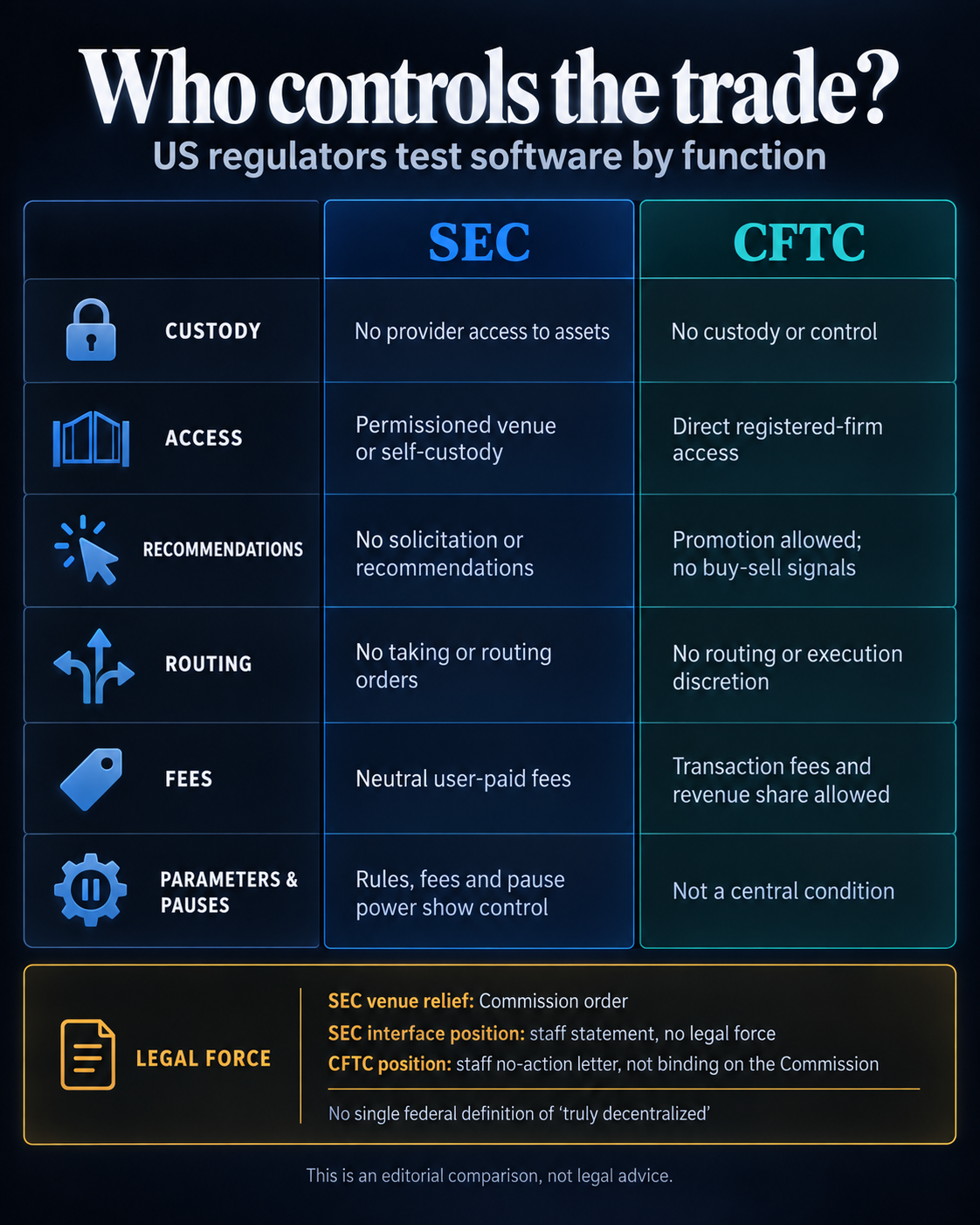
| Area of control | SEC order or staff position | CFTC staff position | Scope of the condition |
|---|---|---|---|
| Custody | The interface provider is barred from holding or accessing user assets | The provider is barred from custody or control of customer property | Each staff position requires separation from customer property |
| Access | A TSV sets participant standards; an interface discloses venue limits | Users trade on a DCM directly or through a member FCM or IB and retain direct access to the registrant | Each document specifies its own access structure |
| Recommendations | The interface position excludes specific-transaction solicitation and investment recommendations | Promotion may be allowed; explicit buy or sell signals are excluded | The staff positions draw different lines around steering |
| Routing | The interface provider is barred from taking or routing orders; displayed alternatives use objective parameters | User-directed transmission may occur; provider discretion over routing or execution is barred | The SEC position excludes order routing, while the CFTC position centers on discretion |
| Fees | User-paid charges must be objectively determined and neutral | Transaction fees and registrant revenue sharing may be allowed | Compensation is treated within each statutory setting |
| Parameters and pauses | Changing pool rules, parameters or fees, or pausing trading can mean a person provides the pool | The letter gives these powers no central role | The SEC factor belongs to the order’s specific venue exemption |
Every factor operates inside its source document’s narrow scope. The Commission order governs one securities-venue model. SEC staff states its Section 15 position for covered interfaces. CFTC staff offers conditional enforcement forbearance within the registered derivatives market.
Technical design matters alongside disclosures, access arrangements, marketing limits, recordkeeping and retained authority. The relevant mix changes across securities venues, crypto interfaces and derivatives software.
Who decides what counts as “truly decentralized”
Peirce supplies a principle: Removing the trusted intermediary weakens the regulatory rationale built around that intermediary. Her individual statement carries no power to establish a Commission category.
Authority is divided across the actions described here. The Commission defines the scope of its TSV order. The SEC’s Division of Trading and Markets applies its own nonbinding Section 15 position. The CFTC’s Market Participants Division decides whether presented facts fit its conditional enforcement posture. Each judgment answers a question arising under a particular statute and form of relief.
A protocol, its governance process and its frontend may occupy different points on the control spectrum. The core protocol may be difficult to alter while an interface remains curated, fee-taking and capable of steering users. Software may also connect users to regulated firms while leaving orders, assets and execution outside the provider’s discretion.
For builders and users, the practical inquiry begins with specific powers: Who controls access and assets? Who can recommend, route or execute a transaction? Who sets fees or changes software parameters? Who can pause the system? The governing statute and the actor exercising those powers then determine which regulator and legal standard apply.
“Truly decentralized” remains Peirce’s description. Federal law provides no matching legal category. These SEC and CFTC actions produce a fact-specific map of retained authority, with separate boundaries for the Commission order and each staff position.
Source: CryptoSlate