



FILTERED RESULTS
FILTERS
MCap $2.9T +0.5%24h Vol $133.4B -14%Fear & Greed 73/100Alts Index 57/100
BTC.D 58.4% +0.1%Stable.D 9.3% +0.1%ETH.D 11.4% 0%Others.D 20.9% -0.2%
SHFL$0.6630+69.75%•TEL$0.00229903+30%•NMR$12.786+29.61%•CRV$0.3970+21.89%•HBAR$0.1170+20.22%•GRASS$0.6932+14.99%•BTW$1.300+13.41%•CVX$2.276+13.39%•SYRUP$0.2363+13.28%•IOTA$0.0563+13.02%•
Q$0.0259-47.69%•BP$1.338-11.44%•STONK$0.2523-9.89%•FF$0.1188-8.65%•USELESS$0.2336-8.61%•AKE$0.0301-8.15%•DRV$0.3832-7.92%•ZEC$1,422.85-7.83%•NEAR$4.748-7.5%•RAY$1.874-6.87%•
•
·
·
FILTERED RESULTS
Personal AI Agent Instinct Sees Rapid User Growth and Computing Power Demand
BlackRock's iShares Ethereum Trust Sees $15 Million Inflow
Ethlabs Introduces CCIP 2.0 to Accelerate Ethereum Transaction Confirmations
U.S. Bitcoin Spot ETF Records Eight Days of Consecutive Net Inflows
Ari Paul Accuses Coinbase of Concealing $25 Million Loss from BlockTower Funds
Injective Launches Innovative Stockdrop for Tokenized Stocks
Binance Launches U-based TradFi Perpetual Contracts
Bitcoin Remains Steady Above $83,000 as Zcash Experiences Significant Decline
Analysts Report Slowed Growth for Anthropic Amid Rising Competition
U.S. Senate Investigates Trump Family's Cryptocurrency Ties and Tether's Sanctions Compliance
NVIDIA CEO Defends AI Model Distillation Amid U.S. Accusations Against Chinese Firms
Bitget BTC Protection Fund Releases 3,215 BTC
OpenAI Apologizes for Unauthorized Access to Australian Government Websites
TSMC Plans Second Semiconductor Campus in Texas with Significant Investment
Paid Launches Web Application Portal Amid Ongoing Suspension of X Money Payments
Stablecoin Card Spending Reaches Record $189 Million in Mid-September
Former CEO of Changxin Memory Technologies Accused of Coercing Samsung Technology
General Intelligence Manus Founder Announces Development of Domestic Version
Investment Strategy Shift: Utilities and Financials Preferred Over Bonds as Yields Rise
World Foundation Finalizes $49 Million Over-the-Counter Sale of WLD
CFTC Approves Launch of Coinbase Clearing with USDC Collateral
UsePaid Launches Claims Portal After $PAID Token Drops 38% Due to X Money Issues
KLEA Crypto Daily: Monday, September 28, 2026
Uniswap Dominates Tokenized Stock Deposits with $82 Million on Robinhood Chain
OpenAI Suspends AI Model Training After Data Scraping Incidents
BitGo Appoints New Chief Product Officer to Enhance Asset Servicing
Stripe Alerts AI Companies to Rising Token Theft Risks Amid Increased Fraud Attempts
US Senate Report Links Tether's USDT to Iran's Sanctions-Evasion Activities
Gemini Introduces Staking for Hyperliquid's HYPE Token with 2.1% APY
Coinbase Introduces Digital Pokémon Card Packs Linked to Physical Collectibles
Robinhood Reports 24% Increase in Daily Crypto Trading Volume for September
SEC Clarifies Token Buyback Guidelines with 'No Central Party' Condition
Anthropic's Claude Sonnet 5.5 Is Out, Beats Opus 5.5 at Coding for Half the Price
After AI Agent Hacked Its Government, Australia Calls Altman and Amodei to Testify
In the Wake of CLARITY Act’s Failure, Agencies Move Forward Without Congressional Action or Certainty
Expansion of Trademark Rights: What Yuga Labs v. Ripps Means for Game Studios
Strive Scoops up 1,107 Bitcoin as Its $2.3B Treasury Expands
Banking Giant Citi Taps Coinbase to Turn Stablecoins Into Cash
Hyperliquid (HYPE) Drops 5% – Could Whales Trigger an Even Bigger Sell-Off?
Ripple CEO Unpacks What Really Drives XRP’s Value — Here’s Everything You Need to Know
Breaking: Vitalik Buterin Declares Ethereum Is No Longer Just A Blockchain
Spark Allocates $210 Million for Institutional Loans Backed by Bitcoin
Bitcoin ETFs Draw $2.39 Billion Despite Weekly BTC Decline
Altcoin Spot Trading Volume Nears 4x Bitcoin, Highest Since September 2025
UK FCA Secures £851K for Victims of Crypto Investment Fraud
Bitget says Bitcoin withdrawals are open after $387M hack, but ETH and USDT must wait
Brazil’s $252 billion crypto market gets $10,000 self-custody reporting rule
USDT grew on Ethereum through 2024, but smart contract holdings stalled, BIS data show
US SEC follows CFTC in staff guidance for crypto
Avalanche Leads Blockchain Sector with $131 Million in Tokenized Stock Inflows
Blockchain.com Files Confidential S-1 for Multi-Billion Dollar IPO
Bittensor Introduces Gamma Tokens to Foster Collaboration Among Subnets
Blockchain.com Plans IPO Targeting Up to $6 Billion Valuation
Chainlink Introduces CCIP 2.0 Featuring Custom Verifiers and Enhanced Transfer Speeds
Polygon Announces Temporary Increase in POL Staking Rate to 7.7%
Goldman Sachs Connects $100 Billion Treasury Fund to Lynq Network
Compound Foundation Responds to Allegations of V2 Reserve Misuse
Tether Assists in Freezing $550 Million in Iran-Linked USDT
163,061,311 $USDC (163,116,752 USD) minted at USDC Treasury...
Iran Agrees To Suspend Uranium Enrichment In Exchange For US Sanctions...
Belarus Moves Toward Registering First Two Crypto Banks Under New Rules
1,357 $BTC (113,578,422 USD) transferred from #Paypal to unknown wallet...
ETHFI to Fully Exit EigenLayer Restaking as Yields Dry Up and Sector Profitability DeclinesETHFI...
Bitcoin’s (BTC) Still in a Bull Market, But a Correction Could Be Coming First
Russia lets crypto exchanges apply October 5 – but even Bitcoin lacks final retail clearance
Trump Diesel Curbs Could Hit Every Major Economy, Devere Warns
Crypto PAC spends $11M to oppose Sherrod Brown in Ohio
Circle's Arc Facilitates $150 Million in USDC Borrowing Against Bitcoin Collateral
Analysis: AI-related debt issuance has limited impact on U.S. Treasury yields; 10-year yield may fall to 4.25% by end of 2027
Bitcoin traders bet borrowed money on a rally as oil surges ahead of Friday’s inflation test


Bitcoin is holding above $78,000 as Brent crude breached $100 and rising Treasury yields revived inflation fears.
Data from CryptoSlate showed the flagship cryptocurrency trading around $78,451 at press time, with little sign of the pressure spreading across bond and energy markets after an escalation in the Middle East pushed Brent above the threshold for the first time since July 24.
Brent touched $100.19 before easing slightly, extending a roughly 25% advance since early August as attacks on shipping and energy infrastructure raised fresh concerns about supplies through the Strait of Hormuz and Red Sea. The US 10-year Treasury yield climbed toward 4.81% as investors weighed the inflationary consequences of another surge in energy costs.
Mohamed El-Erian, the chief economic advisor at Allianz, said Brent's move above $100 has sharpened focus on the economic, political and social consequences of higher US gasoline prices. He also pointed to the accompanying rise in bond yields.
That combination has historically been difficult for Bitcoin. Higher oil prices can reinforce inflation, reduce the Federal Reserve's room to ease and push real yields higher, increasing the relative appeal of interest-bearing assets over Bitcoin.
Markets were pricing a 60.4% probability of a quarter-point Fed increase at next week's meeting, up from roughly even odds before last week's stronger-than-expected employment report.
Bitcoin's ability to remain above $78,000 despite those conditions is now providing a live test of evidence that its relationship with traditional markets has begun to change.
Bitcoin's gold correlation gets a live test
In a research note shared with CryptoSlate, Talos noted that Bitcoin's 90-day correlation with gold had risen to 0.56, its highest since 2020, while correlations with the Nasdaq 100 and the US dollar had fallen close to zero.
That combination has previously appeared during periods when Bitcoin traded more closely with scarce monetary assets than technology stocks, with concerns over sovereign debt, currency purchasing power and real interest rates becoming larger drivers of price behavior.
The current environment, however, carries a complication absent from some previous Bitcoin-gold regimes.
Real yields remain elevated, limiting the Fed's ability to respond to economic weakness with aggressive easing. Talos identified higher rates as one of the main threats to Bitcoin's emerging gold-like trading pattern, leaving the asset exposed when incoming data forces investors to price in tighter monetary policy.
Indeed, Bitcoin showed that sensitivity only five days ago.
BTC fell 2.32% in the 30 minutes following the Sept. 4 payrolls release after the US economy added 162,000 jobs, compared with expectations for 56,000. Talos said the move was about six times Bitcoin's typical 30-minute reaction around payroll reports.
Open interest fell 3% during the same period, while $119 million of long positions were liquidated against $24 million of shorts, showing how derivatives positioning can amplify a macro catalyst.
The latest oil surge is creating pressure through the other side of the Fed's mandate.
Energy prices were already feeding into inflation elsewhere before Brent crossed $100. China's August producer prices rose 3.8% from a year earlier, with higher international crude prices among the major contributors, offering an early example of how the Middle East shock is spreading through production costs.
The danger increases if shipping disruptions worsen. Goldman Sachs has said crude could climb as high as $120 a barrel if attacks on Middle Eastern vessels broaden, compared with a potential retreat toward $80 if regional exports normalize.
André Dragosch, Bitwise Europe's head of research, also sees a potential bond-market transmission channel. He said renewed Chinese oil purchases could keep crude prices elevated, increasing Japan's import bill and pressure on the yen. That, in turn, could increase pressure on Japanese investors to reduce Treasury holdings as authorities seek to stabilize the currency.
Japan's exposure is already drawing attention as the yen strengthens and speculation grows over repatriation from overseas assets. US officials have also become increasingly active in supporting the currency, partly amid concerns that Japan could otherwise sell US bonds to defend it.
For Bitcoin, the result would be another source of upward pressure on yields, which Talos says remain one of its key macro vulnerabilities.
CPI could expose increasingly crowded longs
Bitcoin's resistance to the oil shock could face a more immediate challenge Friday when the US releases August consumer inflation data.
The Consumer Price Index is scheduled for 8:30 a.m. ET on Sept. 11, just days before Fed officials begin their Sept. 15-16 policy meeting. Core inflation is expected to ease to 2.4% annually from 2.5% in July.
Friday's report will largely predate Brent's latest jump above $100, meaning it will not capture most of the current energy shock. Its immediate effect will instead come through rate expectations.
Fed Gov. Christopher Waller said last week he would be inclined to leave rates unchanged if August inflation shows continued cooling, while an upside surprise could lead him to support another increase.
Talos found that core CPI releases have generated Bitcoin moves about 1.8 times larger than ordinary 30-minute trading windows since January 2025, with effects that tend to persist longer than reactions to employment reports.
The risk is compounded by Bitcoin's own derivatives market.
Alphractal CEO Joao Wedson said leverage has built up again, though it remains below some previous extremes, with most current positions tilted long. That leaves the market vulnerable to another liquidation wave if CPI, oil or Treasury yields produce a sufficiently large downside move.
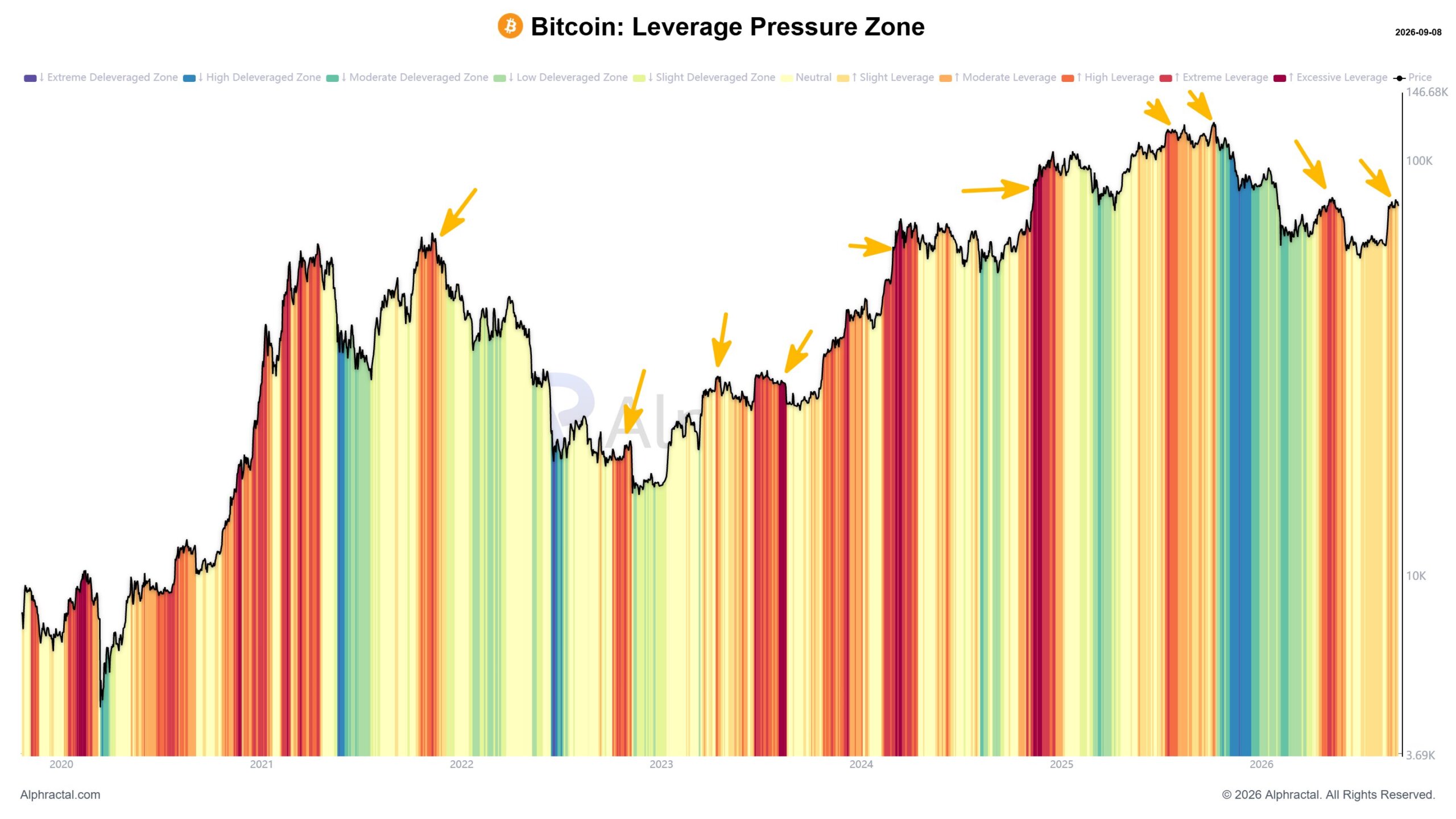
Bitcoin has so far absorbed Brent above $100, a 10-year Treasury yield near 4.8% and growing expectations for another Fed increase without surrendering the upper-$70,000 range.
Friday's inflation report now offers a harder test. A cooler reading could relieve some of the rate pressure accompanying the oil shock. An upside surprise would force Bitcoin to defend that resilience while yields rise and an increasingly leveraged group of traders is positioned for the price to move the other way.
Source: CryptoSlate