



FILTERED RESULTS
FILTERS
MCap $2.9T 0%24h Vol $89.8B 0%Fear & Greed 65/100Alts Index 59/100
BTC.D 59.2% -0.2%Stable.D 9.1% 0%ETH.D 11.3% -0.1%Others.D 20.4% +0.3%
BEAM$0.00254968+19.39%•HNT$0.5924+16.07%•AKT$0.7808+15.88%•PROS$0.8248+14.97%•RAIN$0.0119+13.7%•AXS$1.358+13.34%•FET$0.2530+12.01%•ORCA$2.010+11.48%•GEOD$0.3154+9.92%•DRV$0.4134+9.66%•
BR$0.4591-20.64%•BTW$1.179-18.64%•STONK$0.1996-14.92%•AI$0.1145-14.87%•NIGHT$0.0443-7.4%•CARDS$0.2464-5.95%•S$0.0407-5.89%•CAP$0.0653-5.28%•SUPER$0.2508-3.64%•MINA$0.1577-3.31%•
•
·
·
FILTERED RESULTS
S&P Global Ratings has launched a new risk assessment framework for onchain lending
KLEA Crypto Daily: Sunday, October 04, 2026
Grayscale's Zach Pandl to Present Zcash Investment Case at Digital Asset Yield Summit in Singapore
S&P Global Ratings Introduces Risk Assessment Framework for Onchain Lending Vaults
SEC Commissioner Hester Peirce: Strict Regulation Ended Up Favoring "Useless" Meme CoinsOutgoing...
Nikkei 225 opens up 756.45 points, up 1.11%
149,600,000 $USDC (149,603,889 USD) transferred from #Aave to Unknown Whale 1...
Zcash Advocacy Group Registers First Lobbyist in Washington, D.C.
Crypto Weekly: ZEC Plunges as Bitcoin and Ether Hold Key Support Levels
Glassnode Identifies Key Liquidation Cluster for Bitcoin at $90,000
Ethena-Linked Wallet Withdraws $27.96 Million in ENA from Bybit
Galaxy Finds 7 in 10 Polymarket Retail Traders Lost Money
Ethereum’s past outflow charts can change when more exchange wallets are identified
Bitcoin Market Sees Divergence as European Demand Surges
Former SEC boss made AI Czar, Bitcoin may hit $600K this cycle: Hodler’s Digest
Atkins Vows More Crypto Rule Changes to Keep Markets Onshore
Coinbase's Base Network Attracts $4.7 Billion in Net Inflows in 2026
IMF Approves $138M for El Salvador After Bitcoin Accumulation Waiver
Bitcoin’s $85,000 recovery awaits proof that ETF investors kept buying after payrolls
Community Bankers Sue US Banking Regulator Over ‘Side Door’ Crypto Charters
Bitcoin ETFs Took In a Provisional $82.9 Million This Week…
*S&P 500 CLOSES UP 0.1%, NASDAQ UP 0.2% ...
ETH falls below $2,700, up 0.04% on the day
Bitcoin Core’s new fix closes gap that could redirect funds without stealing keys
Bitcoin Liquidation Map Shows $90,000 Short Squeeze Zone
Cardano Founder Tells UN Crypto Is Entering A New Era Of Exponential Growth
XRP News Today: Chart Points To $11 Long Term, But $1.66 Must Break First
Zcash Price Slides 23% as Grayscale ETF Hits Reverse
Bitcoin and Ethereum ETF Weekly Flows: The Good, the Bad, and the Concerning
New Treasury rules could change how stablecoin issuers get your dollars back
India’s local crypto exchanges get just 0.7% of inflows, Chainalysis reports
Cathie Wood Projects Bitcoin Price Could Reach Up to $2.4 Million by 2030
Polymarket CEO shayne_coplan TEASES TOKEN2049 ANNOUNCEMENT ...
There's an election next month: State of Crypto
Ripple and XRPL Foundation Launch XRP Asia in Seoul as…
4,500 $BTC (383,961,630 USD) transferred from unknown wallet to unknown new...
Ripple President Reveals Plan To Let Payment Customers Borrow Against XRP
SEC Approves Listing of Bitcoin ETF Targeting 3x Daily Futures Moves
Drift hack recovery opened near one cent per dollar lost
Security firm: Revenue Family involved in malicious authorization to steal users' USDG
Trump Taps Jay Clayton, the SEC Chair Who Sued Ripple, to Lead AI Push
What Could Decide Bitcoin’s Q4? The Fed, Bond Yields, and One Crucial Price Level
Vitalik-inspired AI payment system can send expired deposits to its treasury
Tokenized Stocks on Solana Reach $12.4 Billion in Trading Volume in 2026
NEAR Intents Recovers Full $3.8M Stolen in Omni Contract Exploit
Japan Sanctions Garantex as Russia Crypto Crackdown Expands…
Drift Hack Victims Get Their Money Back, 1 Cent at a Time
sunrise ENABLES ACCESS TO $SHIB (Shibtoken) MEMECOIN ON solana LaunchOnSF AND Pumpfun NOW...
Banking Group Sues to Block Crypto's 'Side Door' Into the Banking System
Lido’s proposed staking route needs over 13 times the default entry bond
3x Bitcoin and Ether futures funds clear SEC listing hurdle
Russia Uses Digital Ruble for Salaries After $192,000…
$6 million in wstETH drained from a Base vault controlled by an anonymous 3-of-7 SafeRead...
$6M Vanishes From Crypto Vault Controlled by 7 Mystery Signers
Binance Founder Comments on SAFU Fund's Bitcoin Profit
Base Vault Hack: $6M in wstETH Drained After Attacker Gains Whitelist Access
Billionaire Grant Cardone: Tech giants issued US$66 billion in high-yield debt to seize the AI market; yields will fall if expectations miss
Binance's SAFU Fund Surpasses $1.27 Billion in Bitcoin Holdings
Bybit's weekly platform updates General• ByPicks is live: free picks across crypto, sports and...
'Uptober' Starts Green as Bitcoin ETFs Draw $134 Million
America’s Middle Class Is Getting Crushed: Where Does Bitcoin Fit?
Ethereum's zkAPI Breaks the Link Between AI Prompts and Payers
IMF Releases $138 Million to El Salvador Despite Missed…
Greenfield Files Regulatory Complaint Against Safe Ecosystem Foundation with Swiss Authorities Over Governance Issues
Hyperliquid broker HyperLink completes $2.5 million funding round with participation from Alliance and others
RWA Foundation Reports $6.2 Billion Tokenized Credit Market Amid Holder Growth
‘More Orange Than Ever’: Saylor Stirs Strategy Bitcoin Buy Speculation
CoinW Lists SI Perpetual Contract with Up to 50x Leverage
Strive CEO Indicates Potential Increase in Bitcoin Holdings
Bitcoin’s $84K rally isn’t saving miners as difficulty signals already flash caution


Bitcoin’s post-retarget relief for miners was real, but narrow.
Using a BTC price of $84,751, the completed difficulty increase and the latest gross hashprice is about $40.31 per petahash per second per day. That is roughly 2.65% above the prior modeled baseline.
However, the next difficulty estimate is pointing 2.48% lower. The estimate came after only 14.43% of the new epoch, making it an early signal from slower blocks rather than a result or proof that miners were switching off.
The two readings are compatible. Price had restored a modest amount of gross revenue per unit of computing power after the Sept. 19 retarget. The early block pace showed that the network’s next adjustment remained unsettled.
Bitcoin mining economics improved versus the prior model
A Sept. 15 CryptoSlate analysis calculated that BTC would need to reach about $82,877 to neutralize the revenue-per-hash impact of the difficulty increase then forecast for Sept. 19. That was a modeled network threshold, not an industry-wide production cost.
The realized adjustment was less severe than projected. Mempool’s completed difficulty history shows difficulty rose 4.1634% at block 967,680 on Sept. 19, from 127.451 trillion to 132.757 trillion. At press time, CryptoSlate’s Bitcoin market page showed $84,751, which was about 2.26% above the prior model threshold.
Relative to the Sept. 15 model inputs, BTC’s price had risen about 7.07% while realized difficulty increased 4.16%. The price-to-difficulty ratio improved roughly 2.79%. Including the lower recent fee average, theoretical gross hashprice was about 2.65% above the prior baseline.
| Indicator | Frozen value | Comparison | Interpretation |
|---|---|---|---|
| BTC price | $84,751 | 2.26% above the $82,877 model threshold | Price cleared the prior revenue-per-hash hurdle |
| Mining difficulty | 132.757 trillion | Up 4.16% on Sept. 19 | Competition for each unit of reward increased |
| Theoretical gross hashprice | About $40.31 per PH/s per day | About 2.65% above the prior model baseline | Gross network revenue per unit of hash improved modestly |
| Fees in the 144-block sample | 0.01422626 BTC per block | 0.45% of total rewards | Fees added little support in this window |
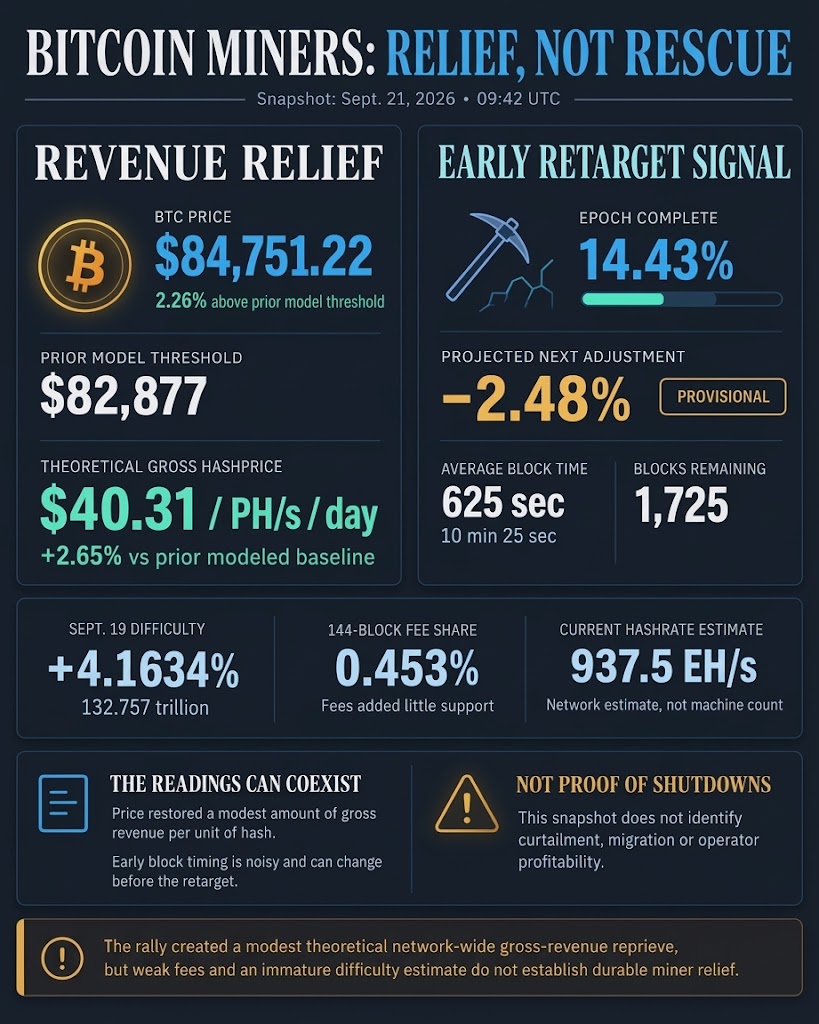
The hashprice estimate uses the 3.125 BTC subsidy, the observed average fee, the frozen BTC price and the network difficulty. It is a theoretical gross revenue benchmark, not reported realized revenue or profit.
Fees offered little extra protection in the measured window. Mempool’s reward statistics show that blocks 967,828 through 967,971 generated 2.04858206 BTC in fees, averaging 0.01422626 BTC per block. Fees were about 0.45% of the 452 BTC total reward across those 144 blocks.
That figure should not be extended into a durable fee regime. It says only that miner revenue in this sample remained overwhelmingly dependent on the block subsidy and BTC price.
Network hashprice also cannot determine which operators were profitable. Fleet efficiency, power contracts, financing, staffing and other costs differ across businesses. As prior CryptoSlate mining analysis documented, the same network revenue level can affect operators differently because their cost structures differ.
The projected difficulty decline is an early signal, not a result
The frozen Mempool difficulty snapshot placed the new epoch at 14.43% complete. Blocks had averaged 625.3 seconds, or about 10 minutes and 25 seconds, with 1,725 blocks remaining. On that pace, the estimate pointed to a 2.48% difficulty reduction around Oct. 3.
Bitcoin recalibrates difficulty every 2,016 blocks to bring average production back toward one block every 10 minutes, as the Bitcoin developer guide explains. Slower-than-target blocks therefore push the next estimate lower.
But a difficulty projection is not a direct count of active machines. Block discovery is stochastic, so short samples can change sharply even if underlying computing power has not made an equally sharp move. Hashrate Index research found that constant-block-time forecasts are especially inaccurate near the beginning of an epoch.
Technical work by Pieter Wuille and academic research on Bitcoin block arrivals support the broader point that early block timing is a noisy hashrate signal. The evidence does not justify treating the Mempool estimate as a diagnosis of shutdowns, curtailment or equipment migration.
Mempool’s one-month estimated hashrate series ranged from roughly 826.1 EH/s to 1.053 ZH/s, while its current estimate was about 937.5 EH/s. Within that observation window, the series showed no sustained, obvious cliff.
Those figures are estimates inferred from block production, not direct readings from every mining machine. They cannot rule out changes at individual operators, and the current estimate should not be confused with the latest daily observation. They show only that the available network series did not display the kind of persistent collapse that would make a broad shutdown claim defensible.
The early retarget reading still matters. If slower blocks persist as the sample grows, the projected decline becomes more informative and a lower completed difficulty would reduce the amount of work competing for each block reward. If blocks accelerate, the estimate can shrink or reverse before the retarget.
What would make the improvement durable
The next test has three parts: BTC price, transaction fees and the maturing block sample.
Price remaining above the prior modeled hurdle would preserve the relief created by the rally. A larger fee contribution would add a second source of revenue instead of leaving miners almost entirely dependent on subsidy and price. A downward retarget that survives a much larger share of the epoch would provide stronger evidence that effective network hashrate had softened.
Even then, network data would not identify the operational cause. Previous CryptoSlate reporting has tracked large AI infrastructure commitments across public miners, but that sector shift does not explain this snapshot’s slower blocks without operator-level evidence.
For now, the strongest conclusion is narrower. Bitcoin’s rally more than offset the finalized difficulty increase in a theoretical network-wide calculation, producing a modest gross-revenue reprieve. Weak fees and an immature next-retarget estimate leave the durability of that relief unresolved.
Source: CryptoSlate