



FILTERED RESULTS
FILTERS
MCap $2.9T +0.5%24h Vol $93.7B -13%Fear & Greed 74/100Alts Index 47/100
BTC.D 58.6% +0.2%Stable.D 9.2% 0%ETH.D 11.3% -0.1%Others.D 20.9% -0.1%
CAP$0.0846+29.79%•BP$1.487+23.22%•BTW$1.422+22.6%•MON$0.0327+15.39%•JASMY$0.0057337+10.87%•PURR$0.1621+10.81%•VELO$0.00574538+10.32%•STX$0.3820+9.98%•NIGHT$0.0407+8.71%•HUMA$0.0330+8.25%•
STONK$0.2313-20.63%•AI$0.1487-17.91%•QNT$261.54-13.43%•2Z$0.0563-11.83%•MET$0.2959-10.52%•NEAR$4.877-10.2%•WLD$0.4887-9.75%•MARSCOIN$0.1259-9.14%•USELESS$0.2250-9.12%•GRASS$0.6714-9.04%•
•
·
·
FILTERED RESULTS
Variant Fund Analyst Suggests Cryptocurrency Market Bottomed in July 2026
Solana Achieves Record 14 Billion Transactions in Q3 2026
Zano Rewinds Blockchain After Verification Bug Enabled Minting Exploit Affecting Over $200M in...
NEAR Financial Company SVRN Shares Drop Over 20% Amid Security Breach
Can Ethereum Rally If US ISM Moves Toward 60?
Crypto.com and Formula 1: The Miami Grand Prix Sponsorship,…
Zano Says Over $200M in Illicit Tokens Led to 30-Day Blockchain Rewind
Two Men Arrested in San Jose Crypto-Targeted Home Invasion Attempt
2/ Most borrowers answer that with a bigger cushion, and rarely account for how much capital
Oct 1 Update:#Bitcoin ETFs:1D NetFlow: -1,796 $BTC(-$150.24M)7D NetFlow: +3,096...
Drift Launches DFX Claims and Redemptions for April 1 Losses; Each DFX Redeemable for USDT Based on...
Lucas Joins Multicoin Capital's Investment Team to Support Crypto Founders
NEAR Intents and near.com Resume Operations Following $3.8 Million Attack
Drift Launches DFX Claims Recovery Pool for Token Holders
Illinois Delays Controversial Crypto Tax Amid Industry Lawsuit
New York, Wyoming regulators sign pact to coordinate crypto oversight
1/ In an on-chain lending market, borrowers on verge of liquidation don't get to choose
Perpetual Futures Market for Real-World Assets Reaches $117.3 Billion in August 2026
Bitcoin Q3 Strength Faces a Tougher Q4 Test
Data: Coinbase stock token daily trading volume reaches $99 million, cumulative total hits $1.6 billion
NEAR Co-founder: NEAR Intents and near.com Back Online, Exploit Impact Limited to USDT on BSC
Broadcom (AVGO) to lend Anthropic up to $42 billion for AI Chips
Evernorth-Armada II Merger Approved, XRP Treasury to Grow
India’s ED Probes Crypto Transfers in ₹7 Crore Digital Arrest Case
Bitcoin fights for local uptrend as US bond yields drop from new 24-year highs
Robinhood Reports $25 Billion in Crypto Holdings Across 12 Blockchains
Visa: Nearly 17% of stablecoin-linked card transaction volume comes from corporate and commercial card programs
Near Intents Hacked for $3.8M Days After Denying North Korea-Linked Bitget Hacker
Trump Just Declared the Super Intelligence Era in the “Unites States.” So Who Controls It?
Reddit to end RSS support on November 13, plans to shut down public API in March 2027
Lloyds Sends Visa $750K in USDC While Banks Are Closed
NEAR Intents Attackers Linked to Lazarus Group
ARK Invest Projects Significant Growth for USDe Supply
Pharaoh Exchange Achieves Record Monthly Volume and Fees on Avalanche
NEAR Price Slides 13% as Exploit Claims Rattle Sentiment
Bitcoin Price Faces $90,000 Wall as Whale Orders Stack Up—Here’s What’s Next
Total crypto liquidations hit $164 million in past 24 hours, mostly longs
Raydium's tokenized stock trading volume rose to about $2.8 billion in September, hitting an all-time high
Hyperliquid Policy Center Urges EU to Apply MiFID II Rules to Crypto Perpetuals
SBI Completes Bitbank Deal to Broaden Digital Asset Operations
Illinois Delays Digital Asset Tax to July 2027 Amid Lawsuit
Monad hints at privacy service launch on October 6, MON surges over 17% intraday
Chainalysis Escapes 15 Celsius Claims, but $3.3B Audit Case…
NEAR Intents attacker possibly linked to Lazarus Group
650 $BTC (54,608,117 USD) transferred from Coinbase Institutional to unknown wallet...
Bitget and Liquid Breaches Drove Crypto Losses to $766M in September
Crypto for Advisors: The CLARITY Act failed, but the rules came anyway
NEAR Intents Exploited for Over $3.8M, Vulnerability Patched with Full Reimbursement PledgedNEAR...
The Meme Coin Most Likely to Explode in October, According to 3 AIs
629 $BTC (52,712,456 USD) transferred from unknown wallet to Coinbase Institutional...
Litecoin Foundation Partners with Greywick Digital to Launch cLTC on Canton Network
Bitget Has Launched an Enhanced-yield Earn Program With Rates of Up to 12% Per Year
Illinois Agrees to Delay Rollout of 0.2% State Crypto Tax
zachxbt SAYS Algorand IS A “POVERTY ECOSYSTEM SO EXPLOITERS THINK IT IS NOT WORTH LOOTING...
NEAR Intents pauses cross-chain trading after $3.8 million exploit in Omni deposit and...
Tron Inc. Continues Daily Purchases of TRX for 252 Days, Holding Over 716 Million Tokens
Ripple Labs Launched Asset Tokenization on XRP Ledger in Brazil
158,315,201 $TRX (52,705,792 USD) transferred from unknown wallet to unknown wallet...
California Governor Signs Executive Order Requiring State Agencies to Continue Using "AI" Terminology
Evernorth and Armada Acquisition Corp. II Merger Approved, Plans Nasdaq Listing
Evernorth’s Shareholders Approved the XRPN Merger;…
Armada Acquisition Corp. II shareholders have approved its business combination with
World Liberty Financial Launches WLFI Staking Program with $1.25 Million Rewards Pool
250,000,000 $USDC (250,022,874 USD) minted at USDC Treasury...
Waller: AI agents now account for about half of FRED traffic; FRED launches MCP Connector
NEAR Intents hit by $3.8 million exploit as crypto's rough year of hacks continues
U.S. September ISM Manufacturing PMI falls to 54.5, prices index rises to 77.9
StraitsX to natively issue XSGD and XUSD on Monad in early 2027
Bitcoin Records 44% Gain in Q3 2026, Its Best Quarter Since Early 2024
Treasury will let states file for stablecoin approval before finishing their rules


Treasury's Sept. 30 rule lets states preserve a path toward stablecoin-regime approval while their rules remain unfinished, by filing an initial certification on time and completing the work before substantive review.
The interim final rule sets forms and review procedures for the Stablecoin Certification Review Committee, the federal body that reviews state stablecoin regimes. The Committee says conditional or incomplete certifications can satisfy the initial filing timeframe, even when additional state legislative or regulatory action is planned.
The rule took effect Sept. 30, but says certifications will not be accepted until after Paperwork Reduction Act approval of the information collection. Treasury will post a notice announcing when acceptance begins.
The flexibility matters for state-qualified payment stablecoin issuers with no more than $10 billion in consolidated outstanding payment stablecoin issuance. They may opt for state regulation if the state regulator certifies that its regime meets Treasury's substantial-similarity criteria and the Committee unanimously approves it as meeting or exceeding the standards and requirements in section 4(a) of the GENIUS Act.
Treasury's separate proposal on substantial similarity addresses the standards used to compare state and federal regimes. The September procedural rule does not finalize those principles.
How a filing reaches substantive review
A conditional filing can be amended at any time. It does not begin substantive review or start the Committee's 30-day approval-or-denial clock. That clock applies only once a certification has been submitted in accordance with the procedures.
For that purpose, a state must provide an unconditional attestation signed by an authorized representative, a detailed explanation of how its regime meets Treasury's similarity principles, supporting legal materials and information the Committee deems necessary.
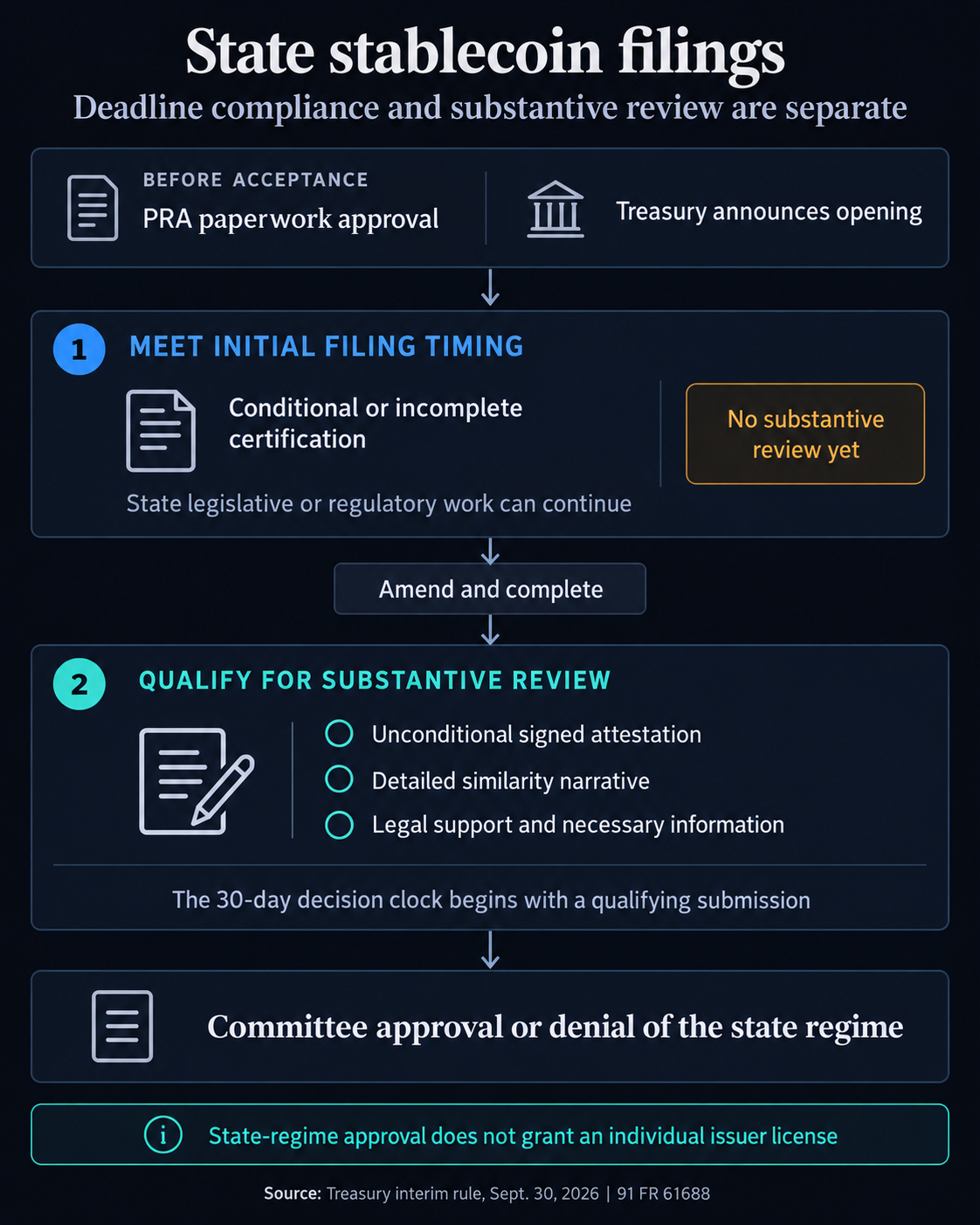
The distinction gives states room to finish their legislative or regulatory work after meeting the initial timeframe. It does not automatically approve their regimes or grant licenses to individual stablecoin issuers.
CryptoSlate's July deadline coverage described the difficulty of assessing state equivalence while federal, Treasury and OCC rules were unfinished. The new rule provides forms and review procedures, including initial filing flexibility, while retaining substantive approval requirements.
The rule uses Jan. 18, 2028 for initial certifications, based on its expected Jan. 18, 2027 effective date for the GENIUS Act. The statutory filing deadline is one year after the Act takes effect.
The Act can take effect earlier. Section 20 sets the earlier of 18 months after enactment or 120 days after primary federal payment stablecoin regulators issue any final regulations implementing it.
Comments on the interim procedures are due Nov. 30.
Source: CryptoSlate