



FILTERED RESULTS
FILTERS
MCap $2.8T -2%24h Vol $14545.2T +13126722%Fear & Greed 64/100Alts Index 53/100
BTC.D 59.5% +0.7%Stable.D 9.5% +0.2%ETH.D 11.1% 0%Others.D 19.9% -0.9%
MET$0.4752+47.62%•STRK$0.0580+16.94%•W$0.0161+15.09%•JUP$0.3697+14.92%•ALGO$0.1321+13.35%•CRV$0.3835+10.31%•JTO$0.5588+9.74%•CVX$2.275+8.6%•TIA$0.4829+7.79%•ATOM$1.795+6.91%•
MINA$0.0826-17.58%•BP$1.053-16.35%•NMR$14.014-12.01%•DRV$0.3630-11.6%•BR$0.5392-10.74%•PUMP$0.00570333-10.57%•USELESS$0.1916-9.27%•VVV$23.846-9.17%•ZEC$1,203.84-7.34%•GRASS$0.5988-7.28%•
•
·
·
FILTERED RESULTS
Sui’s Hashi to launch with $500M in Bitcoin finance commitments
AI Trading Startup Catalyst Secures $30 Million in Seed Funding
Important Ripple News and XRP Price Update: October 8
Greece Lowers Proposed Crypto Tax Rate to 10% in Public Consultation
THORChain made 63% of its record $3 million September income during the Bitget hack-linked trading surge
Chainlink, Cardano and Solana lose key support as short-term price targets turn bearishRead...
ESMA calls for EU crypto firms to fully exit stablecoins that do not...
Morning Minute: Ethereum Researcher Says AI May Break Crypto Encryption Before Quantum
Bitwise CEO Hunter Horsley says AI and crypto are "cut from same cloth" and that it
Binance Founder Warns Against Public Wi-Fi After User Reports Wallet Theft
Bitcoin and ether holders urged to enter ‘bunker mode’ against possible AI attacks
Bitcoin mined for pennies in 2010 moves after 16 years, now worth $8.5 million
New TradFi Perpetual Contract Listing: NKEUSDT, LULUUSDT, and ACNUSDT#Bybit #NewFinancialPlatform...
Manhattan Jury Convicts Hacker for Uranium Finance DeFi Exploits
Bitcoin Price Keeps Falling: Here’s What Is Driving the Sell-Off
ESMA Sets Jan. 8 Deadline for EU Firms to Exit Non-MiCA Stablecoins
Shanghai adds 13 newly registered generative AI services, bringing total to 253
Webull plunged 32% on report of ‘structural’ ties to China
Cointelegraph Denies Sale Report as Website Traffic Falls…
Uranium Finance Hacker Who Bought Pokémon and Magic Cards Convicted Over $50M Theft
Samsung’s Record 107 Trillion Won Quarter Jolts Micron
Samsung Partners With Solana to Bring Stablecoin Transfers…
SEC’s Regulation Crypto Assets Comment Period Ends October…
ETHEREUM L2 Starknet CONSIDERING BECOMING AN L1 BECAUSE OF QUANTUM THREAT AND AI...
Chainlink launches institutional financing solution Fulcrum, adds 40 integrations in September
ESMA Tells EU Crypto Firms to Exit Non-MiCA Stablecoin Exposure by Jan. 8The European Securities...
Polymarket Prices an Iran Blockade That Won’t End Soon
US Government Shifts $770M in Bitcoin as Mystery Wallets Emerge
79thVault Hack: $12.5M Drained From 79AU Pool on BNB Chain
Standard Chartered Plans Crypto and Stablecoin Custody in Singapore for Institutions
Cuomo Fires at Crypto’s Lopsided Political Gamble
Hunter Biden’s LAPTOP Coin Surges After Crash Probe
622 $BTC (51,362,182 USD) transferred from Coinbase Institutional to unknown wallet...
Base Announces Plans to Tokenize Around 500 Stocks by Year-End
Bitcoin ETF investors head for the exit, and it's the biggest rush in months
Crypto ETFs Lose $650.6 Million on October 7 as BlackRock…
TOKEN2049 Singapore Day 2: Wall Street, Coinbase Global Exchange, Cardano’s Midnight, AI, 2027 Expansion
Moscow Exchange Plans to Open Cryptocurrency Trading from December 1
Google Launches a Platform for Creating Games Using Prompts
622 $BTC (51,428,576 USD) transferred from Coinbase Institutional to unknown wallet...
“We aim to launch our custody offering to hold selected crypto, stablecoins and tokenized real
Former Senator Blanche Lincoln Advocates for Kalshi Amid Regulatory Debate
Binance Wallet Launches Zest Protocol (ZEST) Trading Competition, Distributing $200,000 in Rewards Across Two Rounds
Ripple Custody Platform Adds Support for Canton Network Assets
Binance Alpha Trading Competition: Trade Zest Protocol (ZEST) and Share $200K Worth of Rewards (2026...
Ethereum Is About to Lose Its Steadiest Buyer as BitMine Nears a 5% Cap
Why Is Jupiter Price Up Today? JUP Jumps 13% as Solana Slips
BitMine’s Ethereum buying spree could end in six weeks
Bitcoin’s failed breakout reveals a dangerous mix of thin volume and easy profits
Bitcoin and tech stocks under pressure as rising Treasury yields, higher oil prices and a...
SoFi Launches Stablecoin Card Settlement on Mastercard, Projecting $25 Billion in Annual Transactions
Sui's Bitcoin financial infrastructure Hashi to launch mainnet this month, with over $500 million in capital commitments
Hong Kong announces 4.00% interest rate for Silver Bond Series due 2027
China Denies Allegations of AI-Driven Cyber Attacks on South Korean Financial Institutions
Live news: Risk assets under pressure as bond selloff and oil rally intensify
Former PlayStation Exec Slams Sony's Move to Kill Discs: 'What Are You Buying?'
Hyperliquid (HYPE) Price Holds Near $87 After Pullback From $98 Peak
622 $BTC (51,461,639 USD) transferred from Coinbase Institutional to unknown wallet...
XRP Price News: Two Charts Point To $50 If XRP Holds Its Retest Zone
Anthropic IPO: Research Firm Values AI Company At $150 Billion, Calls Offering ‘Most Ridiculous Of 2026’
Starknet Considers Becoming An L1 To Build A Quantum-Resistant Network By 2027
UK 20-year government bond yield hits 6% for first time since March 1998
Ripple Expands into Prime Brokerage with $1.25 Billion Acquisition of Hidden Road
Spot silver falls over 2% intraday, now at $58.56/oz
Greece Plans 10% Crypto Capital Gains Tax, Down From 15% Floated in June
$DRV listed on Lighter perps・
ESMA orders EU crypto firms to phase out non-MiCA compliant stablecoin services within three...
Data Breaches at South Korean Banks Linked to AI Attacks
Vietnam to explore independent digital asset regulatory framework to modernize financial system
Bitcoin just hit a decade-low S&P 500 correlation, but the daily data tells a different story


Investors holding Bitcoin alongside US stocks cannot tell whether their portfolio has become safer simply from a negative correlation between the assets’ price paths. A historical comparison through September 4 shows why: Bitcoin and the S&P 500 can move further apart over a year while still posting losses on many of the same trading dates.
Crypto asset manager Bitwise’s September 7 Market Compass described its 260-day correlation as the lowest since 2015. Its chart measures the logarithms of price levels. In CryptoSlate’s calculation using FRED data, that measure was about −0.62. Correlation between percentage returns over 260 common trading observations was +0.40.
The two figures measure different things. The first tracks how the two price paths moved over the period. The second tracks whether their percentage gains and losses tended to move together. Neither shows on its own that Bitcoin will offset losses when stocks fall.
The FRED prices are also recorded at different times of day. The comparison uses available daily observations, not simultaneous closing prices, so it cannot precisely measure how Bitcoin responds to an equity-market shock.
Two prices can diverge while losses overlap
Bitwise explicitly labels its chart as a log-level calculation and credits Bloomberg and Bitwise Europe. The calculation describes medium-term movement in the two price paths. It is not a daily-return statistic, nor should it be treated as a mistaken version of one.
For someone holding both assets, portfolio gains and losses depend on returns. A negative relationship between price levels does not guarantee negative covariance between returns. In simpler terms, two assets can drift in different directions over months while still rising or falling together on individual days. Their volatility and portfolio weights also determine how much that co-movement affects the portfolio.
The FRED Bitcoin observations and S&P 500 series show the difference. Using the last 260 common price dates through September 4 produces a log-level correlation of −0.6161. Using 260 percentage returns, from August 25, 2025, through September 4, 2026, produces +0.3957. Calculating 260 returns requires one additional starting price.
The negative log-level result resembles the trend in Bitwise’s report, but it is a proxy rather than an exact reproduction of its Bloomberg calculation. FRED’s public S&P history covers only 10 years, so it cannot independently establish the full “since 2015” ranking. That historical claim remains Bitwise’s.
The result also changes with the time period. In the same asynchronous data, return correlation was +0.14 over 30 observations, +0.32 over 60, +0.34 over 126 and +0.13 over 500, all ending September 4. Because those windows overlap, they are not independent evidence of a fixed long-term correlation.
A hypothetical portfolio shows what those differences can mean for an investor. Replacing 5% of the equity allocation with Bitcoin increased measured annualized volatility over the 260-return window, from 12.68% to 13.01%. The largest peak-to-trough decline also grew, from 9.10% to 9.98%.
Over 500 returns, the result reversed. The same Bitcoin allocation modestly reduced both measured volatility and maximum drawdown.
| Common-date return window | Allocation | Annualized volatility | Maximum drawdown |
|---|---|---|---|
| 260 observations | 100% S&P 500 | 12.68% | 9.10% |
| 260 observations | 95% S&P 500 / 5% Bitcoin | 13.01% | 9.98% |
| 500 observations | 100% S&P 500 | 16.11% | 18.90% |
| 500 observations | 95% S&P 500 / 5% Bitcoin | 15.73% | 18.66% |
Both windows end September 4, 2026. CryptoSlate calculations used the dated Bitcoin CSV and S&P 500 CSV, with weights reset at every common observation. Fees, taxes, and dividends were excluded. The S&P series is a price index, so these are not total investment-return comparisons. Maximum drawdown is the largest decline from a preceding portfolio peak within the sample.
The table uses prices recorded at different times rather than an executable strategy rebalanced at one shared closing time.
The two windows produced different results. Bitcoin increased measured volatility and drawdown in the 260-return sample, then modestly reduced both in the 500-return sample. A low correlation can diversify one source of risk without making a portfolio less volatile than equities alone.
What happened when equities fell
But full-period volatility is only part of the risk: investors also need to know what happened to Bitcoin when equities fell. The S&P 500 fell on 115 common dates across the 260-return sample. Bitcoin fell on 76 of them and averaged a 1.03% decline across all 115 equity-down observations. Correlation within that subset was +0.29.
Bitcoin fell even more consistently alongside stocks during larger declines. On the 25 observations when the S&P 500 fell more than 1%, Bitcoin declined on 22 and averaged a 2.59% loss. There were only three observations when equities fell more than 2%. Bitcoin fell on all three, averaging a 4.23% decline.
The results describe what happened in this sample, not what caused the moves. Three declines greater than 2% are also far too few to estimate how reliably Bitcoin would behave during a stock-market crash. Changing the window, loss threshold, or measurement time can substantially change results from such a small sample.
What the observations do show is that negative trend correlation coexisted with repeated losses in both assets. Investors cannot translate a chart of diverging price paths directly into an assumption that one holding will offset the other on a bad day.
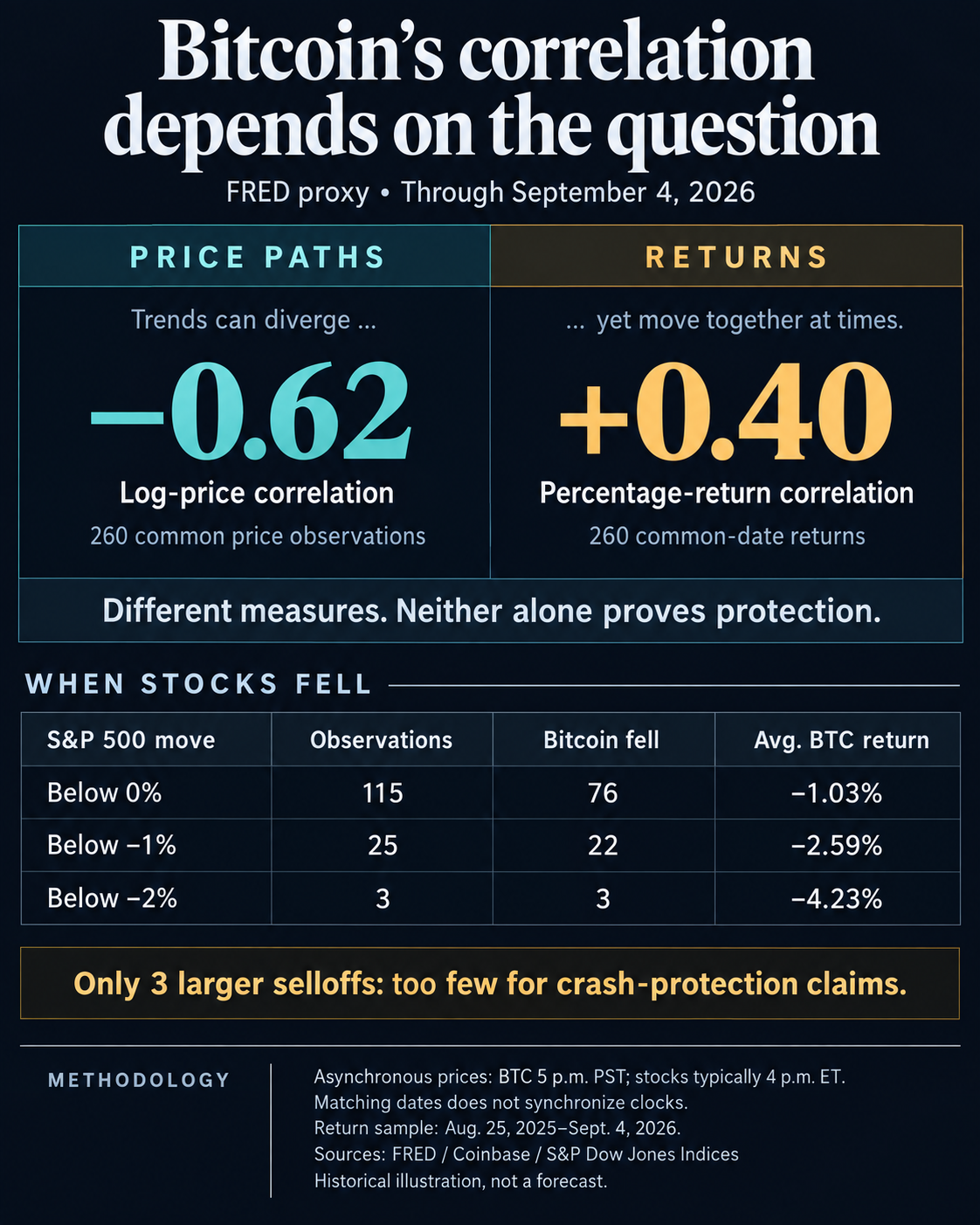
FRED records its Coinbase Bitcoin observation at 5 p.m. PST. Its S&P 500 observation represents the US market close, typically 4 p.m. ET. The two prices therefore share a calendar date but not a timestamp.
The calculations retain dates with valid observations for both assets, then measure changes between consecutive common dates. Bitcoin moves across intervening weekends or holidays are included in the interval. Stock prices are not filled forward to create additional trading observations.
The timing difference can change the result substantially. Moving Bitcoin’s observations back one calendar day changes the 260-return correlation to +0.14; moving them forward changes it to +0.03. Over 30 observations, those shifts produce −0.30 and −0.37, respectively.
Those shifts test possible lead-and-lag effects; they do not create synchronized prices. The sensitivity also means +0.40 should not be read as the exact correlation between Bitcoin and equities at the same moment. Measuring that would require prices recorded at matching times.
Bitwise also stops short of describing the decoupling as a hedge. Its report says a repeat of Bitcoin’s roughly 9,800% rise from mid-2015 to late 2017 is unlikely and warns that decouplings usually do not last.
For investors holding both assets, the numbers answer two separate questions. The negative log-level correlation shows that Bitcoin and the S&P 500 followed increasingly different price paths over the period. Their returns show that the two assets still lost money together on many of the same days.
Portfolio risk depends on the second question as well as allocation size, volatility, measurement time, and the period being studied.
Source: CryptoSlate