



FILTERED RESULTS
FILTERS
MCap $2.9T -0.5%24h Vol $81B -9.8%Fear & Greed 73/100Alts Index 55/100
BTC.D 59.4% +0.6%Stable.D 9.1% 0%ETH.D 11.4% +0.1%Others.D 20.1% -0.7%
NMR$17.388+47.86%•ORCA$2.598+31.28%•CAP$0.0740+13.98%•SENT$0.0264+12.47%•ZRO$2.159+10.98%•RENDER$2.148+8.06%•FIL$1.168+7.72%•CHIP$0.0532+7.64%•RAY$2.198+7.32%•THETA$0.2442+6.29%•
MINA$0.1295-23.35%•BR$0.4000-12.73%•MON$0.0288-9.86%•STRK$0.0519-8.97%•AKE$0.0316-8.47%•SKY$0.0900-8.02%•SAND$0.0663-7.82%•ENA$0.2405-7.27%•FLUID$2.064-7.04%•FARTCOIN$0.1756-6.5%•
•
·
·
FILTERED RESULTS
Self-proclaimed "Godfather" Adam Iza was sentenced to over 6 years in prison for fraud,
UPBIT Introduces Numeraire (NMR) Trading with KRW and USDT Support
Whale transfers 5,513 ETH to Kraken, worth about $14.97 million
Donald Trump bought PTC before $22.6B buyout
$NMR listed on Upbit spot (KRW)・
Ethereum Executes First Atomic L1-to-L2 Transaction on Mainnet
ZRO Price Nears $2.20: Can LayerZero Extend Its Breakout Toward $3.00?
Upbit to list NMR token on KRW and USDT markets
The VIX of bonds is rising but bitcoin and stocks aren't hearing it yet
Stategy’s $21B Bitcoin Quarter Beat Meta Yet 2026 Is Still in the Red
Bitget Stolen Funds Generated $573K in THORChain Fees, Analysis Finds
Google Opens Gemini Omni to Everyone: A Step-by-Step Guide to Creating Free Videos in Vids
Vitalik Buterin Commends Nethermind's Efficiency Enhancements Ahead of Glamsterdam Fork
Soneium Plans to Support On-Chain IP Asset and License Registration Standard ERC-8432
Tokenized stock market cap hits record high of $3.8 billion
El Salvador's $138 Million IMF Disbursement: The Bitcoin Waiver That Wasn't a Win
Stablecoin Wallets in China Surged 43x Even as Beijing Tightened Crypto Rules
Two Wall Street Firms Raise AMD Stock Price Target To $700
How ZachXBT Infiltrated a Crypto Laundering Network Handling Bybit and Other Stolen Funds
Ondo Finance Launches Private Markets Platform for Tokenized Notes
Mastercard Executive Discusses Future of Payments and Stablecoins at OKX NOW Conference
ETH Price Holds $2,700 as Ethereum Economic Zone Runs Atomic L1-to-L2 Mainnet Test
Adam Iza Sentenced to 78 Months for Meta Fraud and Hiring Ex-Deputies
BIT Appoints Former OSL Group CMO Jack Derong as New Chief Marketing Officer
Live updates: A drop below $84,000 could put $80,000 in play for bitcoin
Crypto 'Godfather' Gets Six Years for Hiring Sheriff's Deputies, $37M Meta Fraud
OKX to Launch Tokenized Securities Trading Venue in Collaboration with ICE
NEW: South Korea's finance minister said government will gather industry, expert, and
Binance Introduced Three New AI Products for Trading
Smaller altcoins shine as bitcoin stills trades around $85,000
Arthur Hayes Says Bitcoin Price Hits $1M and Saylor No Longer Matters
Vitalik Buterin: AI Will Become the New UI for Crypto
Hyperliquid’s October 6 Unlock: 9.9M HYPE on Paper, 3.75M…
Hong Kong officials double down on end-2026 deadline for crypto licensing bill
Circle Introduces Aave for Bitcoin-Backed Borrowing in Mint
Ethereum Economic Zone Executes First Atomic L1-to-L2…
BlackRock Maintains No Plans for XRP ETF Amid Rival Funds' Growth
0G Commits S$20 Million to Singapore, Makes City-State Its Global Headquarters
Pi Network’s PI Token Remains Below Key Resistance, Bitcoin (BTC) Returns to $86K: Market Watch
Binance BTC outflows hit highest since mid-2023 as whales deposit stablecoins
Pump.fun Reports $2.8 Billion On-Chain Treasury Dominated by PUMP Token
Pump.fun holds $2.8 billion in on-chain assets, of which $2.19 billion is its PUMP token
AI Tokens Propelled South Korea’s Crypto Market to Top in East Asia — Chainalysis
Solana Foundation has launched an open-source delivery-versus-payment settlement program
NEAR ecosystem wallet MyNearWallet to shut down on Oct 31, users need to migrate
Stablecoin payments firm Rain has applied to OCC to establish a national trust bank
Update on the Collateral Ratio Under Cross Margin and Portfolio Margin (2026-10-09)Binance will upda...
OpenAI Will Introduce Watermarks for ChatGPT Text in the EU
Rain Seeks Federal Charter for National Trust Bank Focused on Stablecoins
U.S. Department of Justice Advances Roman Storm Case Amid FinCEN Developments
NEW: Crypto super PAC Fairshake plans to back 32 House incumbents in U.S. midterms, including
Ray Dalio Just Put a Three-Year Clock on a US Debt Crisis
Ondo opens private markets with tokenized pre-IPO AI exposure
U.S.- China AI race heats up as Chinese rivals secure billions ahead of IPOs
Ethereum Economic Zone contributor Eduardo Antuña said project has executed
Vitalik: AI Will Become the New UIOn October 6, 2026, Ethereum co-founder Vitalik Buterin...
Binance Cold Wallet Holds Nearly 250,000 Bitcoin, Leading the Blockchain Rich List
Ethereum's Glamsterdam upgrade is set to activate on Sepolia testnet later Tuesday,
Bitcoin’s 4chan Prophecy Called the 2025 Top – Now It Targets the Bottom
DigiFT Lists Tokenized Interests in Fidelity U.S. Treasury Money Market Fund
Payward's Bank Deal Lets Institutional Crypto Settle Around the Clock
OKX Money lets users save, earn 10% yield and spend dollar stablecoins in one app
FinCEN Withdraws Rules Targeting Crypto Wallets and Mixers
Why Are COIN, CRCL, HOOD and TSLA Up? Crypto Stocks Rise as Bitcoin Holds $86K
China’s crypto ban Is failing to stop a $176 billion P2P economy
U.S. Rep. Don Davis introduced a bill to ban federal candidates,ir spouses,
Tokenized Stocks Reach Record $3.8 Billion Market Capitalization
Bitcoin Accumulation Builds as $3.3B Leaves Binance Exchange
Spiko completes $90 million Series B round, tokenized cash fund AUM reaches $2.7 billion
Cardano just added the kind of token controls Wall Street wants and DeFi may hate


Cardano’s proposed programmable-token standard could let a freeze on one asset temporarily block unrelated tokens held in the same transaction output.
CIP-113, merged into Cardano’s main improvement-proposal repository on Sept. 29, is designed to add issuer-controlled transfer rules to native assets without abandoning the network’s extended unspent transaction output, or eUTXO, model.
The Cardano Foundation has positioned programmable tokens as infrastructure for regulated financial assets, including stablecoins, securities and real-world assets that may require transfer restrictions, freezes and other compliance controls.
The framework could therefore broaden Cardano’s appeal to institutional issuers while introducing new dependencies for wallets and DeFi applications when several assets share the same output.
However, the milestone stops short of full activation. CIP-113’s official page still lists the proposal as “Proposed,” with its path to Active requiring issuance on Preview and mainnet, end-to-end testing and support from a widely adopted wallet.
Still, Matteo Coppola, chief executive officer of Fluid Tokens and a contributor to CIP-113, hailed the milestone, saying the merge followed years of development and puts the framework in Cardano projects' hands.
“This means the official standard for programmable tokens on Cardano, including securities, is out,” Coppola said, adding that contributors had worked to make it production-ready.
Compliance rules can spill across a shared output
That institutional flexibility comes with a structural complication: on Cardano, the rules governing one programmable token can affect other assets bundled alongside it.
Under the eUTXO model, a transaction output can contain several tokens as well as ADA. Spending that output consumes it as a unit, so a restriction attached to one programmable asset can determine whether the entire transaction goes through.
If an output contains restricted token A, unrelated token B, and ADA, for example, a freeze or denylist rule on A can prevent the holder from spending that output to move B. Neither B nor the ADA has been independently frozen, but both become temporarily inaccessible because they share the same output with A.
CIP-113 provides a way to break that dependency through a restructuring mechanism known as “unfracking.”
The process allows one token policy to be separated from the rest of an output without changing ownership. If the transaction is permitted, A can be moved into its own output while B remains in another output controlled by the same holder. A stays restricted, while B is no longer subject to A’s transfer rule on a subsequent spend.
However, the holder does not automatically control the ability to separate the assets.
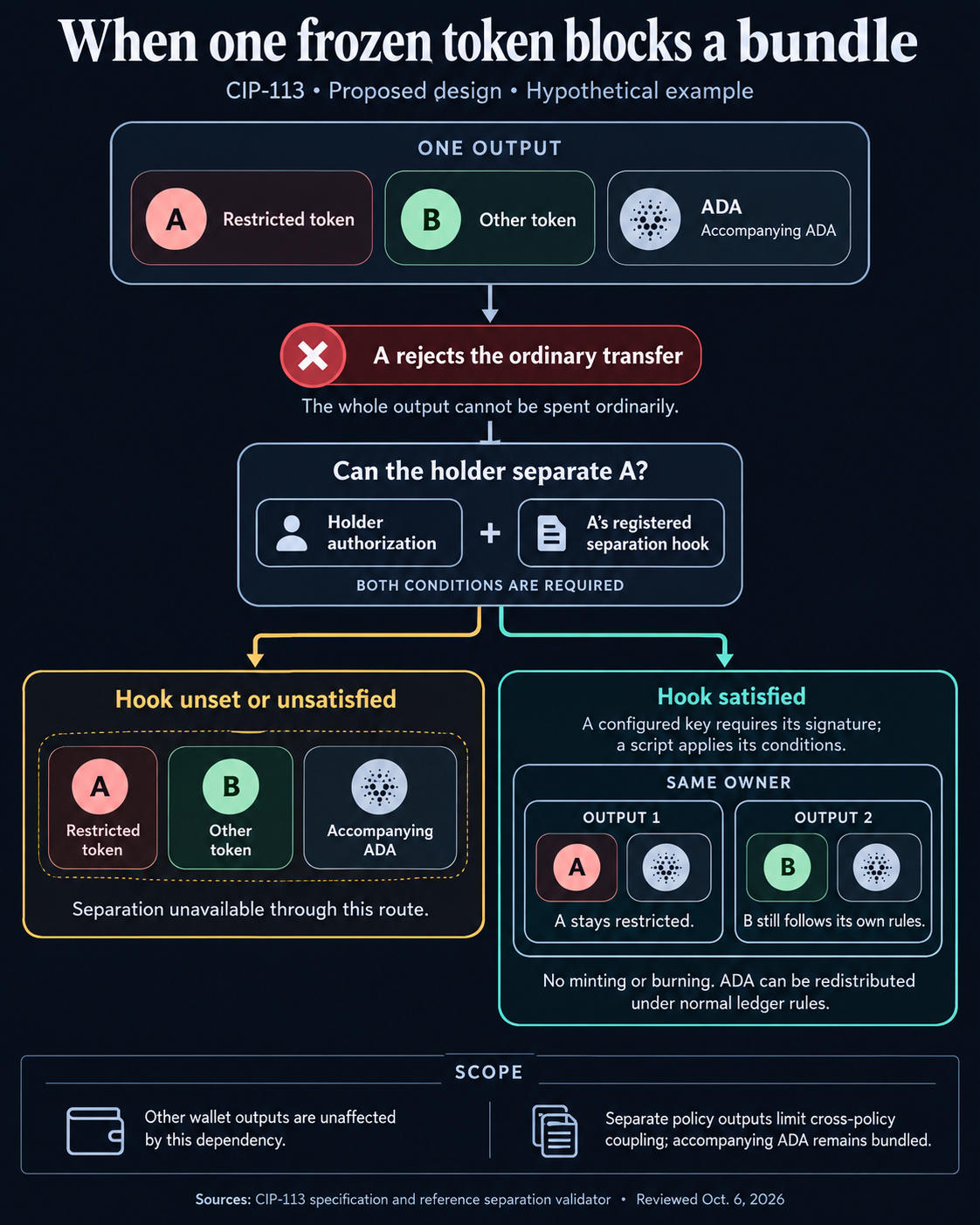
An unfracking transaction requires the holder’s authorization and must also satisfy the affected token’s registered separation rules. Those rules can require an additional signature, impose conditions through a script, or block the restructuring route entirely.
That means a holder cannot always free unrelated assets simply by signing a transaction. If A’s policy does not allow separation, B and the ADA sharing that output can remain inaccessible until the relevant conditions change.
The proposal draws a line between that kind of blockage and seizure. A token issuer’s control over A does not give it ownership of B or other assets in the same output, and the reference implementation is designed to preserve balances belonging to unrelated token policies during authorized third-party actions.
For wallets and DeFi applications, the practical consequence is that asset ownership alone may no longer determine immediate spendability. How tokens are grouped inside an output, and what separation permissions each policy allows, can become part of the risk attached to holding or accepting them.
Wallets and DeFi protocols inherit the design risk
Avoiding that dependency for wallets and DeFi protocols may require changing how assets are packaged before any restriction is triggered.
The CIP-113 reference implementation describes single-policy outputs as the preferred construction, although the validator does not require developers to use them. Keeping programmable assets separate would reduce the risk that one issuer’s compliance action prevents an unrelated token from moving.
ADA remains exposed to the same constraint. Cardano outputs containing tokens also carry ADA, meaning some of the network’s native asset can become temporarily inaccessible when it shares an output with a restricted programmable token.
That adds complexity for wallets. A displayed balance may show what a user owns without revealing what can immediately be spent. Applications supporting CIP-113 may need to track which policies share an output, the permissions currently attached to each asset, and whether a blocked token can be separated.
For lending protocols, the issue becomes a collateral-management risk.
A DeFi platform accepting a programmable token would need to assess whether its issuer can freeze transfers, whether the protocol can authorize separation, and whether those controls could interfere with withdrawals or liquidations. A restriction arriving during a market downturn could be particularly consequential if a lender cannot move collateral when it needs to close an undersecured position.
Those questions are becoming more relevant as Cardano tries to expand its stablecoin and tokenized-asset market. USDCx, backed one-for-one by USDC through Circle’s xReserve infrastructure, has already added another source of dollar liquidity to the network.
CIP-113 could widen that market by giving prospective issuers the compliance controls required for regulated stablecoins, securities, and other tokenized assets while retaining Cardano’s native-asset architecture.
The cost is that wallets and DeFi protocols may have to treat an asset’s permission structure as another layer of financial risk.
Wallet developers could segregate programmable policies by default, while lending protocols may impose lower collateral values, tighter parameters, or reject tokens whose freeze and separation rules create uncertainty around liquidation.
That puts the focus on the first production integrations. As projects adopt CIP-113, their decisions on output construction and issuer permissions will help determine whether regulated assets can plug into Cardano’s DeFi markets cleanly or require protocols to price the risk that compliance controls could restrict access to collateral when it is needed most.
Source: CryptoSlate