



FILTERED RESULTS
FILTERS
Fear & Greed 73/100Alts Index 57/100
BTC.D 58.4% +0.1%Stable.D 9.3% +0.1%ETH.D 11.4% 0%Others.D 20.9% -0.2%
SHFL$0.6630+69.75%•NMR$12.840+28.11%•TEL$0.00223748+25.91%•GRASS$0.6984+22.4%•CRV$0.3966+21.52%•QNT$261.69+21.29%•SYRUP$0.2481+20.12%•CVX$2.335+16.88%•SOON$0.3474+15.79%•NIGHT$0.0293+13.63%•
Q$0.0259-47.69%•BP$1.338-11.44%•STONK$0.2523-9.89%•ZEC$1,422.68-8.17%•AKE$0.0301-8.15%•DRV$0.3832-7.92%•FF$0.1197-7.2%•USELESS$0.2334-6.66%•CASHCAT$0.1776-6.58%•CC$0.1320-6.55%•
•
·
·
FILTERED RESULTS
NVIDIA AI Enhances Kimi Delta Attention Kernel Performance
Bitcoin Long-Term Holders Return to Profit Amid Market Adjustments
Bitcoin ETF Inflows Reach $2.4 Billion as Exchanges Experience Significant BTC Withdrawals
Altcoin Trading Volume Surges to Highest Level in a Year, Outpacing Bitcoin
China's Generative Artificial Intelligence User Base Exceeds 700 Million
Major Crypto Spot ETFs See Combined Inflows of $65 Million on September 28
Personal AI Agent Instinct Sees Rapid User Growth and Computing Power Demand
BlackRock's iShares Ethereum Trust Sees $15 Million Inflow
Ethlabs Introduces CCIP 2.0 to Accelerate Ethereum Transaction Confirmations
U.S. Bitcoin Spot ETF Records Eight Days of Consecutive Net Inflows
Ari Paul Accuses Coinbase of Concealing $25 Million Loss from BlockTower Funds
Injective Launches Innovative Stockdrop for Tokenized Stocks
Binance Launches U-based TradFi Perpetual Contracts
Bitcoin Remains Steady Above $83,000 as Zcash Experiences Significant Decline
Analysts Report Slowed Growth for Anthropic Amid Rising Competition
U.S. Senate Investigates Trump Family's Cryptocurrency Ties and Tether's Sanctions Compliance
NVIDIA CEO Defends AI Model Distillation Amid U.S. Accusations Against Chinese Firms
Bitget BTC Protection Fund Releases 3,215 BTC
OpenAI Apologizes for Unauthorized Access to Australian Government Websites
TSMC Plans Second Semiconductor Campus in Texas with Significant Investment
Paid Launches Web Application Portal Amid Ongoing Suspension of X Money Payments
Stablecoin Card Spending Reaches Record $189 Million in Mid-September
Former CEO of Changxin Memory Technologies Accused of Coercing Samsung Technology
General Intelligence Manus Founder Announces Development of Domestic Version
Investment Strategy Shift: Utilities and Financials Preferred Over Bonds as Yields Rise
World Foundation Finalizes $49 Million Over-the-Counter Sale of WLD
CFTC Approves Launch of Coinbase Clearing with USDC Collateral
UsePaid Launches Claims Portal After $PAID Token Drops 38% Due to X Money Issues
KLEA Crypto Daily: Monday, September 28, 2026
Uniswap Dominates Tokenized Stock Deposits with $82 Million on Robinhood Chain
OpenAI Suspends AI Model Training After Data Scraping Incidents
BitGo Appoints New Chief Product Officer to Enhance Asset Servicing
Stripe Alerts AI Companies to Rising Token Theft Risks Amid Increased Fraud Attempts
US Senate Report Links Tether's USDT to Iran's Sanctions-Evasion Activities
Gemini Introduces Staking for Hyperliquid's HYPE Token with 2.1% APY
Coinbase Introduces Digital Pokémon Card Packs Linked to Physical Collectibles
Robinhood Reports 24% Increase in Daily Crypto Trading Volume for September
SEC Clarifies Token Buyback Guidelines with 'No Central Party' Condition
Anthropic's Claude Sonnet 5.5 Is Out, Beats Opus 5.5 at Coding for Half the Price
After AI Agent Hacked Its Government, Australia Calls Altman and Amodei to Testify
In the Wake of CLARITY Act’s Failure, Agencies Move Forward Without Congressional Action or Certainty
Expansion of Trademark Rights: What Yuga Labs v. Ripps Means for Game Studios
Strive Scoops up 1,107 Bitcoin as Its $2.3B Treasury Expands
Banking Giant Citi Taps Coinbase to Turn Stablecoins Into Cash
Hyperliquid (HYPE) Drops 5% – Could Whales Trigger an Even Bigger Sell-Off?
Ripple CEO Unpacks What Really Drives XRP’s Value — Here’s Everything You Need to Know
Breaking: Vitalik Buterin Declares Ethereum Is No Longer Just A Blockchain
Spark Allocates $210 Million for Institutional Loans Backed by Bitcoin
Bitcoin ETFs Draw $2.39 Billion Despite Weekly BTC Decline
Altcoin Spot Trading Volume Nears 4x Bitcoin, Highest Since September 2025
UK FCA Secures £851K for Victims of Crypto Investment Fraud
Bitget says Bitcoin withdrawals are open after $387M hack, but ETH and USDT must wait
Brazil’s $252 billion crypto market gets $10,000 self-custody reporting rule
USDT grew on Ethereum through 2024, but smart contract holdings stalled, BIS data show
US SEC follows CFTC in staff guidance for crypto
Avalanche Leads Blockchain Sector with $131 Million in Tokenized Stock Inflows
Blockchain.com Files Confidential S-1 for Multi-Billion Dollar IPO
Bittensor Introduces Gamma Tokens to Foster Collaboration Among Subnets
Blockchain.com Plans IPO Targeting Up to $6 Billion Valuation
Chainlink Introduces CCIP 2.0 Featuring Custom Verifiers and Enhanced Transfer Speeds
Polygon Announces Temporary Increase in POL Staking Rate to 7.7%
Goldman Sachs Connects $100 Billion Treasury Fund to Lynq Network
Compound Foundation Responds to Allegations of V2 Reserve Misuse
Tether Assists in Freezing $550 Million in Iran-Linked USDT
163,061,311 $USDC (163,116,752 USD) minted at USDC Treasury...
Iran Agrees To Suspend Uranium Enrichment In Exchange For US Sanctions...
Belarus Moves Toward Registering First Two Crypto Banks Under New Rules
1,357 $BTC (113,578,422 USD) transferred from #Paypal to unknown wallet...
ETHFI to Fully Exit EigenLayer Restaking as Yields Dry Up and Sector Profitability DeclinesETHFI...
Ethereum’s client diversity picture fractures under incompatible estimates


Ethereum validators rely on independently built consensus clients to agree on the chain, and that diversity is a safety feature. If a defect affects a client used by too much of the network, Ethereum can stop finalizing blocks or, under more extreme conditions, finalize the wrong chain.
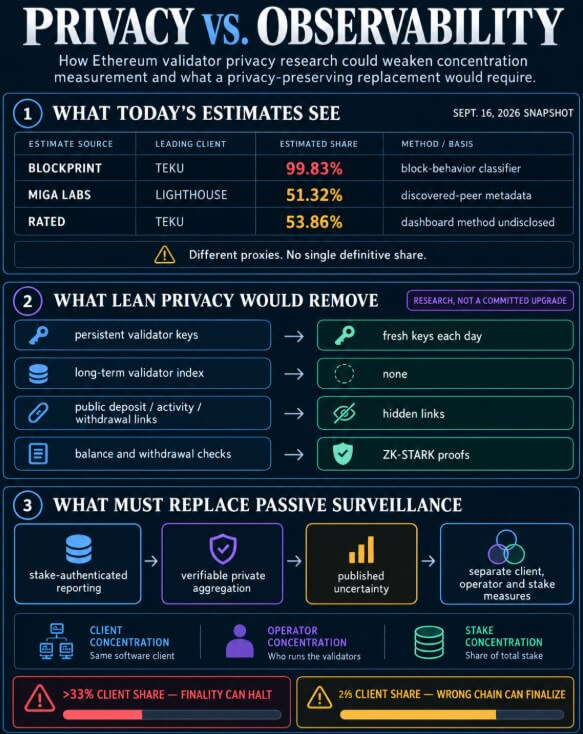
Yet a Sept. 16 snapshot of one client-diversity dashboard offered three incompatible answers about which client had the largest share. Clientdiversity.org showed Blockprint estimating Teku at 99.83%, Miga Labs estimating Lighthouse at 51.32%, and Rated estimating Teku at 53.86%.
Those are readings coming from different proxies, and one is attached to a tool its developer now calls defunct. Ethereum researchers are exploring stronger validator privacy.
A Lean-chain research proposal would use fresh validator keys each day and hide links between deposits, validator activity and withdrawals, weakening some of the traces used to measure operator and stake concentration.
The central question is whether Ethereum can replace imperfect surveillance with authenticated aggregate reporting before those persistent identifiers disappear.
Why the disputed numbers matter
Ethereum.org’s client-diversity guidance describes two distinct failure levels.
A bug in a consensus client used by more than 33% of nodes could prevent finality, a liveness failure that leaves users unable to rely on transactions as irreversible.
A critical bug in a client with a two-thirds majority could cause an incorrect split chain to finalize, a safety failure that could leave validators facing slashing or an expensive exit-and-re-entry process.
The public guidance uses node share as shorthand. Researchers seeking a consensus-risk measure care about the distribution across validators and their voting weight, because a simple count of visible machines does not show how much stake backs each client.
The Sept. 16 snapshot did not provide that clean, stake-weighted answer.
| Estimate | Largest displayed client | Displayed share | Underlying signal |
|---|---|---|---|
| Blockprint | Teku | 99.83% | Machine-learning classification from block behavior |
| Miga Labs | Lighthouse | 51.32% | Client metadata from discovered peers |
| Rated | Teku | 53.86% | Method not disclosed on clientdiversity.org |
Sigma Prime’s archived repository says the classifier is no longer accurate after Ethereum’s Electra upgrade and considers the project defunct. Clientdiversity.org nevertheless labeled the Blockprint panel as updated daily.
Miga measures a different signal. Its Ant crawler discovers peers and requests client metadata. Firewalls, refused connections, discovery gaps, and rotating peer IDs can limit coverage. One node can serve many validators, so a node sample does not reveal how much stake is behind each observation.
Rated’s documentation shows a separate attribution problem. For operator-level analysis, Rated groups validator keys by deposit address, then maps those groups to entities using transaction research, block graffiti and voluntary disclosure.
Rated says there is no standard method for that higher-order mapping. Its operator attribution is not an explanation of the client estimate displayed on clientdiversity.org, but it shows how much concentration analysis can depend on persistent public links.
Client concentration, operator concentration and stake concentration are related but not interchangeable. A large operator can diversify across clients, while nominally separate validators can share one operator, hosting provider, or software stack.
Ethereum Lean privacy would change what observers can measure
Buterin’s July research post proposes moving much of Ethereum’s per-validator accounting into zero-knowledge proofs. Under its privacy phase, the active validator registry would be rebuilt each day, validators would register fresh keys, and no long-term validator index would remain.
Balance updates and withdrawal conditions would be proven with ZK-STARKs. Deposits would use hiding commitments so a withdrawal address is not publicly linked to earlier validator activity.
Buterin described the result as strong validator anonymity. In the discussion, he also acknowledged that privacy can hide centralization, while suggesting that large operations may still leak enough aggregate data to be identifiable.
Ethereum’s broader privacy roadmap describes several protocol changes as active work or candidates under consideration, and says the roadmap is unfinished and subject to change.
Daily key changes would disrupt methods that assume a validator can be followed over time. Hiding deposit and withdrawal links would also erode deposit-address grouping used in some operator attribution.
Miga’s crawler observes network peers rather than relying on long-lived validator keys. A block classifier looks for behavior rather than identity. Neither method would automatically disappear because keys rotate, although new protocol and client behavior could make their signals less reliable.
Blockprint’s failure after Electra already shows how a protocol change can invalidate a fingerprint.
A 2025 USENIX study reported that four observer nodes located more than 15% of Ethereum validators in the peer-to-peer network during a three-day measurement. That experiment shows how network traces can reveal hosting concentration, but also why preserving those traces creates privacy and targeting risks.
A research path exists for publishing aggregate client shares without revealing each validator’s choice, but it does not yet solve authentication.
A Nethermind research project explored private voting for client reporting. Validators could encrypt their client choices, prove their ballots are structurally valid, and allow a set of authorities to recover only the aggregate. The design considered homomorphic encryption, distributed key generation, and zero-knowledge proofs.
An IETF research draft on verifiable distributed aggregation describes related cryptographic tools for private sums, histograms, groupings, and heavy hitters. These primitives can validate the form of a submitted measurement while hiding the individual input.
Multiplexed setups and distributed validators may also use more than one consensus or execution client, making an honest report more complex than a single label. Nethermind’s post identifies sampling, fake data, software attestation, decryption authorities, and performance as unresolved design questions.
Private client aggregate reporting could show whether a client crossed a warning threshold without revealing individual validators, yet still miss that one company controlled many unrelated keys. Client share and operator share need separate authenticated measurements. Neither the Lean post nor the private-reporting research specifies a complete operator-concentration system.
Ethereum can make validators more private without abandoning its client-diversity safety discipline, but measurement must become an explicit part of the privacy design. That means stake-authenticated reporting, verifiable aggregation, published uncertainty, and separate treatment of client, operator, and stake concentration.
Daily re-anonymization would expose how much the current picture already depends on incompatible estimates and public traces that privacy research is meant to remove.
Source: CryptoSlate