



FILTERED RESULTS
FILTERS
MCap $2.8T 0%24h Vol $85.8T +0.5%Fear & Greed 53/100Alts Index 51/100
BTC.D 59.4% +0.1%Stable.D 9.6% 0%ETH.D 10.7% 0%Others.D 20.3% -0.1%
WAL$0.0563+39.16%•Q$0.0496+27.97%•BTW$2.347+23.28%•AI$0.1028+20.01%•PRL$1.905+14.73%•DEEP$0.0237+10.69%•PYTH$0.0841+4.57%•TRAC$0.4368+4.54%•FLUID$2.426+3.42%•PONS$0.3190+3.31%•
GRASS$0.6109-16.06%•BAT$0.1696-15.81%•ZAMA$0.0676-14.55%•CAP$0.0758-14.01%•CHIP$0.0505-13.3%•OP$0.1416-11.45%•SYRUP$0.2083-11.07%•W$0.0154-10.25%•STRK$0.0772-10.04%•JTO$0.4865-9.93%•
•
·
·
FILTERED RESULTS
Whale sells 1,312 BTC for 43,000 ETH over 4 days, sitting on $4.15M unrealized loss
Irene Patrikios Appointed Chief Commercial Officer of Zama
Pear VC Launches $333 Million Fifth Fund
METR Proposes Public Evaluation Plan for Frontier AI "Loss-of-Control Risk"
Market news: First White House AI working group meeting to be held Thursday
Nvidia-backed AI drug company Iambic raises $150 million in US IPO
Doubao Phone Blocked by 155 Apps from Agent Operations, Including WeChat, Taobao, Alipay
Jakub Rusiecki Joins Colosseum as Principal
Bill Gates: AI misuse could trigger more cyberattacks in the coming year; regulation should not rely solely on corporate self-discipline
a16z's David Haber Discusses Advancements in Long-Cycle Intelligent Agents
Getty Images plans to go private through bankruptcy restructuring, existing shareholders to inject up to $433 million
133,898,000 $USDC (133,956,446 USD) transferred from Unknown Whale 1 to #Aave...
Andreessen Horowitz Reduces Post-Investment Recruitment Team
Apple to Launch AI Platform in China This December
ASML CFO Criticizes Proposed U.S. Sales Restrictions to China
Bill Gates Warns of AI Threats in Cybersecurity and Biosecurity
xAI Releases Grok Voice 3.0, Voice API Priced at $0.08 per Minute
Optimism Price Prediction: Can OP Lead Ethereum’s Superchain Boom?
Nikkei 225 Index Plunges 3.00% Intraday, Now at 65,711.85 Points
Korean Exchange Triggers Sidecar Mechanism on KOSPI Index, Suspends Programmatic Selling
KLEA Crypto Daily: Wednesday, October 14, 2026
Evernorth Rings Nasdaq Closing Bell, Showcasing XRP Treasury
Dollar Index Erases All Gains Since CPI Report Release
South Korean stock index opens down over 5%
133,898,000 $USDC (133,955,040 USD) transferred from #Aave to Unknown Whale 1...
Mexico and Brazil Lead Stablecoin Adoption, Ripple (XRP) Survey Says
SEC Approves Cboe's Prediction Market Options Linked to Major Companies
Block says OpenAI tools speed security response; shares edge lower
Brooklyn DA and FBI Crush Massive International Crypto Scam
Starknet Considers Becoming an L1 to Reach Quantum Resistance by 2027
Coins.ph users face app lockout as central bank intervenes
Coinbase's Innovative Cold Storage Key Generation Process Revealed
Circle’s USDC Gains Significant E-Money Token Status in…
Anthropic's Q3 revenue rose to $16.8 billion and turned profitable
Researcher Traces $100 Million Laundering Scheme Linked to Ledger Supply-Chain Attack
Two Polymarket Whales Face Off in $500K Seahawks-Broncos Showdown
SEC approves new binary options tied to Coinbase trading volume and...
Shayne Coplan Renews Speculation About Polymarket Token
Surging dollar forces Bitcoin sell-off as rate hike odds double
VanEck files to withdraw registration statement for Lido staked ETH ETF
US SEC Approves Cboe to List Binary Options Tied to Listed Companies' KPIs
AMD says MMseqs2 and HIPSW++ speed protein search on Instinct GPUs
Godfather of AI and 400 Scientists Want AI Models Cut Off From the Internet
VanEck has asked SEC to withdraw registration statement for a planned Lido
VanEck Withdraws Registration for Lido Staked Ethereum ETF
GitHub replaces stargazer scraping with privacy-safe history API
250,000,000 $USDC (250,104,125 USD) minted at USDC Treasury...
Bitwise CIO Highlights Bitcoin's Resilience Amid Economic Uncertainty
Tempo Launches Zones Privacy System in Collaboration with Deel
Algorand Foundation's Marketing Chief Resigns Amid Leadership Restructuring
SOMEONE PULLS A cryptopunks NFT AFTER SPENDING $150 IN $ETH ON AN NFT GACHAH/T: vangoyaa...
Developer Who Cloned Photoshop With AI Just Did the Same to Microsoft Office
Polygon Rolls Out US-Regulated Payments With Completed Coinme Deal
Organizations join forces to fight Illinois crypto tax, after 6-month pause
250,000,000 $USDC (250,092,749 USD) minted at USDC Treasury...
UK’s FCA Finalises Cryptoasset Perimeter Guidance Ahead of Authorisation Application Window
Securities Enforcement Roundup – September 2026
BitGo Reaffirms Client Asset Protection Amid Expansion into New Services
White House Chief Crypto Advisor Patrick Witt Resigns Amid Legislative Challenges
SkyAI Slides 4.4% as Shareholder Demands Answers Over 70% SOL Treasury Reduction
Bitso Integrates Western Union's USDPT Stablecoin for Mexican Users
Riot Platforms Transfers Bitcoin Custody to BitGo Bank & Trust
Blockaid Reports $86K Drained in UNCX Vesting Pool Exploit
Apple Plans to Launch First Apple Intelligence Features in China in December
Coinbase and Deribit Introduce Six New Equity Perpetual Futures Markets
Binance Research flags crypto market themes in October 2026
4,521 $BTC (370,209,058 USD) transferred from unknown wallet to unknown wallet...
XLM Experiences 4% Decline Amidst Stellar's New Data Services Launch
Top Trending Coins (Today) 1. ASTRO 2. ZYLO 3. PRL 4. NEAR 5. WAL 6. PENGU 7. STRK 8. QTC 9. HYPE...
Lido DAO exposes token flaw and forces a budget review


Lido’s DAO is debating whether its 2027 grant budget should guide automated purchases of the LDO governance token.
The Oct. 7 discussion puts two choices on the table: link NEST’s revenue threshold to approved spending, or periodically clear the buyback engine’s negative spending counter.
NEST had made no purchases funded by its allocator when checked on Oct. 13. Genuine cost cuts could leave more income available for buying, while a reset would only remove past constraints.
Governance contributor Kuzmich proposed the budget link on Oct. 7. In an Oct. 9 response, Jenya_K supported considering it in the 2027 grant request, but said the amount must come from bottom-up planning.
Kuzmich’s Oct. 11 follow-up corrected the treatment of staking rebates and tested profits without assumed treasury income.
What the counter measures
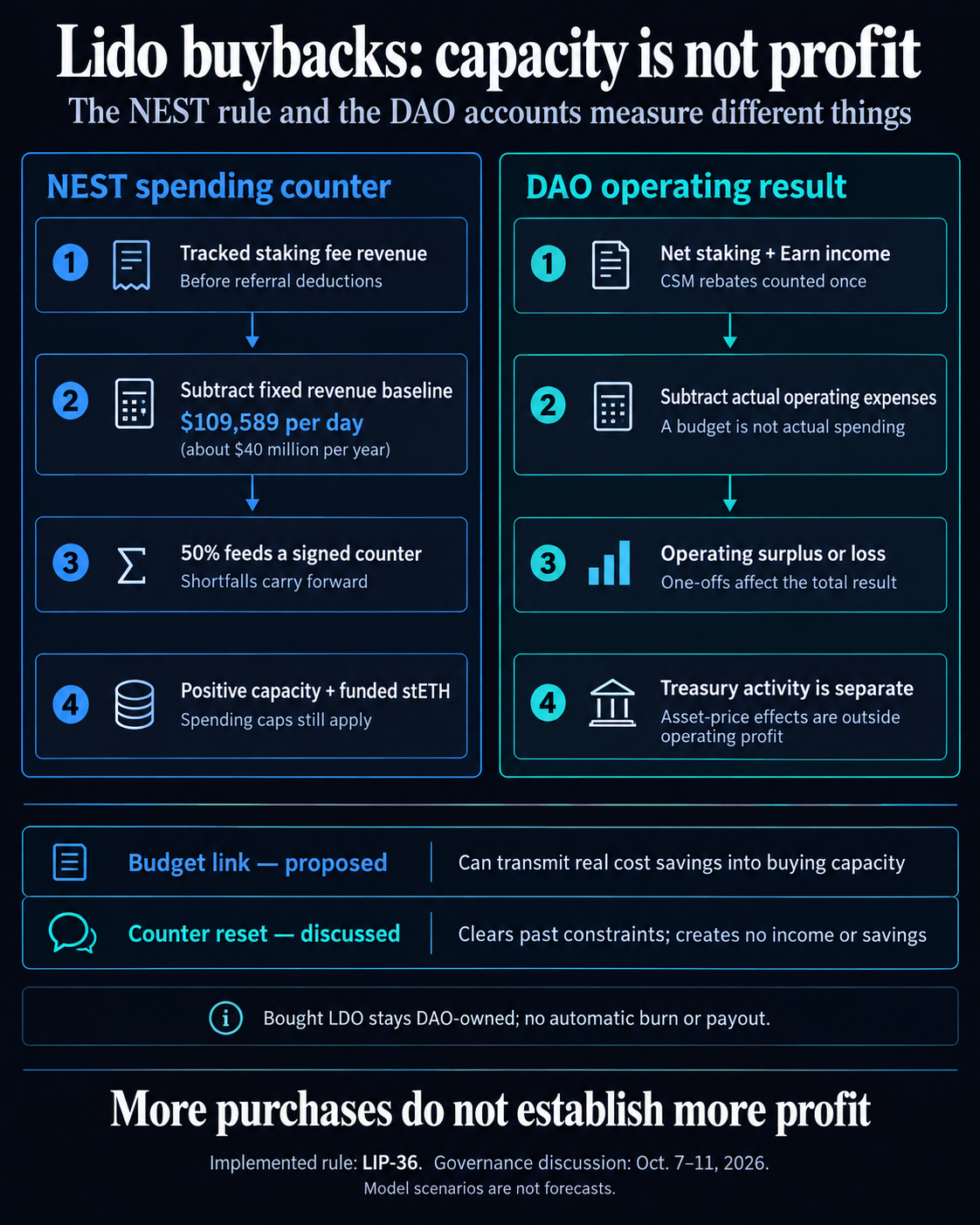
Under Lido’s implemented specification, NEST compares measured staking revenue with a daily baseline of $109,589, approximately $40 million a year. Half the difference feeds a running spending counter.
Revenue below the baseline subtracts from that counter, and stronger revenue must repair the shortfall before purchases can start. A treasury can hold assets while the counter remains negative, and a positive counter would not by itself establish accounting profit.
The latest captured checkpoint on Oct. 13 recorded a counter of minus $564,230.96 and a skipped allocation.
Separately, the allocator held about 41.12 stETH when checked on Oct. 13. Its complete indexed transfer history showed one 41-stETH top-up on Aug. 28 and no outgoing trans
Any future spending must satisfy sufficient counter capacity and funded stETH. It also faces a $50,000 daily cap, a $10 million cap over fixed 365-day windows, and a $1,000 allocation minimum.
Lido’s separate discretionary stETH-to-LDO acquisitions are a different program, and the community reconstruction identifies an August trade as a route test.
NEST does not currently capture monthly Community Staking Module rebates or Earn income. Jenya_K said CSM rebates are already included in financial reporting, so adding them again to reported net revenue would double-count them.
Lido’s unaudited accounts for the first half show $15.7 million in net staking revenue plus $230,000 from Earn, producing $15.9 million in net DAO revenue. Foundations expenses of $14.3 million left an operating surplus of $1.6 million, and a $6 million Kelp-related one-off turned the total result into a $4.4 million loss.
The report separately places $1.4 million of treasury income and a $60.9 million asset-price effect in its treasury bridge, outside the profit-and-loss statement. Jenya_K also warned that treasury operations can include losses.
The 2026 grant request presents a $43.8 million baseline, and the first-half report references $41 million and projects full-year expenses of $37.7 million. The cited materials do not explicitly reconcile the two baseline labels, and none is interchangeable with NEST’s $40 million revenue threshold.
The budget model needs an expense correction
Kuzmich’s Oct. 11 model uses 1,000 ETH price paths over 12 months from Oct. 1, beginning at $2,679.84 with 61% annual volatility and no expected arithmetic price drift. Its purchase frequencies are not measured probabilities of what will happen next.
In the published Oct. 1 simulations under the current rule, mean purchases were about $2.3 million, but the median was zero. Stronger ETH paths lift the average even when more than half the simulations produce no purchases.
Lower budget-linked thresholds produce larger purchases in that model. However, its profit comparison contains a consequential mismatch: the forum says actual expenses match the approved budget, while the code scales a forecast expense curve by each budget divided by $43.8 million.
That curve implies about $39.8 million of expenses across the modeled year before scaling, and only $27.3 million in the row labeled $30 million.
The table below holds the published revenue paths and purchase rules constant, but sets actual expenses equal to each threshold. Profit excludes treasury income and is measured before purchases.
| Annual threshold and actual expenses | Mean modeled purchases | Median modeled purchases | Mean modeled profit before purchases |
|---|---|---|---|
| $40 million | $2.32 million | $0 | −$1.92 million |
| $35 million | $3.35 million | $1.26 million | $3.08 million |
| $30 million | $4.71 million | $3.18 million | $8.08 million |
The expense correction leaves the purchase amounts unchanged because this version of NEST buys against the revenue threshold, without checking actual expenses.
At $30 million in actual expenses, mean modeled profit excluding treasury income falls from the published $10.7 million to $8 million. Among paths with purchases, the fraction ending in a loss rises from 12.6% to 22.2%.
A separate CryptoSlate sensitivity starting Oct. 13, assuming continued funding and using the refreshed counter and explorer ETH quote but unchanged September fee volumes and first-half deduction and Earn assumptions, produced a $2.1 million median for the $30 million case.
The economic direction remains clear within these assumptions: real spending cuts improve the modeled profit balance. Lowering the contract’s threshold alone permits additional buying even when the DAO’s broader operations finish at a loss.
A reset loosens the spending brake
An annual reset would discard a negative counter at a calendar-year boundary while retaining positive capacity.
CryptoSlate’s reset comparison corrects a period overlap in the published script: whole-month purchase totals count September 2028 in two adjacent 365-day profit periods.
That recalculation gives average spending of about $2.6 million per modeled 365-day period with carry-forward and $2.8 million with annual resets, resulting in a roughly 8% gain. Quarterly resets produce about $2.9 million.
With treasury income excluded, periods ending in a loss account for about 19.5% of purchase-making periods under carry-forward, compared with 30.0% under annual resets. Their shares of purchase dollars are much smaller, about 3.5% and 4.4%, respectively.
The result supports a limited conclusion: a reset cannot make the DAO more profitable, and its modeled spending effect is smaller than the budget changes.
The existing allocator has no direct reset function. Its Voting-controlled threshold setters preserve the accumulated counter and apply changes prospectively, so a recurring reset needs a different implementation or governance arrangement.
The 2027 grant process would need to set a feasible spending budget and its corresponding threshold, account for additional revenue without double-counting, and fund any permitted purchases.
The treasury-only design returns purchased LDO tokens to the DAO, with no automatic burn or holder payout. Jenya_K reported no specific plans for the acquired LDO, burns remain a discussion proposal, and liquidity mode requires a separate DAO decision.
Lido’s report treats token acquisitions as asset swaps or purchases without an immediate profit-and-loss effect, with LDO excluded from headline treasury value. More buying can change the treasury’s asset mix without establishing stronger earnings, guaranteed price support, or better ETH staking returns.
That leaves the grant request with a concrete economic test: whether net income improves after actual costs, and whether the acquisition policy preserves those gains.
Source: CryptoSlate